Families near M-53 and 24 Mile Road say traffic noise has taken over their yards and bedrooms. MDOT says a noise study generally requires added freeway capacity, while proposed state funding rules remain under review.
On Nov. 29, 2023, M-53 carried an average of 62,310 vehicles near 24 Mile Road. Families living beside the highway say the noise now reaches their bedrooms and backyards.
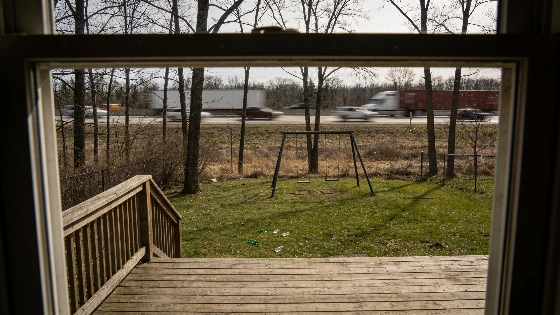
Kimberly Zachmann hears it every day. Traffic startles her 3-year-old son, Kameron, drowns out conversation and forces her to shout for his attention. At night, the family uses sleep machines to cover the highway.
That has changed their yard.
Zachmann no longer imagines putting a swing set in the backyard. Her family still uses a smoker and grill outside, but they stopped using the deck. She also stopped maintaining two water features because the traffic overpowered them. Glass shards have turned up in the yard, she said. The family has spent about $20,000 replacing windows and porch doors to cut the noise.
A petition seeks a formal response
Zachmann has lived in the house for nearly seven years. She says the noise has grown worse over the past two. Her online petition asks the Michigan Department of Transportation and local officials to build continuous sound-absorptive walls along residential parts of the freeway.
The petition requests decibel and noise-impact studies at homes near M-53. It also calls for comparisons with federal noise-abatement criteria, dedicated state and federal infrastructure funding, and a public timeline.
Residents want listening sessions, too. They would use them to review study findings, engineering plans and possible construction schedules.
MDOT says eligibility is limited
M-53 was built from Utica to Washington Township in 1965. The highway has two lanes in each direction.
MDOT spokesperson Diane Cross said the latest 24-hour traffic count near 24 Mile Road was recorded Nov. 29, 2023. The count found 30,949 northbound vehicles and 31,361 southbound vehicles. The posted speed limit is 65 mph for trucks and 70 mph for other vehicles.
The Michigan Department of Transportation told Zachmann that an existing roadway generally must receive additional capacity before it qualifies for a traffic-noise study that could lead to a sound wall. M-53 has not gained lanes since it was built, the agency said.
MDOT's publicly available transportation and environmental information is the relevant state record for a future request involving the highway right of way. Residents can review the agency's MDOT programs as they seek updates.
That rule blocks the usual route.
A voluntary Federal Highway Administration Type II program could cover homes built before an adjacent highway was constructed. The program has been suspended since fiscal year 2024. It is not expected to return in the foreseeable future.
Type II projects are separate from noise reviews tied to a new highway or a capacity expansion. That distinction matters for residents seeking help with an existing road.
Shelby Township could pay for a wall or berm itself. It would then need to prepare a design and seek MDOT approval to build within the agency's right of way. Depending on the location, the township might also need to determine whether its own right of way is available.
Any project would require work among the township, MDOT and affected property owners. It would not be a simple local construction contract.
The price exceeds township capacity
Township Supervisor Rick Stathakis told Zachmann that a sound barrier would cost an estimated $3.5 million to $6.5 million per mile on one side of the road. A noise study covering the entire highway could cost about $42 million at the low end, he said.
The township's general budget is about $20 million. That figure excludes police, fire and public works.
The township has no construction allocation, Stathakis said. He believes MDOT must lead the effort. Other locations also need sound barriers, he said, and the township must weigh road funding against competing needs.
Shelby Township's population rose from 29,467 in 1970 to 48,655 in the 1990 census. The estimated population reached 80,415 in 2025. Residents say traffic grew with development around the corridor.
Doreen Nied, 81, has lived near the road since 1992. Morning and evening traffic now fills the highway, she said. On evenings and weekends, the freeway can resemble a dragstrip.
Over the years, Nied and her husband spent nearly $100,000 on triple-pane windows, added insulation, solid interior doors, a berm with shrubs and an air-purifier system. The changes helped inside the house. Vibration and fumes still reach the yard.
A related infrastructure question appeared in earlier Michigan reporting about how communities weigh large public and infrastructure demands. That story dealt with data centers, not highway noise. In Shelby Township, the question is narrower: can a project outside the usual state eligibility rules be designed, financed and permitted without placing the full cost on residents?
Legislation remains under review
In February 2025, Sen. Michael Webber, R-Rochester Hills, and Rep. Ron Robinson, R-Utica, introduced bills intended to make sound-barrier funding easier to access through MDOT.
Modeled after a Minnesota law, the proposal would create a fund within the Michigan Department of Treasury. MDOT would administer it. State and local governments could apply for money for qualifying noise-abatement projects where barriers do not currently exist.
The bills went to committees and have not become law. Residents should check the Michigan Legislature records before treating the proposal as a funding source.
Robinson said residents repeatedly raised sound barriers while he was campaigning. He also cited a Sterling Heights man whose classic Corvette was struck by debris from M-53. The car is now stored elsewhere at the owner's expense.
Communities across Michigan face similar requests, Robinson said. Most local governments cannot pay for the walls without state support.
A legislative analysis counted 308 noise barriers on Michigan state trunkline highways. Together, they cover 76 miles.
The analysis found that 12 barriers covering 3.74 miles needed replacement or rehabilitation. The estimated cost was $19 million. Another 60 barriers covering 13.5 miles needed repairs estimated at $27 million. Preventive maintenance for barriers in good condition was estimated at about $2 million each year.
Nied is not planning to move. She and her husband are retired or nearing retirement. They have invested heavily in their home and are settled there.
She wants a barrier because she can no longer comfortably entertain in the backyard. Zachmann may consider leaving if the issue does not advance. For now, her toddler still cannot use the backyard as the family planned.
The record is plain. Traffic is heavy. Residents report persistent noise and debris. The available funding rules do not give Shelby Township a practical way to build.
A petition can document the burden. It cannot replace a state-backed eligibility and funding program.
Until Michigan creates that path or MDOT changes its approach, families along M-53 will keep paying for partial fixes themselves. The agencies responsible for the corridor still point to the limits of their authority.