A Farmington Hills roundabout ranked fourth among Michigan's most crash-prone intersections in 2025, yet it recorded fewer injuries than nearby traditional crossroads.
At 14 Mile Road and Orchard Lake Road in Farmington Hills, 118 crashes were reported in 2025. The roundabout ranked No. 4 in a private analysis by Michigan Auto Law. Michigan does not maintain an official statewide ranking of this kind.
Four roundabouts placed among the six highest spots in the analysis. The Farmington Hills location sits near the West Bloomfield border. It was one of six roundabouts among the 20 Michigan intersections with the most reported crashes last year. A Detroit Free Press video published and updated Oct. 4, 2026, also identifies the location as a roundabout and places it fourth in the state by crash count.
The numbers do not erase the safety advantage of roundabouts. They show that many drivers still enter and move through the circles without following the rules that keep traffic flowing. The reason is simple.
The City of Farmington Hills and Oakland County are the relevant local government jurisdictions for residents seeking information about nearby roads, traffic operations, and public safety concerns. The ranking itself is not a municipal or county report.
High crash counts can mean fewer injuries
The 14 Mile and Orchard Lake roundabout recorded nine injuries in its 118 crashes. Five miles away, the intersection at Maple Road and Telegraph Road in Bloomfield Township ranked No. 10. It had 83 incidents and 47 injuries.
That gap shows one central feature of roundabouts. Vehicles move more slowly inside them. Crashes also tend to avoid the head-on and side-impact forces common at traditional four-way intersections.
The roundabout at 18 ½ Mile Road and Van Dyke Avenue in Sterling Heights led the statewide list with 210 crashes. A previous crash breakdown detailed that ranking after the list was released. A separate Navbug summary also describes an M-53 roundabout as the leader of a 20-intersection list based on the same Michigan Auto Law research. Readers should treat the rankings as a private analysis. Results may depend on the geographic and data definitions used.
Brandon Hewitt is COO of Michigan Auto Law, which compiles the annual list from police reports and ambulance calls. He is a personal injury litigator and drives about 25,000 miles per year. Hewitt says roundabouts remain safer than conventional intersections even when their crash totals are high.
What drivers keep getting wrong
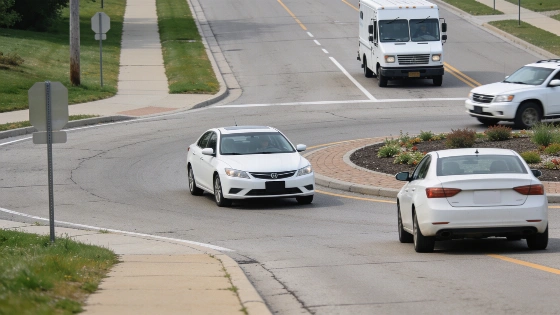
On a Tuesday afternoon in September at 14 Mile and Orchard Lake, the problems were easy to see. A white BMW moved across the path of a work van during a lane change. A white Ford Escape hesitated before entering. A white GMC pickup cut off a sedan. A white Jeep nearly stopped to let another vehicle enter.
Each maneuver disrupted the traffic flow. Some drivers drew horns after changing lanes inside the circle or failing to enter when a safe opening was available. Others mistook courtesy for caution. They slowed so sharply that vehicles behind them faced a new conflict.
Michigan Department of Transportation guidance is direct. Choose the correct lane before entering. Yield to vehicles already in the circle. Follow signs and pavement markings. Watch for pedestrians. Signal before exiting.
The safe approach is neither aggressive nor timid. Drivers should take a reasonable opening without forcing another vehicle to brake or collide. For current construction, incident, speed, and road-condition information, the state's Mi Drive information is the proper official starting point. It does not replace a crash-history analysis.
More circles are coming
Michigan has used roundabouts since 1999. The modern design grew from a system popularized in England in the 1960s. Engineers established that vehicles already inside the circle should have the right of way.
The United States has about 15,300 roundabouts, according to Roadsigns.com's data. Florida has 1,628 and ranks first among states by count. Michigan ranks 15th with 326.
Those numbers make a return to four-way intersections unrealistic as a statewide answer to driver confusion. More circles are likely to remain part of Michigan's road system.
Elaine Chen, a civil engineer with Southfield-based Kimley-Horn, said roundabouts remain a major subject at traffic engineering conferences. Transportation planners are also studying other intersection designs, including diverging diamond interchanges. Those layouts temporarily move traffic to the opposite side of the road. They already operate at I-75 and Big Beaver Road and at I-75 and University Drive.
Drivers have adjusted to unfamiliar designs before. The Michigan left began as a formal median U-turn crossover. It later became ordinary local driving vocabulary. Roundabouts are following a similar path. The infrastructure is established, but the habits needed to use it safely are not universal.
Local road users may face different responsibilities depending on whether a route is maintained by the City of Farmington Hills, Oakland County, or the Michigan Department of Transportation.
The crash rankings point to one clear lesson. A roundabout can reduce the severity of collisions without preventing crashes caused by poor lane choices, hesitation, or abrupt courtesy. Drivers should treat the circle as a flowing roadway. They should not improvise inside it.
That refresher matters. Michigan should keep reinforcing it as roundabouts become a permanent part of the state's roads.