A $30 million National Science Foundation grant will fund the TEMPEST Science and Technology Center at Michigan State University, aiming to advance turbulence research with AI, computation and hands-on experiments starting in 2026
Michigan State University has secured a $30 million grant from the National Science Foundation to launch the TEMPEST Science and Technology Center, a major new national hub for turbulence research that will bring together experts from across the country. The center is scheduled to begin operations in September 2026, with the goal of transforming how scientists and engineers understand, predict and eventually control turbulent systems in fields ranging from energy to aerospace.
Unlike previous efforts that tackled turbulence in isolated disciplines, the TEMPEST Center will unite researchers in physics, mathematics, engineering and artificial intelligence. The project will be led by Michigan State University but will include a broad academic consortium featuring Auburn University, Baylor University, Georgia Institute of Technology, San José State University, Texas A&M University-Corpus Christi, University of Rochester and Yale University. National laboratories such as Los Alamos, Sandia and Lawrence Livermore, along with private-sector partners like Pacific Fusion and General Atomics, are also participating.
Research Focus and Practical Impact
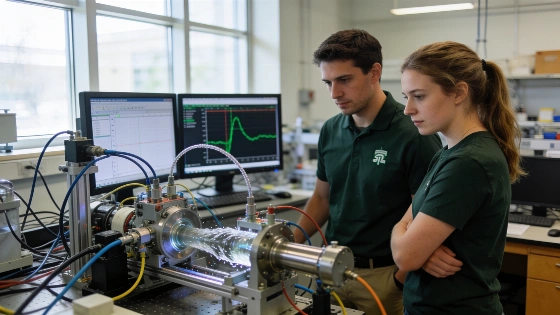
Turbulence-the unpredictable, swirling motion found in fluids and plasmas-remains one of science's most persistent challenges. It affects everything from weather systems and ocean currents to jet engines, manufacturing processes and experimental fusion reactors. According to Michigan State University, the TEMPEST Center will combine theoretical models, advanced computing, laboratory experiments and artificial intelligence to develop more reliable ways to predict and eventually manage turbulent behavior in real-world systems.
The research is expected to have broad applications. Improved turbulence modeling could lead to safer and more efficient aircraft, better weather forecasting, advances in clean energy production, and new manufacturing techniques. The center's work will also support public health and transportation by enabling more accurate predictions of air and water flows that affect pollution and disease transmission.
Consortium Structure and Educational Goals
Michigan State University will coordinate the multi-institutional effort, with its College of Engineering focusing on practical applications in energy, transportation, aerospace and manufacturing. The College of Natural Science will develop new theories and mathematical frameworks to explain how turbulence originates and evolves across different scales. By integrating these approaches with AI and experimental data, the center aims to create predictive models that can be tested and refined in real-world scenarios.
Beyond research, TEMPEST plans to make its data and software tools widely available, allowing outside researchers to build on its findings. The center will also launch educational and public engagement programs, including museum exhibits and immersive media, with the goal of reaching more than 10,000 K-12 students each year. Workforce development is a priority, with a focus on training scientists and engineers to use modern computational and AI methods in multidisciplinary research.
Funding, Timeline and Next Steps
The $30 million NSF grant will fund the center's initial operations, with TEMPEST to be housed in Michigan State's Engineering Building before moving to the new Leinweber Center for Engineering and Digital Innovation, expected to open in 2028. The NSF Science and Technology Center model is designed to foster collaboration across institutions and disciplines, integrating research, education and workforce development to address large-scale scientific challenges.
For Michigan State University, the award represents a significant investment in its research capacity and national leadership in engineering and science. The center's director, Michael Murillo, will oversee the effort to connect fundamental scientific discovery with practical engineering solutions, aiming to make turbulence not just understandable but controllable in ways that could reshape multiple industries.
The TEMPEST Center's launch signals a shift in how complex scientific problems are tackled in the United States. By combining expertise from universities, national labs and industry, and by prioritizing open data and education, the project sets a new standard for collaborative research with real-world impact. If successful, the center could help unlock solutions to challenges that have stymied scientists for generations, while preparing a new generation of researchers fluent in both science and artificial intelligence.