Michigan produces more than 10 million scrap tires each year. Research led by Michigan Tech's Zhanping You has brought tire rubber onto hundreds of miles of Michigan roads, with about 30 projects across 20 counties now shaping new standards.
Michigan produces more than 10 million scrap tires each year. Cold and wet conditions also speed up cracks and potholes on roads that can be 30 to 50 years old. Zhanping You and his Michigan Tech team are tackling both problems with recycled tire rubber.
The team has worked on about 30 completed or ongoing projects. The material can strengthen pavement or extend the life of roads already in use.
The approach has moved a once-discredited idea into road projects across the state. That shift took years.
For residents of Farmington and Farmington Hills, the first question is which agency controls a road. The next is whether the treatment suits its condition and budget. The City of Farmington and the City of Farmington Hills manage municipal streets. County and state agencies oversee other parts of the transportation network.
That division makes project specifications and clear maintenance records important when agencies test new pavement methods.
From tire waste to pavement
You developed the methods after early attempts to use large pieces of scrap tires performed poorly. When he joined Michigan Technological University as an assistant professor in 2005, agencies were wary of putting recycled rubber on public roads.
Those early products had a reputation for failure. Processing methods have since changed.
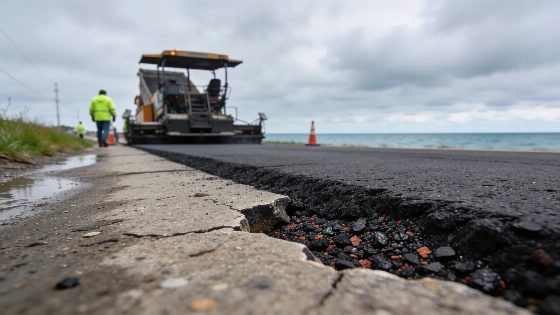
Large tire pieces can now go beneath new road construction as a foundation layer. The layer helps keep the road dry. Finer rubber powder can be mixed into chipseal for existing pavement or added to rubber asphalt for new roads.
The rubber makes asphalt more elastic. That flexibility may help pavement resist cracks and potholes caused by cold, wet conditions. Rubber asphalt may also lower the risk of ruts where vehicles stop or travel repeatedly, including intersections and stop signs.
For chipseal work, the material acts as a sealcoat. It fills existing cracks and blocks new ones.
Project findings say conventional chipseal generally lasts six to seven years. Rubber asphalt chipseal is expected to last about twice as long. That is a performance estimate, not a guarantee. Weather, traffic, pavement preparation and installation quality can change the result.
Separate research found that laboratory mixtures with ground tire rubber and tire-fabric fibers performed better against rutting and cracking. A Michigan field demonstration reportedly showed no visible cracks after two years of service.
Those findings support more testing. They do not replace long-term monitoring across different traffic loads and pavement designs.
Projects reach Michigan counties
You's team has completed projects in 20 Michigan counties. Bay, Dickinson and Kalamazoo are among them. Researchers plan to expand onto city streets in Ann Arbor and Detroit.
County and city agencies still have to match each pavement choice to an available budget. That is the hard part.
A Saginaw County project used roughly 26,000 tires for paving last year. Another project in the county is expected to cover more than 10 miles and cost more than $10 million.
The larger rubber asphalt option costs more than chipseal. It produces pavement four to eight inches thick and reuses more tire material.
A road test can put a local government at real financial risk. A single project may cost nearly a half-million dollars. Counties with limited road budgets may not have the money to repair a failed installation.
That is why You's team works with local engineers, contractors, material suppliers, manufacturers and transportation services. The researchers treat the work as a field project, not only as a laboratory exercise.
Michigan Tech alumni in county and city agencies have helped build confidence in the projects. Their professional ties give local officials a better sense of the research and of the demands involved in specifying, installing and inspecting the work.
Community feedback has also shaped the research. Drivers told the team that rubber roads seemed quieter. Researchers then began formal noise tests.
The team is testing the chemical content of stormwater runoff from rubber asphalt after community members raised concerns. Michigan communities have asked for similar environmental detail in other infrastructure settings, as shown in earlier PFAS coverage.
For work that affects local drainage or busy corridors, residents can check public notices, council agendas and engineering reports from the relevant municipality. The City of Farmington Hills, Oakland County and other public agencies may have different duties depending on the road, drainage system or funding source.
The Farmington Hills municipal portal can help residents find city contacts and meeting information. It does not show that a rubber-asphalt project has been approved there.
Rules could widen adoption
You is working with the County Road Association of Michigan, the Michigan Department of Transportation and the Federal Highway Administration on guidelines for recycled rubber in road construction.
The team hopes to have draft specifications for chipseal and rubber asphalt mixtures ready next year. That would give road engineers a clearer way to assess the materials.
It would not put rubber asphalt on every road. Local agencies would still choose treatments based on pavement conditions, project costs and their own resources.
Michigan Department of Transportation standards would matter most for state-funded or state-maintained work. Municipalities and counties would keep responsibility for decisions in their own jurisdictions.
The work has spread beyond Michigan. You has five active projects in Minnesota and collaborators in New York, Missouri, Illinois, Texas and other states.
More than 300 million scrap tires are produced each year in the United States. Only about 5% are recycled into asphalt, according to You.
You first studied tire reuse while working as an assistant professor at Texas A&M University-Kingsville. He joined Michigan Tech after that work continued. In Texas, tire fires created a waste problem. They could release toxic chemicals into the air and pollute nearby neighborhoods.
At Michigan Tech, he continued the research through years of pavement testing. He later became a professor of transportation engineering and director of the Michigan Tech Transportation Institute.
Michigan Tech promoted You to professor in 2014, distinguished professor in 2019 and university professor in 2025. He has published more than 300 peer-reviewed papers. He received the Michigan Tech Research Award for outstanding scholarly achievement in 2019.
More than 60 Michigan counties have not yet worked with You's team. The researchers also want to keep serving the 20 counties already involved.
The evidence supports more testing and clear standards. It does not make recycled rubber a universal fix. Agencies still need to judge each road by performance, cost and environmental results, not by the failures of experiments conducted decades ago.