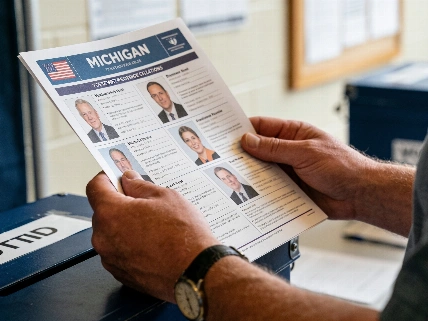
Michigan voters will pick two members for the State Board of Education on November 3. The results could change the board's partisan split and shape public school policy for the next eight years.
This November, Michigan voters will decide who takes two open seats on the State Board of Education. The board now has a 6-2 Democratic majority. That could hold, or the election could bring a 4-4 split. If that happens, it will be harder to push through new policies for Michigan's 1.4 million public school students. The board's choices affect local districts, including Farmington Public Schools, which serves families in Farmington, Farmington Hills, and nearby Oakland County communities.
Four major-party candidates are in the running. Democrats Tiffany Tilley and Judith Pritchett want another term. Republicans Terence Collins and Bree Moeggenberg are trying to unseat them. Whoever wins will help set policy for the next eight years. The board shapes rules on literacy, special education, and more. It does not control the state's education budget or pass new laws. Instead, it acts as Michigan's main planning and coordination group for public schools and hires the state superintendent. The board meets monthly. Meetings are open to the public and often include comments from local school boards and city officials, including those from the Farmington Public Schools Board of Education.
Key issues and candidate positions
Literacy is a top concern. Michigan recently hit a new low in third grade English language arts scores. The state now requires districts to use evidence-based reading programs or explain their choices to parents. There are grants for proven literacy materials, new rules for dyslexia screening, and a mandate for "science of reading" training for elementary teachers by 2031. In the last two years, Michigan spent $151.4 million on literacy materials. Another $50 million is planned for the next budget. Funding also supports teacher training and literacy coaches, according to the Michigan Department of Education and CBS News Detroit.
Terence Collins, a Republican, wants earlier phonics instruction and more staff in struggling districts. Bree Moeggenberg, also a Republican, supports the science of reading but says schools need to get back to basics and restore classroom order. Democrat Judith Pritchett calls for more teacher support, smaller classes, and more parent involvement. Tiffany Tilley, also a Democrat, has pushed for required teacher training and wants to look at literacy models from other states. State Superintendent Glenn Maleyko and Governor Gretchen Whitmer have both called literacy Michigan's top education priority, keeping the debate in the spotlight, as reported by the Washington Post.
Special education and standards debates
Special education is another big issue. The board set up a bipartisan committee to improve services for students with disabilities. On September 22, 2026, the State Board's Special Education Committee started a public input process. Students, families, teachers, and community members can send feedback through October 16. This is meant to make sure local voices, including those from Farmington and Farmington Hills, help shape state special education policy, according to the Michigan Department of Education. Candidates pointed to ongoing problems like low pay for paraprofessionals, teacher shortages, crowded classrooms, and the need for parents to be involved in Individualized Education Programs (IEPs).
State standards are also under review. Both Republican candidates want to change the state's health education standards and oppose teaching about gender identity and sexual orientation. The Democratic candidates want to update science standards and bring in artificial intelligence, but say literacy must come first. Local districts in Oakland County and elsewhere must follow state standards, but they can also offer more chances for public comment at the district level.
Superintendent performance and board dynamics
State Superintendent Glenn Maleyko's work has drawn mixed reactions. Collins criticized how Maleyko handled federal investigations and his stance against tax credit scholarships. Moeggenberg questioned Maleyko's dual citizenship and his overall record. Pritchett praised his leadership and engagement. Tilley said he works well with others and builds consensus. In recent months, the board set up the special education committee, asked lawmakers for more funding, and voted against federal tax credit scholarship programs. Board President Dr. Pamela Pugh said the board will keep tracking attendance and chronic absenteeism. She urged the Michigan Department of Education and local districts to keep using what works to get students to school. Statewide public school attendance rose to 91.5% in the 2025-26 school year. That's the fourth year in a row attendance has gone up, according to the Michigan Department of Education.
Third party options and election details
Voters will also see several third-party candidates on the ballot: Charles Essner (Libertarian), William Mohr II and Christine C. Schwartz (US Taxpayers), Wissam Charafeddine (Green), Mary Anne Hering (Working Class), and Kelli Monroe (Natural Law). The election is November 3. The two candidates with the most votes will serve eight-year terms. For details on polling places and how to vote, residents can check the City of Farmington elections page.
The State Board of Education is not the same as the Michigan Legislature. Lawmakers control the education budget and pass laws. The board sets policy direction, hires the superintendent, and passes resolutions that can shape statewide priorities. As reported earlier, Michigan's public schools still face problems like chronic absenteeism and falling proficiency rates. That makes the board's leadership even more important in the years ahead.
With the board's balance of power up for grabs, Michigan voters have a rare chance to steer public education for nearly a decade. The winners will set the agenda for literacy, special education, and curriculum standards. They will also decide how the board responds to the changing needs of students and families in Farmington, Farmington Hills, and across Oakland County.
- Politics & Elections
- Local Elections
- Government Oversight & Ethics
- Schools & Education
- School Boards & Leadership
- Data & Investigative Analysis
- Michigan Department of Education
- Michigan Elections
- General Election
- School Board Election
- School Institutions and Boards
- Education Programs and Operations
- State Education Tax