
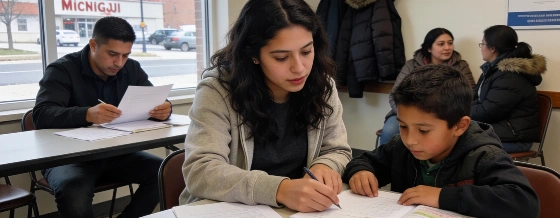
Michigan's Latino population is nearing 600,000, bringing new challenges and opportunities in education, housing, health, and jobs across the state.
Michigan is changing fast as Latino communities grow, now reaching almost 600,000 people across the state. With Michigan's population getting older and the workforce shifting, Latino families are playing a bigger role in the state's future. State estimates put Michigan's total population at 10,127,884 in 2025, up by nearly 28,000 from the year before. This rise comes from both natural growth and strong migration trends, according to state population data.
Latinos now make up 5.9% of Michigan's population. That's below the national average of 21%, but their numbers have grown quickly in the last ten years. You can see this growth in big cities like Detroit and Grand Rapids, and in smaller places like Holland and Oceana County, where Latino residents now make up a much bigger share than the state average. Farmington and Farmington Hills have also seen steady increases, adding to the region's culture and economy.
Economic and educational gaps remain
Even as their numbers rise, many Latino communities still face big hurdles. The 2024 American Community Survey shows that majority-Latino neighborhoods in Michigan have poverty rates nearly three times higher than the state average. Unemployment is almost twice as high. Housing is another problem, with rent taking up a bigger share of income than in other parts of Michigan. Local school districts, including Farmington Public Schools, are trying to close education gaps by adding language support and services for families who speak more than one language.
Education is a key issue. Latino communities are younger on average than the rest of Michigan, so good schools matter for both families and the state's economy. But many areas with large Latino populations lag behind in educational achievement. The Farmington Public Schools board has talked about more outreach and bilingual programs to help these students. This is part of a wider push in Oakland County.
Health and environmental concerns
Health care and basic needs are still uneven. Many Latino communities have lower rates of health insurance and struggle with food security. Environmental risks are higher too. Majority-Latino neighborhoods are more likely to be near hazardous waste sites and places with toxic releases, putting residents at greater risk. The Oakland County Health Division has pointed out these gaps in recent health reports and called for targeted help.
Latino business owners are making a difference in Michigan's economy. The 2023 Annual Business Survey counted 3,256 Latino-owned employer businesses in the state. These businesses employ over 36,000 people and bring in more than $8.17 billion a year. They cover many industries and help create jobs. Federal data shows that from October 2018 to July 2025, more than 37,800 migrants moved to Michigan, adding to the state's workforce and business scene.
Historical roots and modern expansion
Latino communities have deep roots in Michigan. Migration from Mexico for farm work began around 1915, later spreading into manufacturing and transportation. What's new now is the size and reach of these communities. They are shaping Michigan's population and economy in ways not seen before. The state has responded by setting up the Hispanic/Latino Commission, which coordinates policy and services for Hispanic and Latino residents Hispanic/Latino Commission.
As the Latino population grows, Michigan's ability to tackle gaps in income, education, health, and environmental safety will decide if this shift leads to broader prosperity. Action from all levels of government is needed to improve access to affordable housing, job training, small business loans, education, health care, and environmental protections. The City of Farmington posts public hearing notices and civic calendars to get more people involved in these talks.
Statewide impact and next steps
The success of Latino communities is now closely tied to Michigan's economic strength. Investing in young workers, business owners, and families is not just about fairness-it's a practical need for the state's future. As reported earlier, federal budget pressures are already making it harder for Michigan to fund key services. This makes targeted support for growing communities even more urgent.
Michigan's population and economy are shifting, and Latino communities are leading that change. The state's long-term growth depends on whether leaders can turn these population gains into real opportunities for everyone. The facts are clear: Michigan's future prosperity is tied to the well-being and progress of its Latino communities.
Latino residents are spread across both cities and rural areas. Detroit has more than 53,000 Latino residents, and Grand Rapids has over 32,000. Many of these communities have higher shares of foreign-born residents and are growing faster than the state as a whole. Latino-owned businesses are adding jobs and economic activity in many sectors. Fixing gaps in education, health, and environmental safety will take ongoing teamwork between state agencies, local governments, and community groups.