
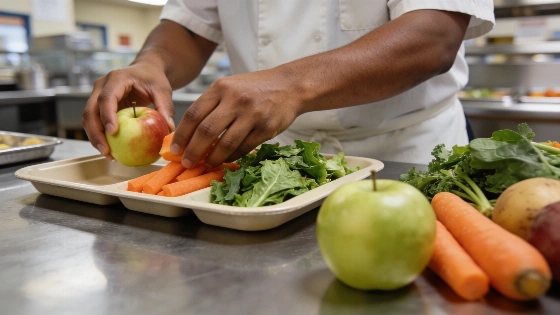
Dearborn Public Schools will use the grant and support services to add more Michigan-grown ingredients to more than 3 million meals served each year. The work will also build stronger ties with farmers and regional suppliers.
About 20,000 Dearborn students could see more Michigan-grown and Michigan-produced food on their meal trays. Dearborn Public Schools will receive $460,565 for the work. The grant also includes support services to help the district change its purchasing process and build ties with regional farmers and suppliers.
Dearborn serves more than 3 million meals each year at over 30 sites. The award will not make every meal Michigan-sourced right away. It gives the district money and specialized help to raise that share over time.
The decision is about buying food as much as nutrition. Dearborn Public Schools highlighted the effort on Sept. 24, 2026. State agriculture and nutrition officials had visited the district the day before.
How the grant will work
Dearborn will work with Southwest Food Excellence, a company that provides culinary services for schools. The partnership will focus on buying more Michigan food for student meals. It will also help the district connect with farmers who can supply schools.
The Good Food for Michigan Project is built around the buying power of large institutions. Schools, hospitals and other organizations can give growers and food producers steadier markets when they buy Michigan products on a regular basis. Dearborn's grant supports a districtwide effort, not a menu change at one school.
Officials from the Michigan Department of Agriculture and Rural Development and the Michigan Department of Education's Office of Nutrition Services visited Dearborn on Wednesday, Sept. 23. They discussed the project with district officials. A press conference followed at Henry Ford Early College in Dearborn on Thursday, Sept. 24.
Those at the press conference included MDARD Director Tim Boring, Office of Nutrition Services Director Dr. Deanne Kelleher, Center for Good Food Purchasing Michigan impact manager Melanie Tran and Superintendent Mike Esseily.
WWJ Newsradio also reported Boring's participation in the visit. Its coverage connected the effort to the Good Food for Michigan Project. MDARD presents the project as a way to expand local food markets for schools.
That is the basic aim.
Why school purchasing matters
Boring said dependable institutional markets give Michigan farmers steady demand for the food they grow. He also said those markets support related local businesses. Esseily described Dearborn's purchasing practices as one way to increase access to Michigan-grown food while supporting student nutrition.
Kelleher said school meals are part of the school day. Nutrition professionals help students get the food they need to learn and grow. Her office connects schools and child nutrition programs with Michigan farmers and suppliers through the Farm to Program Directory. The directory helps participating programs find sources of Michigan-grown food.
Dearborn is Michigan's third-largest school district. That gives the project a large operating footprint. Changes in what the district buys could affect meal planning, supplier relationships and the amount of Michigan food entering school kitchens.
The available information does not say which foods will be added or when menu changes will begin. The effect will depend on how the district uses the grant.
Schools elsewhere in Michigan are also changing cafeteria operations. An earlier school-food report examined reusable trays and utensils at five districts. The Dearborn grant deals with a different part of the meal system: where ingredients come from and how schools connect with producers.
A statewide purchasing network
The Good Food for Michigan Project reaches beyond Dearborn. MDARD and the Michigan State University Center for Regional Food Systems have established grower networks. The networks are meant to connect schools, hospitals and other institutions with Michigan food producers.
This summer, the project introduced the Good Food for Michigan pledge. Institutions can use it to make a public commitment to purchasing practices that fit their capacity and goals. Since the announcement, 32 schools, hospitals, community organizations and other institutions across Michigan have signed it.
The 32 organizations signed the pledge. They did not receive grants through that count. The project keeps a map of participating institutions and plans to update it as more organizations join.
Dearborn's award is more concrete than a public pledge. It provides $460,565 and support services for a defined district effort. The money will not guarantee Michigan ingredients in every meal. It gives the district resources to test and expand those purchases across a system that serves millions of meals each year.
The grant is part of a wider Michigan funding cycle. MDARD announced $2.3 million in grants on Sept. 23 for 28 agricultural businesses and community organizations. The awards support food systems and local supply-chain projects. That statewide round provides context for Dearborn's grant, but it is separate from the district's award.
Michigan is also involved in food-supply work outside school cafeterias. A fiscal year 2026 USDA summary lists $375,262 for a Michigan Farm to Food Bank project. The Michigan Department of Education is partnering with the Food Bank Council of Michigan to coordinate growers, processors and seven Feeding America food banks.
The federal agency's Farm to Food Bank summary describes another way to move locally produced food through charitable food networks.
USDA is also expanding the school-purchasing framework. The agency's Sept. 22, 2026, Harvest to Hallways announcement said it is expanding local-food procurement support for schools. That includes up to $25 million in new Patrick Leahy Farm to School Grants for fiscal year 2026.
USDA says the investments are meant to help schools buy more locally produced food and create new markets for farmers and ranchers.
Dearborn's grant links the district with the Michigan Department of Agriculture and Rural Development, the Michigan Department of Education, growers, processors and institutional food buyers. The practical test is clear. Can the district build reliable supplier relationships? Can it steadily increase the amount of Michigan food served to students?