Police responded to Ann J. Kellogg Elementary School after a gun discharged inside a third-grade student's backpack on Sept. 22. No one was injured, but the key question remains unanswered: how did the child get the firearm?
Police arrived at Ann J. Kellogg Elementary School in Battle Creek at about 8:30 a.m. on Sept. 22. A gun had discharged inside a third-grade student's backpack. No one was injured.
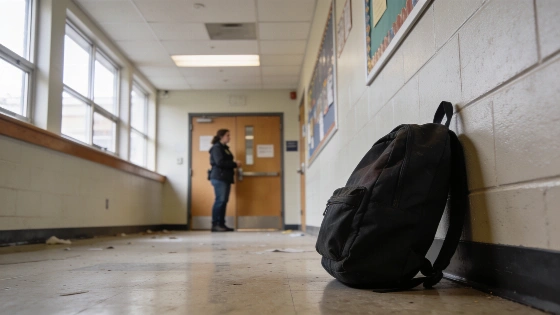
A staff member secured the gun after it fired in a hallway. The school went into lockdown. Police lifted the lockdown at about 4:30 p.m.
The immediate danger ended. The central question did not.
Where did the gun come from? That question begins before the backpack entered the school.
Battle Creek police questioned the child and obtained a search warrant for the residence where the child lived. Officers recovered additional evidence. Investigators are examining the gun's origin and how it reached the student.
The case was being prepared for referral to the Calhoun County Prosecutor's Office. Available reports do not establish who owned the firearm. They also do not show whether anyone will face charges.
In a family communication, Battle Creek Public Schools said staff and police acted quickly under safety protocols. The firearm was secured at once. The child was removed from the general student population.
The district described the temporary lockdown as a precaution. That response is separate from the unanswered question of how the child got access to the weapon. Families can check the official district website for future school communications.
School security still matters. Staff must take threats seriously. Entrances must be controlled. Emergency procedures must be practiced.
Those steps address the moment a weapon reaches the school. They do not explain how an elementary school student came to possess one.
Battle Creek police are investigating the origin of this gun and how it reached this child. Until that work is complete, the circumstances of the firearm's access remain unknown.
That distinction matters.
Assigning responsibility before the facts are established would replace an investigation with speculation.
Public policy should work backward in the same way. Officials and communities should examine the conditions that allow guns to reach children, not only the lockdown, cameras, drills or threat assessments that follow a school incident.
Local reporting also noted that Battle Creek police had taken 15 juveniles into custody for firearm possession since February 2026. That figure places this incident within a wider concern about youth access to guns. It does not prove that the cases are connected.
After 33 years teaching in public schools, I recognize the cycle that follows a gun incident. Schools are shocked. Families worry. Public arguments quickly turn toward guns, mental health, school security and parenting. Politicians promise action. Attention eventually moves elsewhere.
That pattern followed Columbine, Newtown, Parkland and Oxford. Each event briefly appeared capable of changing the national conversation. The systems around childhood continued to change, but public attention often stayed fixed on what happened inside the school building.
When I began teaching in the early 1990s, school shootings were not entirely unknown. Troubled children, bullying, dysfunctional families and guns were not new either. After Columbine in 1999, school shootings became part of the vocabulary of American childhood.
By the end of my career, active-shooter drills had become a recurring part of school life. I never expected to conduct them.
The change was not limited to school violence. Childhood became more closely supervised in the physical world. At the same time, it expanded into a digital world that adults often understood less well.
A national study of American teenagers from 1976 through 2016 found declines in activities linked to independence. Those activities included driving, paid work, dating and going out without parents. Smartphones and social media also allowed peer conflict, exclusion and humiliation to follow students beyond the school day.
Children today are not necessarily worse than children were three decades ago. Long-term declines in bullying on school property and drinking do not justify nostalgia for an earlier era with serious problems of its own.
The narrower point is that childhood changed. Schools increasingly became the place where those changes appeared.
The Centers for Disease Control and Prevention describes violence as the product of interacting factors involving individuals, families and peers, communities and society. That framework is more useful than a single-cause explanation. It directs attention to the conditions around a child as well as the school's response.
Schools have added locks, cameras, drills, staff training and threat assessments because those tools can protect students after danger appears. After the Battle Creek incident, the district also added weapon-detection systems at Ann J. Kellogg Elementary School entrances.
Those systems may reduce the chance that someone brings a weapon through an entry point. They cannot explain how this firearm reached a backpack before the school's defenses could matter.
Schools also face wider operational pressures that shape daily life for students and families. A school attendance report on Michigan students shows how much public discussion focuses on problems that appear at school, even when their causes extend into families and communities.
For Farmington-area readers, the civic lesson is not that Battle Creek's facts can be transferred to another district. The lesson is that accountability should be traceable through the institutions responsible for schools and public safety.
Those institutions include the City of Farmington, the City of Farmington Hills, the Farmington Public Schools board and Oakland County administration. State of Michigan departmental registries and public records can also help residents separate documented policy from rumor when questions arise about firearm storage, school security or youth services.
The Battle Creek incident ended without an injury. The inquiry should continue.
Investigators need to establish how the child accessed the gun. Communities need to examine how firearms are stored and how adults, families, peers and institutions can prevent children from reaching them.
Those questions are separate from whether schools should maintain security measures. Both sets of questions need attention. The City of Battle Creek portal can help residents find municipal announcements and public-safety information as the investigation develops.
The event should not be used to blame Ann J. Kellogg Elementary School for a problem that may have begun elsewhere. The absence of injuries should not make the incident easy to dismiss.
A gun inside an elementary student's backpack shows that prevention failed before the school went into lockdown.
After decades in classrooms, my conclusion is direct: school safety cannot begin at the schoolhouse door. The lockdown and the secured gun were necessary responses.
The lasting public responsibility is to work backward from that hallway. Investigators and communities must determine how a child gained access to the firearm.
Until that question receives as much attention as drills and security systems, the response will focus on managing danger after it arrives. Prevention must begin earlier.