
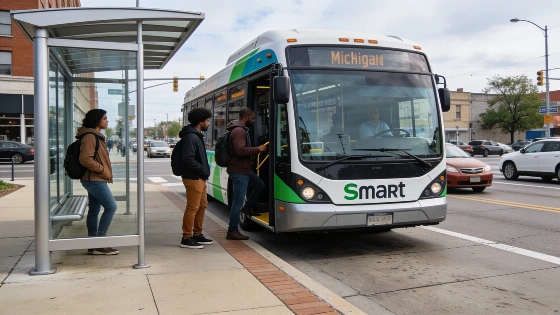
SMART will launch new bus routes and service improvements in Wayne County after voters approved a 10-year transit millage expected to generate at least $570 million for regional transportation upgrades
Wayne County's public transit map is about to change. After years of patchwork service and opt-out communities, SMART is preparing to roll out new bus routes and restore connections in areas that have gone decades without fixed-route transit. The catalyst: a countywide millage renewal and expansion passed by voters in August, unlocking at least $570 million over the next decade for the Suburban Mobility Authority for Regional Transportation.
For the first time since 2005, cities like Livonia and Hamtramck will see SMART buses return to their streets. The new funding will allow SMART to add eight new routes and extend five existing ones, with the first changes arriving as soon as next week. The agency's plan targets major commercial corridors including I-75 Downriver, Telegraph, Middlebelt, Newburgh, Allen Road, Plymouth Road, Haggerty Road and Seven Mile, aiming to connect more residents to jobs, schools and medical centers.
What Changes Are Coming
SMART's expansion will unfold in phases through 2029. The first new route, Route 500, will restore service to Hamtramck and link the city to the broader network via the Mound Road corridor. Other proposed routes will run along Middlebelt and Plymouth in Livonia, and a north-south line from Farmington to Westland via Newburgh, Levan, Haggerty, Five Mile and Eight Mile. The 250 Ford Road route will double its frequency to every 30 minutes, and Saturday service will return for the first time since 2011.
Communities that previously opted out-such as Canton Township, Plymouth, Northville and Livonia-are now included after a state law closed the opt-out loophole two years ago. SMART's CEO Tiffany Gunter said the agency is focused on building "stronger regional connections" and tailoring service to each community's needs, including expanded on-demand Flex transit in lower-density areas.
Who Supported the Millage
The August 4 vote marked a turning point for regional transit. In Detroit, 85.8% of voters backed the 1-mill renewal, while 17 other cities and townships that had previously opted out also participated. Seven municipalities-including Livonia, Flat Rock and Grosse Ile Township-rejected the measure, but Livonia's margin was razor-thin at just 77 votes. Livonia Mayor Maureen Miller Brosnan urged residents to give the new system time to deliver on its promises, noting that the city has been planning for expanded transit since 2021.
In western Wayne County, Canton Township Supervisor Anne-Marie Graham Hudak described the expansion as an "extraordinary opportunity." Canton and six neighboring communities collaborated with SMART to shape the new routes, with residents calling for an airport shuttle and better cross-municipality connections. Canton alone is expected to contribute $6 million to SMART in 2027, part of a $17 million regional share.
Service Details and Community Impact
SMART's current network covers 1,742 square miles with 45 fixed routes and five Flex zones, serving 2.8 million people across Macomb, Oakland and Wayne counties. Ridership has climbed 25% in the past year, according to agency data. The expansion will prioritize areas with high population density, pedestrian infrastructure and mixed-use development, based on a February evaluation that identified Canton Township, Livonia, Plymouth, Plymouth Township and Northville as top candidates for new fixed routes.
For many seniors, people with disabilities and young adults, reliable transit is a necessity. City leaders and transit advocates argue that improved service will help attract employers and residents, fueling economic growth. Livonia's Liv&Go; and Nankin Transit-smaller, on-demand systems-will continue to operate with additional millage support, potentially expanding hours and service areas.
Implementation Timeline and Next Steps
SMART will begin by extending existing routes to create immediate regional links, followed by new fixed routes in high-activity centers and expanded Flex coverage in lower-density townships. The agency has not released a detailed schedule for each new route, but the rollout is expected to continue through 2029. Officials say the sequence is designed to build momentum year over year, ensuring each community receives service tailored to its travel patterns.
As SMART finalizes its plans, CEO Tiffany Gunter is focused on both the big picture and the granular details that shape rider experience. During a recent ride on the FAST Michigan 261 route, she noted small but important issues-like unclear signage and confusing digital displays-that can affect usability. Gunter's approach is clear: "Your riders will experience either what you ignore or what you pay attention to."
For residents in Wayne County, the next three years will test whether a unified regional transit system can deliver on decades of unmet promise. The stakes are high: if SMART's expansion succeeds, it could reshape how people move, work and live across Metro Detroit. If it falters, skepticism about regional transit will only deepen. As with other infrastructure debates-such as the reported earlier power moratorium in Ypsilanti Township-the outcome will depend on execution, transparency and whether local needs are met. For now, Wayne County's transit future is on the move, and the next stops are already coming into view.
- Local Government
- Planning & Public Hearings
- Budgets & Public Spending
- Rules & Public Services
- Development & Real Estate
- Transportation & Infrastructure
- Detroit
- Dearborn
- Livonia
- Northville
- Plymouth
- Canton Township
- Wayne County
- Millage Proposal
- Transit Agencies and Mobility Systems
- Regional Transit Authority of Southeast Michigan
- Suburban Mobility Authority for Regional Transportation
- Detroit Metropolitan Airport
- Public Works