
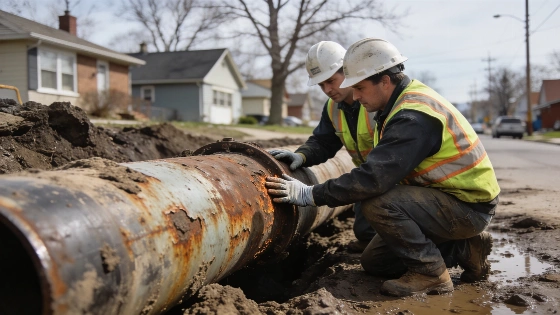
A new report says Michigan needs to spend $85 billion on water and sewer systems over the next two decades. Recent main breaks and aging pipes show the urgent need for a statewide funding plan.
Michigan's water and sewer systems are wearing out. A new report says the state must spend $85 billion in the next twenty years to stop more failures and service outages. The Great Lakes Water Authority (GLWA), which supplies about 4 million people in southeast Michigan, ordered the study after a string of big water main breaks. These breaks left homes flooded, schools closed, and forced boil water advisories for residents and businesses.
Recent breaks in Novi, Farmington Hills, Detroit, and Auburn Hills have shown what happens when old pipes fail. In February 2025, a major break in southwest Detroit sent millions of gallons of water into streets and homes. More than 200 families had to move into hotels. Earlier, a break in Auburn Hills shut down businesses and schools in five Oakland County communities. Both Farmington and Farmington Hills, which get water from GLWA, have faced repeated service warnings and strain on their systems. The problem is not just local-it's regional.
Report details and cost breakdown
The report, called "The Crisis Beneath Us," comes from the Water Funding Task Force. This group includes financial, legal, engineering, and policy experts brought together by GLWA. Released on September 23, the report is based on six months of research. GLWA says it needs $1.2 billion just to replace water pipes that are more than 100 years old. The authority's 800 miles of main pipes average 72 years old. Many were installed in the 1920s and after World War II.
Across Michigan, the Environmental Protection Agency's latest surveys put the 20-year need at $16.3 billion for drinking water and $15.1 billion for wastewater. But the US Water Alliance's 2025 report, which GLWA cites, puts the total need much higher-$85 billion. That's $41 billion for water systems and $44 billion for wastewater. These bigger numbers include replacing lead service lines, stormwater upgrades, PFAS cleanup, and ongoing maintenance. The Oakland County Water Resources Commissioner has stressed that these upgrades are needed to protect public health and local waterways.
Funding options and political challenges
The report says Michigan needs a real funding plan. Options include new state debt, expanding the sales tax, pay-as-you-go funding, and using the state's Rainy Day Fund. Issuing general obligation bonds would need a two-thirds vote in the Michigan Legislature and approval from voters. Past ballot measures for water and environmental bonds have passed, including $1 billion in 2002 and $675 million in 1998.
Raising water and sewer rates has been a tough sell. Local governments have to juggle other needs, and recent public meetings have seen residents push back against higher rates. Maggie Pallone, the report's lead author and a senior vice president at Public Sector Consultants, called the gap between what's being spent and what's needed "huge." She warned that waiting will only make things worse. The Farmington Public Schools board has talked about how water main breaks disrupt school operations, showing how these failures hit the whole community.
Impact on residents and next steps
For people in Michigan, the effects are already here. Water main breaks have flooded homes, canceled classes, and led to days of boil water advisories. The report's authors say that without action, these problems will happen more often and get worse as pipes keep aging past their limits.
GLWA CEO Suzanne Coffey said the report is meant to show lawmakers how big the problem is and what can be done. She hopes it will start a real debate about how to protect Michigan's water systems for the future. The Water Funding Task Force looked at how other states are handling similar problems, but said Michigan's case is especially urgent because of how old its systems are and how much work has been put off.
Michigan's infrastructure problems are similar to other big changes, like building out electric vehicle charging networks, which have also raised questions about funding and fair access, as reported earlier.
Understanding the local and statewide context
Most of Michigan's water and sewer pipes went in between the 1920s and the years after World War II. They were built to last 75 to 100 years. Now, as these systems reach or pass their design life, the risk of failures goes up. GLWA serves 112 communities in southeast Michigan, but the funding gap affects cities and towns all over the state. The report's recommendations are meant to help lawmakers figure out how to pay for upgrades and replacements that will keep people safe and support the economy.
In May 2026, a 42-inch GLWA main broke in Oakland County. Thousands lost water pressure and service. Governor Gretchen Whitmer approved nearly $7 million in public aid from the Disaster and Emergency Contingency Fund, with $223,986 set aside for Oakland County recovery. The official state release said this money covered not just storm and tornado damage, but also the direct impact of the water main break. This marked a shift toward treating infrastructure failures as emergencies, according to the Michigan.gov press release.
Cities like Farmington Hills have sped up water main replacements as breaks become more common, as shown in recent city council actions and public works updates. In Oak Park, fast-tracked construction projects in 2026 were tied directly to frequent main failures. This is happening across the Detroit metro area. Residents can check for updates on projects and emergency advisories through the Farmington Hills Department of Public Works portal.
Michigan is not alone in facing water infrastructure problems, but the size of the investment needed here is bigger than most. Whether the state can come up with a real funding plan will decide if people keep dealing with emergencies or finally get reliable service. The facts are clear: without a coordinated plan and real money, Michigan's old pipes will keep causing trouble.
- Planning & Public Hearings
- Rules & Public Services
- Public Works & Capital Projects
- Local Utilities & Service Outages
- Environment & Great Lakes
- Water & Drinking Water
- Data & Investigative Analysis
- Detroit
- Oakland County Water Resources Commissioner
- Public Hearing
- Great Lakes Water Authority
- Detroit Water and Sewerage Department
- Water Main
- Sanitary Sewer
- Stormwater Infrastructure
- Water Rate
- Sewer Rate
- Boil Water Advisory
- Public Works
- PFAS
- Lead Service Lines
- Drinking Water Quality
- Combined Sewer Overflow
- Infrastructure Investment and Jobs Act