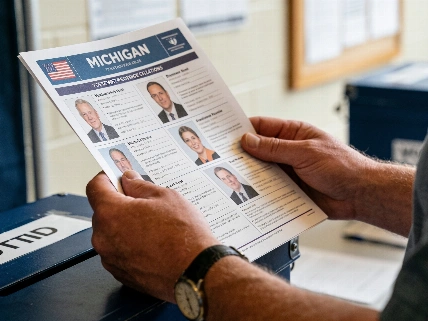

As Mike Rogers campaigns for Michigan's open U.S. Senate seat, Democrats are raising concerns about his recent years spent in Florida and his current residency status. Rogers maintains a home in Michigan and is listed as a registered voter there.
Republican Mike Rogers, a former U.S. Representative from Livingston County, is facing renewed scrutiny over his residency as he campaigns for Michigan's open U.S. Senate seat. Opponents, including Democratic candidate Abdul El-Sayed, have questioned whether Rogers is truly committed to Michigan after spending recent years in Florida.
Rogers, who served in Congress from 2001 to 2014, is running to succeed retiring Democratic Senator Gary Peters. The debate over his residency intensified after El-Sayed, the former Detroit Health Director, labeled Rogers a "Florida man" following the August primary, suggesting Rogers left Michigan behind after his congressional career.
Residency Claims and Political Attacks
Democratic leaders have argued that Rogers moved to Florida after leaving Congress and only returned to Michigan to pursue the Senate seat. Michigan Democratic Party Chair Curtis Hertel Jr. stated that Rogers "left us, and he left the people that he served," while El-Sayed has repeatedly referenced Rogers' Florida property in campaign speeches and social media posts.
El-Sayed's campaign has highlighted that Rogers and his wife purchased a home in Cape Coral, Florida, in 2022 for approximately $1.6 million. In 2023, the couple declared the Florida property as their permanent residence to receive a property tax exemption, though this was only for one year. The home, a two-story, five-bedroom property near Fort Myers, has been on the market for over a year and is currently listed for $2.4 million.
Rogers' campaign has responded by emphasizing his current residence in White Lake Township, Oakland County, where property records confirm he and his wife have claimed a principal residence exemption. Under Michigan law, this exemption requires the homeowner to file an affidavit stating the property is their primary residence. The campaign attributed any delay in moving into the White Lake home to ongoing construction, noting that Rogers previously lived in Genoa Township at a home owned by his sister-in-law, where he was registered to vote.
Voter Registration and Current Status
Questions about Rogers' voter registration surfaced during the 2024 election cycle. As of April 2024, he was still registered to vote in Florida, but his campaign said he was in the process of canceling that registration. By late August, Rogers was no longer registered in Florida and was listed as an active voter in Michigan for his White Lake Township address.
While Rogers' time in Florida has become a focal point for Democratic criticism, there are currently no challenges to his eligibility to appear on the Michigan ballot. The issue remains a matter for voters to consider as the campaign continues.
Context and Related Developments
Residency questions are not new in Michigan politics, especially in high-profile races. Rogers faced similar scrutiny during his 2024 campaign against Democrat Elissa Slotkin, who narrowly won the seat vacated by Senator Debbie Stabenow. The debate over candidate residency has become a recurring theme in statewide contests, reflecting broader concerns about political accountability and local representation.
For additional perspective on leadership transitions in Michigan's public institutions, readers may be interested in recent coverage of the University of Michigan's presidential appointment, available here.
In Michigan, candidates for U.S. Senate are required to be residents of the state at the time of the election. The principal residence exemption is a key indicator of primary residency for property tax purposes, but candidates often face public scrutiny if they have spent significant time out of state. As the November election approaches, the focus on Rogers' residency underscores the importance of local ties in statewide campaigns.