An engineering assessment says a tornado may have exposed weaknesses in a Portage warehouse. Available records do not verify every incident detail or confirm later code changes.
Forty workers reportedly survived the May 7, 2024, storm by sheltering in restrooms at a FedEx warehouse near Kalamazoo/Battle Creek International Airport, according to an engineering assessment. The report describes an EF2 tornado with estimated wind speeds of 111 to 135 mph.
Those findings should be treated as claims from the assessment. The available search results did not independently verify the casualty, damage, or wind-speed account. They also did not produce a confirmed statement from FedEx, the National Weather Service, the City of Portage, or a building-code authority covering every incident detail.
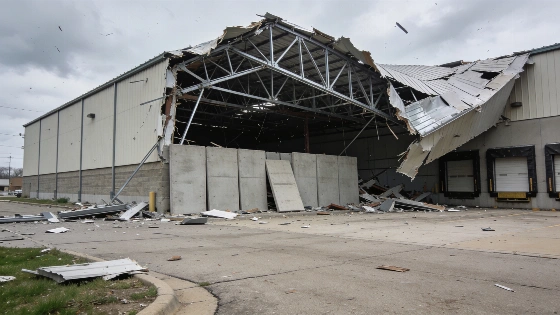
The assessment says pressure changes helped peel away a large part of the roof. Precast concrete wall panels then buckled inward. The report says wind entered through partially open roll-up doors and overwhelmed connections that held the roof and exterior walls together.
The report does not establish a new building-code requirement. It describes design changes that engineers recommend while national standards are under review. Available records do not confirm whether Portage officials later adopted warehouse-design rules, changed requirements for open doors, or issued a final public report on the building.
How the warehouse failed
The warehouse was designed under the 2015 International Building Code. Its design wind speed was 115 mph, and it carried Exposure Category C. That classification fit relatively open terrain with few obstructions. The building was also classified as enclosed because the design assumed its doors would stay shut during a wind event.
That assumption became a weak point during the tornado, according to the assessment. The storm damaged or removed partially open roll-up doors, allowing wind to enter the structure. Investigators said the air pushed pressure up inside the warehouse while wind over the roof created an upward force outside.
Those forces pushed on the building's load path from both sides. The connection between the metal roof deck and the bar joists failed. The roof-joist connections to the exterior wall panels failed as well. Once those supports gave way, the wall panels could buckle inward and collapse.
The assessment team compared the effect to a balloon inflating inside a building. A large warehouse can build internal pressure quickly when wind enters through a failed or open door. Suction above the roof then tries to lift the roof away from the walls.
Why open doors matter
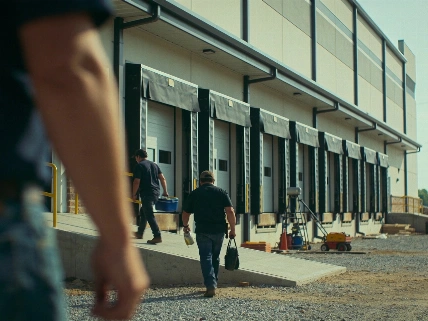
Warehouses are not sealed boxes. Large overhead doors often stay open for deliveries and loading. Even an intact door can allow enough air leakage to pressurize a broad interior space.
For that reason, the primary recommendation from the ASCE/Structural Engineering Institute assessment is to classify large, unpartitioned Risk Category II structures in tornado-prone regions as partially enclosed rather than fully enclosed. The structures would then be designed under that assumption. The recommendation focuses on how a warehouse operates in practice instead of assuming that every opening will be closed.
Franklin T. Lombardo, Ph.D., M.ASCE, of the University of Illinois Urbana-Champaign, and Donald R. Scott, P.E., S.E., F.SEI, F.ASCE, were among the investigators named in the assessment. Their report, Portage, Michigan, Tornado of May 7, 2024, Post-Disaster Assessment, also examined damage to nearby trees, light poles, and other structures.
Tornado loads enter the code debate
The 2015 building code used for the warehouse had no specific tornado-design provisions. Those provisions appeared later in the 2022 edition of the ASCE/SEI 7 Standard, which treats tornado loading separately from simpler straight-line wind calculations.
The difference matters because tornadoes can create strong vertical lift and intense suction pressure. They can also exploit openings and weak points that ordinary wind assumptions may not expose. Stronger welded connections designed for higher loads are one measure that could improve the resilience of warehouse-like structures.
Warehouse construction is expanding, and tornado risk remains a concern in states such as Illinois and Michigan. Still, the available material does not independently support the claim that Illinois recorded more tornadoes than any other state in 2026. A full-year comparison would require a completed, authoritative national dataset.
Code changes can take years to move from professional recommendations into enforceable construction requirements. Tornado provisions are being considered for ASCE 7, but the available material does not confirm a specific date for their incorporation into the International Building Code.
Better measurements after storms
The Portage investigation also described a problem with storm data. A measuring instrument had been installed behind the FedEx warehouse, but it did not record the tornado's wind speed. Its programming disregarded readings above the range it expected.
Without that measurement, investigators estimated the storm's strength by examining physical damage. Trees, light poles, and other structures that failed or remained standing offered clues about the forces involved. That method is less direct than a reliable instrument reading.
The assessment team recommended better collection and preservation of information after damaging events. Evidence can disappear or change soon after a storm. Later analysis then becomes harder, and conclusions about wind strength and structural performance become less certain.
Until updated requirements become enforceable, owners and designers seeking stronger protection may need to apply lessons from assessments such as this one voluntarily. The timing of any code change will determine how quickly those recommendations reach new buildings.
For readers in Farmington, the Portage case is an engineering lesson, not proof of a local policy change. Portage-specific records would need to come from the City of Portage municipal portal. Local comparisons would involve the City of Farmington and City of Farmington Hills, not a Portage inspection file.
The Farmington Public Schools board and Oakland County administration also cannot be cited as confirming this incident. The available search results identified no relevant public records from those entities.
A local government, school district, or property owner would need to publish its own inspection records, emergency updates, hearing notices, or repair decisions before those details could be reported as confirmed facts. Available search results did not establish a final Portage building disposition, financial loss, later technical ruling, or changes to Michigan construction requirements. They also did not establish action by State of Michigan departmental registries or building authorities.
The assessment describes a clear failure sequence: an opening let wind inside, internal pressure rose, exterior suction pulled upward, and critical connections gave way. A warehouse classified as enclosed on paper may operate as partially open in reality. Stronger connections and more realistic tornado loading address the weaknesses described by investigators, but the public record still requires further verification before broader conclusions can be treated as settled fact. Related Michigan business coverage appears in this earlier business report.