
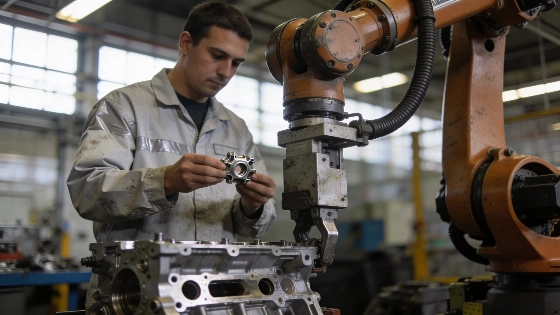
Michigan LIFT will connect manufacturers with buyers, financing, public resources and workforce support across priority industries. Ford hopes to direct up to $1 billion in business to innovative suppliers over the next decade.
On September 29, Ford set a long-range goal of steering up to $1 billion in business toward innovative suppliers through Michigan LIFT. The initiative also aims to help those companies secure financing and expand production in Michigan.
Ford Motor Company, JPMorganChase, the State of Michigan, Michigan Central and Newlab are behind the public-private effort. The mechanism is simple. Industrial buyers identify manufacturing or supply-chain problems and publish them as Open Calls. Suppliers with workable solutions can seek evaluation and coordinated support for commercialization.
For residents of Farmington and Farmington Hills, this is an industrial-development and workforce story. It is not a new municipal program. Any future local effects, including supplier expansion, hiring or infrastructure needs, would still go through the proper city, county and state review processes.
Michigan LIFT is aimed at companies with useful technology or production skills that have not yet reached industrial scale. The platform will connect qualifying suppliers with customer demand, possible debt financing, state economic-development resources, workforce assistance, testing space and commercialization services. Each opportunity will remain subject to the participating organizations' usual qualification, sourcing and approval rules.
Ford is the anchor industrial buyer. It hopes to award as much as $1 billion in business through opportunities advanced by the platform over the next decade. JPMorganChase is the founding capital provider. It hopes to arrange up to $1 billion in debt capital for Michigan LIFT suppliers through its Security and Resiliency Initiative.
That banking initiative is a $1.5 trillion, 10-year plan for industries tied to national security and economic resilience. The State of Michigan will take part through the Michigan Economic Development Corporation. It will use its economic-development tools for companies that show credible paths to commercial and industrial scale.
A separate action came one day earlier. The Michigan Department of Environment, Great Lakes, and Energy awarded Ford $577,655 for an industrial-decarbonization study at the Michigan Assembly Plant with Newlab. The award shows an existing Ford-Newlab-state collaboration. It is separate from the new LIFT platform.
Michigan Central will provide testing and scaling space across its 30-acre innovation district. Newlab hopes to provide $20 million in in-kind support for commercialization work and the operating capacity needed to run the platform.
Initial Open Calls will cover areas tied to Michigan's manufacturing base and JPMorganChase's Security and Resiliency Initiative. The list includes robotics and advanced manufacturing automation; advanced energy technologies such as nuclear systems, semiconductors and battery storage; advanced mobility, aerospace propulsion and critical components; critical minerals mining, processing and recovery; and life sciences manufacturing.
The life sciences category includes pharmaceutical precursors, sterile injectables, medical isotopes and precision medical devices. Companies that want to establish or expand production in Michigan can apply through michiganlift.org. Industrial buyers do not need to be based in Michigan.
More buyers are expected.
Michigan Central, Newlab and the Michigan Economic Development Corporation also hope to attract 10 to 20 additional industrial buyers by the end of 2036. If they reach that goal, those buyers are expected to represent more than $1 billion in annual demand commitments.
The initiative targets a practical problem in industrial growth. Promising suppliers may lack dependable customer demand. Financing may arrive too late. Trained workers can be difficult to find. Complex supplier qualification systems and disconnected support programs can create another barrier between a prototype and a production line.
Ford Philanthropy and JPMorganChase are pairing the launch with $550,000 in collective support for Focus: HOPE in Detroit. The nonprofit's industrial manufacturing training program will use the grant for manufacturing skills, robotics and welding instruction. It will also support employer connections, career placement and transportation assistance.
Access can determine participation. Flint's recycling record offers a local example in which equipment and access mattered. For Michigan LIFT, the test is whether capital, customer demand and training reach suppliers and workers when production needs to expand.
The platform grew from the Michigan Resiliency Summit. JPMorganChase and the State of Michigan hosted the meeting jointly in Detroit in June. Industrial, financial and government leaders used it to identify obstacles that keep promising companies and technologies from reaching production scale.
Michigan offers a concentrated test environment. The state has manufacturing depth, skilled workers, a broad supplier base and an expanding innovation ecosystem. JPMorganChase described Michigan LIFT as an extension of its long-term Detroit engagement. That work includes a $200 million commitment combining business and philanthropic investment, research, employee expertise and local partnerships.
Ford has placed the platform alongside its ACCELERATE The Essential Economy conference and its stated effort to strengthen the nation's manufacturing base. Governor Gretchen Whitmer said the initiative is meant to bring manufacturers, innovative companies, skilled workers and capital together. She also linked it to new investment and jobs in Michigan.
For local readers, the public record will extend beyond business announcements. The City of Farmington and the City of Farmington Hills publish meeting information and notices through their civic portals. Regional economic-development decisions may involve Oakland County administration and state agencies. Residents can use the Farmington-area civic portal to monitor city information as questions about jobs, development or infrastructure arise.
Workforce effects may also reach education and training discussions. Farmington Public Schools board agendas and minutes provide a local record of district discussions about workforce issues, career-technical programs and community partnerships. Those records should not be treated as proof that the district is taking part in Michigan LIFT unless an official action says so. The district's board and district website is the proper place to check.
The founding participants want to see whether lessons from Michigan can support similar efforts elsewhere. That makes the launch more than a supplier referral website. It is not proof that a company has reached production through the program. The promises are explicitly aspirational. Financing and business awards will depend on individual reviews and approvals.
The buyer comes first.
Michigan LIFT addresses a specific industrial bottleneck by putting buyer demand at the center. Suppliers do not have to scale first and search for customers later. The initiative will prove its value through actual Open Calls, contracts, financing and trained workers. For now, its strongest result is the assembly of the institutions needed to connect those pieces in one place.