
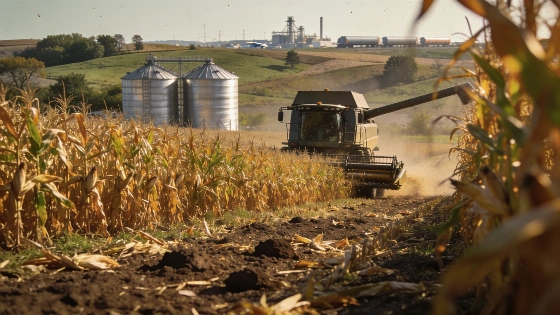
A three-year partnership will test whether Michigan crops can support sustainable aviation and maritime fuel markets. It will also develop carbon-verification tools and a farmer-owned cooperative, but no plant, production volume, construction schedule or airport agreement has been confirmed.
The partnership runs through 2029 and will receive $3 million from Michigan. The Michigan Department of Agriculture and Rural Development and the Corn Marketing Program of Michigan will use the money to study fuel production, carbon measurement and new ways for growers to earn from conservation work.
No plant exists yet. The plan pays for feasibility work, measurement standards and farmer-led market development. The work will test whether Michigan could support a sustainable fuel hub serving Detroit Metropolitan Airport and the Port of Detroit. Available independent reporting has not confirmed a final site, production capacity, construction schedule, operating plant or signed supply agreement with either transportation hub.
For Farmington-area readers, this is a statewide agricultural and industrial proposal. It is not a project announced by the City of Farmington or the City of Farmington Hills. Neither city is named as a project sponsor in the available material. Local civic information is available through the City of Farmington portal and the Farmington Hills website.
The partnership also does not name the Farmington Public Schools board or Oakland County administration. Their involvement would require separate public action, agreements or meeting records. None was confirmed in the material reviewed for this report. State departmental registries and public announcements also provide no independent confirmation that construction or fuel production has begun.
One part of the agreement will study whether Michigan can host a sustainable aviation fuel and maritime fuel facility. Private companies, state and federal partners, and technical specialists will examine whether such an operation could supply the airport and port with agricultural products grown in the state.
Michigan produces millions of bushels of corn and soybeans each year. Some next-generation fuel pathways use those crops. Many farms that grow them sit within a few hours of Detroit Metropolitan Airport and the Port of Detroit. That gives Michigan a possible supply and transport advantage. The project still has to show that a facility would work.
The reason is simple. A potential supply is not a working fuel plant.
A second project will create a carbon-benefit verification standard through the Michigan Agriculture Environmental Assurance Program. MDARD and Michigan State University will develop carbon-accounting protocols. The protocols are meant to document and verify the environmental benefits of conservation practices on farms.
The third part supports the Corn Marketing Program of Michigan's ELITE Leadership program. Participants will research and design a farmer-owned carbon cooperative. The program is expected to pursue a cooperative that could group verified carbon benefits and strengthen growers' negotiating power in emerging markets. The announcement describes a possible launch, not a completed cooperative.
For sustainable aviation fuel, the crop is only one part of the climate calculation. A sound assessment must cover farm inputs, land-use change, processing energy, transport, conversion efficiency and the treatment of coproducts across the full life cycle. A lower-carbon claim cannot be established simply by identifying Michigan-grown corn or soybeans.
SAF can be used in aviation only through approved fuel technologies and specifications. Virgin Atlantic's November 2023 transatlantic demonstration used 100% SAF and showed what an approved demonstration pathway could do. It did not authorize unrestricted use of unblended SAF across the commercial fleet.
Industry forecasts show the size of the challenge. They do not guarantee future output. One IATA-linked estimate cited in an independent review puts possible global SAF production at roughly 400 million metric tons per year by 2050. A net-zero scenario may require about 500 million tons. These are scenario estimates, not commitments from Michigan producers or evidence of a planned facility's capacity.
Michigan farmers already use conservation practices that can improve soil health and may store carbon. They have not had a formal state-verified system for measuring and monetizing those benefits. Without a consistent way to document results, growers have had fewer tools to show fuel producers and other buyers what their practices are worth.
The proposed standard would address that gap. Farmers would have a common method for accounting for carbon benefits. The work also connects MDARD's regenerative agriculture efforts with value-chain development and climate-resilient farming. Conservation would be tied more directly to farm income.
The Corn Marketing Program of Michigan commissioned Public Sector Consultants earlier this year to study whether Michigan could become the foundation for a sustainable aviation fuel hub. The report, published in September, found that Southeast Michigan is uniquely positioned to develop an ethanol-to-jet production hub. That finding provides the immediate policy context for the state investment. The partnership will now test the practical requirements in more detail.
The planned work fits with other Michigan efforts to connect manufacturers and suppliers with new markets. One example is the earlier manufacturing initiative, which focused on financing, buyers and workforce support. The fuel partnership is narrower. It focuses on farm commodities, verified environmental benefits and transport infrastructure in Southeast Michigan.
Industry buyers sometimes use long-term purchase commitments to help finance new SAF projects. Reporting reviewed for this article on the Sustainable Aviation Buyers Alliance does not confirm participation by Michigan, Detroit Metropolitan Airport, the Port of Detroit or the organizations involved in this partnership. The feasibility announcement does not establish any such commitment.
For growers, the near-term result is not a guaranteed payment or a completed manufacturing project. The partnership will build evidence, a business structure and industry connections that could make those opportunities possible. Its farmer-owned cooperative component is intended to give producers a collective role in negotiating for verified carbon benefits and seeking additional margin from crops.
The state is placing agriculture inside a developing transportation-fuel supply chain. Airlines, freight carriers and maritime industries are seeking lower-carbon fuel options. Michigan will use the partnership to test whether its farms, researchers, manufacturers and transport hubs can work together at commercial scale.
The agreement lasts three years and runs through 2029. It is funded through MDARD's strategic grantmaking for agricultural innovation, value-chain development and climate-resilient farming. The announced work will evaluate a facility, build a verification system and support cooperative development. It does not announce a final site, an operating plant, a guaranteed market for farmers or a confirmed public hearing schedule.
That distinction matters. Michigan now has funding to test whether agricultural production can support sustainable aviation and maritime fuels while rewarding documented conservation. The central commercial questions remain part of the project. MDARD and the Corn Marketing Program of Michigan are funding feasibility work and farmer control at the same time. They have not promised an outcome that has yet to be established.