
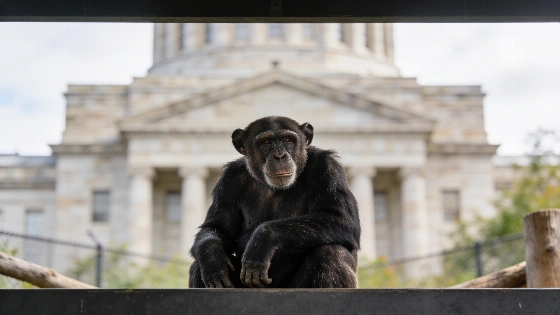
Justice Elizabeth Welch has indicated she would consider whether chimpanzees possess a common-law right to bodily liberty. No verified Michigan ruling has granted animals legal-person status.
No verified Michigan ruling has granted animals legal-person status or recognized a chimpanzee's right to bodily liberty.
Justice Elizabeth Welch has indicated she is willing to consider that question under common law. Her position does not grant animals legal rights. It is not a court ruling. It means a case brought by the Nonhuman Rights Project could receive serious consideration after Welch's accession helped give Democrats a majority on the court.
The available reporting does not independently confirm that the Michigan Supreme Court has issued a final decision on chimpanzee rights. No official court announcement, separate written opinion by Welch or verified case outcome located for this article establishes that animals have become legal persons in Michigan.
The organization argues that common-law courts should recognize certain nonhuman animals as legal persons for purposes of habeas corpus. In practical terms, the claim seeks to use a legal process traditionally associated with human detention. It would challenge the confinement of an animal and ask a court to review its bodily liberty.
The immediate issue is procedural. A court would first have to accept the case. It would then need to decide whether the claimant could invoke habeas corpus and whether existing common-law principles can apply to chimpanzees.
That is the legal hurdle.
For Farmington-area readers, the dispute belongs to the state judicial system, not city government or local schools. The City of Farmington official portal and the City of Farmington Hills address municipal services, ordinances and local public business. Neither city decides whether Michigan common law recognizes a new category of legal person.
What Welch has signaled
Available secondary accounts describe Welch as open to examining whether chimpanzees have a common-law right to bodily liberty. She also rejected the idea that the Book of Genesis provides a sound foundation for Michigan common law.
Her position places the question within legal reasoning about precedent and rights. Religious text would not control the state's judicial doctrine under that approach.
Welch campaigned under the slogan "Put People First." Critics say that considering legal-person status for animals conflicts with that message. Supporters of the Nonhuman Rights Project frame the issue differently. They seek recognition of a specific liberty interest for animals, not a blanket declaration that animals possess every right held by humans.
The distinction matters.
The available material does not report that chimpanzees can vote, marry, bring ordinary lawsuits or receive all human legal protections. It describes a potential habeas corpus claim centered on bodily liberty.
A related New York case shows the legal boundary. In the 2022 litigation involving Happy the elephant, the court declined to extend habeas corpus to the animal. It still recognized that animals may receive legal protections under state law.
That outcome is not binding on Michigan. It shows why statutory animal-welfare protections and legal-person status are separate questions.
The political context
Welch's arrival changed the balance of the Michigan Supreme Court. Democrats held the majority according to the reporting reviewed for this article.
Michigan Supreme Court justices serve eight-year elected terms. Elections can therefore affect the court's membership and the range of arguments likely to receive consideration. A change in composition does not itself change a legal rule or guarantee a particular result.
Welch's campaign also received backing from Planned Parenthood. That political connection has become part of the criticism surrounding her willingness to consider animal-rights litigation. Opponents contrast animal-liberty arguments with Planned Parenthood's support for abortion rights.
The material reviewed also criticizes Peter Singer, an advocate of animal equality and liberty whom Welch cited. Claims about Singer's views on children, elderly people and sex with animals appear in political criticism of Welch's reference to his work. They are not findings in a Michigan case.
That is not a judicial determination.
The broader political argument is familiar. Opponents say the court would be elevating animals while failing to recognize the rights of unborn humans.
That is an ideological critique, not a description of a ruling. No decision identified here gives animals legal-person status. No Michigan court action described in the available reporting establishes a new right.
What happens next
The Nonhuman Rights Project would need to bring its legal challenge through the courts before the Michigan Supreme Court could decide whether to review the underlying question. Welch's stated openness means the issue could be considered. It does not mean she has committed to a result or that the other justices share her view.
The procedural posture is essential for readers tracking the issue. A court's willingness to hear an argument differs from accepting it. Accepting the argument would still differ from issuing a final ruling.
The reviewed material does not provide a verified case number, hearing date or decision date for a final Michigan ruling on chimpanzee bodily liberty.
No final ruling has been verified.
Local civic institutions provide context but do not control this litigation. The Farmington Public Schools Board handles district governance and public meetings. Oakland County administration oversees county functions.
Neither body determines the scope of habeas corpus under Michigan common law. Residents checking local agendas should distinguish school-board or municipal proceedings from filings in the state court system. The district's school board information is a separate public record from any Michigan Supreme Court docket.
The Michigan Department of Natural Resources and other State of Michigan departmental registries may be relevant to wildlife, licensing or animal-care regulation. An administrative animal-protection rule would not by itself establish legal-person status or create a constitutional right to bodily liberty.
Michigan residents can also place this development alongside recent Michigan election coverage that examined the state's changing political landscape. The two stories concern different institutions. Both show why judicial composition and election results can affect the direction of public-policy debates.
The concrete news is not that animals have gained rights in Michigan. They have not.
The development is narrower. A sitting justice has indicated that the court could examine whether chimpanzees possess a legally protected liberty interest.
That is a legitimate subject for legal analysis. Presenting a possible case as proof that monkeys already have human rights would misstate the facts. The responsible reading is more limited: Michigan may be asked to decide whether its common law can recognize a new category of protection for a nonhuman animal.