
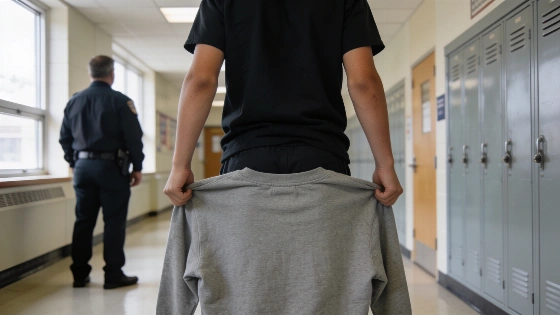
The Supreme Court declined to hear a Michigan case over "Let's Go Brandon" sweatshirts. A lower-court ruling remains in place, allowing the school district to restrict clothing it considers vulgar.
On October 5, the Supreme Court declined to hear an appeal from Tri County Area Schools. The case concerned sweatshirts bearing the phrase "Let's Go Brandon." The court gave no reason for rejecting the appeal. No justice was reported to have dissented.
The dispute involves Tri County Middle School and Tri County Area Schools. It does not involve Farmington Public Schools, the City of Farmington or the City of Farmington Hills. A mother sued for her two sons after school officials told the boys to remove the sweatshirts in 2022. One was in eighth grade. The other was in sixth grade. The family bought the clothing as Christmas gifts in 2021.
The distinction matters.
For local readers, the ruling does not create a policy for the Farmington Public Schools district. It also was not an action by the City of Farmington, the City of Farmington Hills or Oakland County administration. Those governments and school officials would rely on their own policies and any controlling court precedent in separate disputes.
The phrase contains no swear words. The mother's attorneys also argued that it has no sexual meaning. They said school officials had too much discretion to suppress political expression based on their own view of what counts as vulgar.
A federal district court sided with the school district. The court found that officials could prohibit the sweatshirts because students and staff could reasonably understand the slogan as vulgar speech in a school setting. The words printed on the clothing were not themselves profane.
The 6th U.S. Circuit Court of Appeals upheld that decision in a 2-1 ruling. The majority relied in part on the Supreme Court's decision in Bethel School District v. Fraser. That case permits schools to restrict lewd, vulgar or sexually suggestive expression in school settings.
The majority said an euphemism or indirect reference does not automatically place otherwise vulgar expression beyond school regulation. It summarized its position with the phrase, "in the schoolhouse, vulgarity trumps politics."
Politics did not control the result.
The appeals court also said constitutional protection for political speech does not give students unlimited permission to use vulgarity at school. That remains true when the message appears through innuendo or an euphemism.
The school district said the issue was not only the letters printed on the sweatshirt. The court also had to consider the message that students and staff would reasonably understand. In the district's view, the phrase acted as a substitute for an offensive political slogan aimed at Biden.
The mother's legal team presented the case as a First Amendment dispute over political speech. The attorneys argued that a school should not remove a message merely because adults interpret an indirect phrase as offensive or vulgar.
With the Supreme Court's refusal, the lower-court ruling remains in place. The decision does not create a new nationwide test for political clothing disputes in schools. It also does not say that every school may ban any expression an administrator considers offensive.
The appeal is over. The 6th Circuit's decision remains controlling in the lower courts within that circuit's jurisdiction.
The case concerns clothing and student expression. It does not concern attendance or other school operations. Readers following the separate issue of missed instructional time can find earlier reporting on chronic absenteeism in Michigan schools.
The practical result is direct. Students in Tri County Area Schools may be barred from wearing the sweatshirts even though the slogan uses an euphemism instead of explicit profanity. The courts treated the school setting as a place where political expression remains protected, but does not automatically override rules against vulgar language.
For Farmington-area families, the decision concerns a separate Michigan district and precedent applied by the 6th Circuit. It is not a finding about Farmington Public Schools, the City of Farmington Hills or any local school board meeting.
Any future local dispute would depend on its own facts. Courts would also consider the wording of the applicable student-conduct policy and how people understand the expression in that school environment.