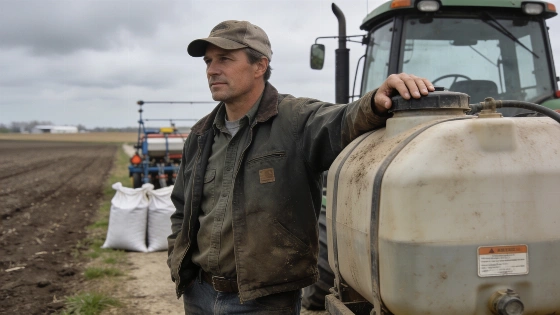
Dennis Kellogg says fuel and fertilizer costs are rising as federal decisions add pressure to Michigan agriculture, household budgets and rural businesses.
Dennis Kellogg, a sixth-generation farmer in Gratiot County and vice president of the Michigan Farmers Union, says the strain on Michigan agriculture is showing up in fuel, fertilizer and energy bills.
The consequences reach well beyond farm gates. Michigan's food and agriculture sector is the state's second-largest industry, while dairy remains its largest agricultural sector. Representatives of Michigan State University have also described agriculture as the state's second-largest source of income. That helps explain why farm costs affect businesses and households far beyond rural communities.
Kellogg's argument is direct. Farmers cannot control the weather or changing markets, but policymakers can avoid adding costs that make it harder to plant, harvest, transport and sell food. Families in suburban communities such as Farmington and Farmington Hills can feel those pressures through grocery prices, utility bills and the wider cost of living.
Local governments have narrower powers. The City of Farmington, the City of Farmington Hills and Oakland County administration handle different parts of planning, public infrastructure and community services. None can set federal farm policy. Local decisions about development, transportation and energy demand can still shape how statewide economic pressure reaches families and small businesses.
War costs and farm inputs
Kellogg places the war in Iran at the center of his criticism. He says the Trump administration and policies backed by Representatives Bill Huizenga, Tom Barrett and John Moolenaar have added to the economic strain. He also argues that the representatives voted to spend more than a trillion dollars on the conflict as the national debt reached record levels.
In Kellogg's account, the war has helped push up gas and diesel prices. He cites an estimated taxpayer cost of $43.6 billion so far, including more than $860 per American household for energy. He says the conflict has also disrupted fertilizer supplies, a development that could raise farmers' input costs and put further pressure on future food prices.
Those figures form part of Kellogg's opinion case against current federal policy. They describe the burden he believes farmers and families are carrying, rather than a new relief program or completed policy change. The claims about the war's total cost, household burden and congressional voting record should be checked against official budget, legislative and defense records.
One confirmed federal development offers a different piece of context. USDA Farm Service Agency estimates put 2025 Agriculture Risk Coverage and Price Loss Coverage payments at approximately $13.8 billion, the largest annual total since the programs were created in 2014. The payments may cushion some producers, while also showing the scale of financial volatility facing the farm economy.
Energy choices for rural businesses
Kellogg says federal policy is narrowing farmers' access to lower-cost energy options. The 2025 budget law, P.L. 119-21, did not eliminate every federal clean-energy tax incentive. It shortened the life of several incentives, set earlier deadlines for some wind and solar projects, created new end dates for clean fuels and hydrogen, and expanded restrictions involving foreign entities.
He points to the Rural Energy for America Program as a practical tool. REAP has helped farmers and rural businesses invest in renewable-energy and energy-efficiency projects that can lower long-term operating costs. After the new federal rules took effect, USDA paused new grant decisions while reviewing the program's regulations. Applicants planning equipment upgrades or renewable-energy installations were left with added uncertainty.
Kellogg also criticizes the administration for spending billions to halt or unwind clean-energy projects. His position is that those actions work against the immediate need to reduce the cost of powering and operating farms. The debate carries particular weight in Michigan, where fuel, electricity and equipment expenses affect dairy farms, crop producers and food processors.
Michigan is examining ways to create more value from agricultural products. The Michigan Department of Agriculture and Rural Development announced a partnership with the Corn Marketing Program of Michigan to advance more sustainable fuel production. The department says the investment could help farmers add value to crops on the farm and benefit from demand for sustainable fuel. The MDARD partnership announcement provides the state's description of the initiative.
That approach fits Representative Tom Barrett's stated agricultural priorities: research, workforce preparation and market access. His office says those areas are intended to help farmers remain competitive and strengthen the resilience of Michigan's agricultural economy.
Trade uncertainty crosses the border
Canada is another pressure point in Kellogg's analysis. Canadian neighbors are among Michigan's most important economic partners. He says tariffs have increased uncertainty and costs for businesses on both sides of the border.
Kellogg cites Michigan's own review, which found that tariffs increased raw-material and production costs and hurt agricultural exporters through retaliatory measures. Farmers already dealing with volatile fuel and fertilizer expenses have less room to plan when trade policy keeps shifting, he argues.
The concern reflects a broader Michigan business reality. Production depends on cross-border relationships and reliable access to materials and markets. A separate look at Michigan's manufacturing strategy described how Michigan's supplier push seeks to connect manufacturers with buyers, financing, public resources and workforce support. Kellogg's point is that those efforts cannot fully offset avoidable costs created by tariffs and energy policy.
For communities in Oakland County, the issue extends beyond farms. Manufacturers, food businesses, retailers and households all depend on predictable transportation costs and access to goods. The Oakland County administration and the State of Michigan's departmental registries remain useful for separating announced programs from proposals, although neither changes the federal tariff framework.
Who pays for data-center demand
Kellogg's final policy concern is the growth of artificial-intelligence infrastructure and data centers. He calls for a rational and enforceable plan that protects Michigan communities, families, farms, small businesses and utility ratepayers from paying for infrastructure built primarily to serve wealthy technology companies.
President Trump has argued that communities opposing data centers risk becoming "backwards and poor" and has urged Americans to "let data reign." Kellogg counters that heavy electricity demand has direct consequences for people who depend on stable and affordable power, including farmers whose businesses already face high energy costs.
He also cites Elon Musk's call for an environment that is "relatively free of regulation" as a warning that powerful technology companies may have priorities that do not match those of Michigan communities. Kellogg's proposed response is stronger public oversight before major electricity demands are shifted onto families, farms and small businesses.
That debate could involve zoning, utility planning, emergency services and public hearings. In Farmington and Farmington Hills, residents would ordinarily encounter those questions through city planning and council processes. The Farmington Public Schools board could also face community discussion if large developments affect enrollment, transportation or local infrastructure. These institutions do not approve every regional energy project, but their records help residents track how broader development pressure reaches neighborhoods.
Kellogg's proposals are practical rather than speculative. He wants lower costs tied to war and energy, continued access to lower-cost rural energy options, less trade uncertainty and data centers to account for the infrastructure they need. The choices are political. The expenses appear in fuel bills, fertilizer purchases, electricity costs and food prices.
Michigan farmers will still face unpredictable weather, changing markets and difficult seasons. Kellogg says they should not also absorb avoidable costs created by federal decisions. Lowering those costs, he argues, would strengthen rural communities, protect the food supply and make everyday life more affordable for families across the state.