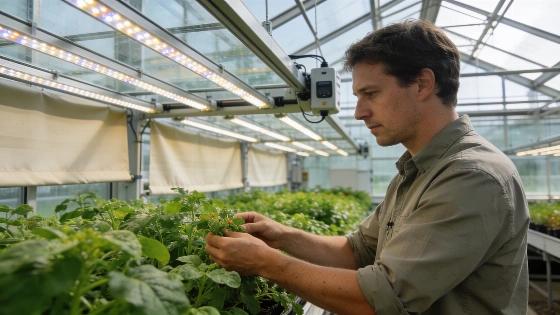
Michigan State University will combine more than $16 million in USDA support with matching funds to finish upgrades at its Plant Science Research Greenhouse Complex and expand year-round research capacity.
Inside Michigan State University's Plant Science Research Greenhouse Complex, older sections are set for a major overhaul backed by federal money.
The U.S. Department of Agriculture's National Institute of Food and Agriculture announced the award on Oct. 7, 2026. The funding was part of more than $121 million distributed to 36 universities through the Research Facilities Act Program. MSU appears on the program's official recipient list in the USDA award announcement.
The federal grant requires an equivalent contribution from MSU. Combined, the award and university match will provide more than $32 million for the project, extending controlled-environment research capacity at one of the university's central plant science facilities.
The program funds agricultural research infrastructure at a national level. Its projects can include laboratories, followed by greenhouses and livestock facilities. Aquaculture centers also qualify. The work supports basic research. It also covers applied research and developmental research, rather than commercial crop production alone.
For Farmington-area readers, this is a university and federal investment, not a municipal or K-12 construction project.
The City of Farmington and the City of Farmington Hills are not named as recipients in the USDA announcement. The Farmington Public Schools board is not listed as a participating agency. The local connection is educational and regional: MSU research can inform Michigan growers. Agricultural businesses can use the findings, while educators and students may benefit across the state.
What the grant will change
About 60% of the greenhouse complex has already undergone substantial work, according to project information reported by WLNS. That phase included a new headhouse building and environmental-control systems. It also added LED lighting, new glazing panels and taller ceilings. The completed construction and renovation work was valued at about $35 million.
The remaining areas will receive comparable upgrades. LED lighting, environmental controls and taller ceilings are planned for those sections. Across the complex, automated shade systems and energy curtains will adjust light exposure and temperature. They will also manage humidity and help reduce energy use.
That matters in experiments where a small change in conditions can affect the result.
Researchers will gain tighter control over the main drivers of plant growth. They can run drought studies without the limits of older spaces. Pest-control research will also have more consistent conditions, and taller crops can fit beneath the upgraded ceilings.
Research behind the investment
Michigan's growing season is unpredictable, which makes controlled greenhouse environments valuable for year-round plant research. Faculty and students can study crops under repeatable conditions. The facilities will also help build skills for agriculture-related industries, with staff supporting the work inside the complex.
MSU's College of Agriculture and Natural Resources is connected to the project. The College of Natural Science is involved as well. Dean Matt Daum said NIFA support will give researchers and students access to high-quality greenhouse infrastructure. Staff are part of that research operation, while AgBioResearch leaders have stressed the need for modern facilities to address plant agriculture challenges in Michigan. Those challenges also extend across the United States and internationally.
Erik Runkle, a professor and MSU Extension specialist in the Department of Horticulture, has described the upgrades as a way to improve control over temperature and light. He has also pointed to barriers affecting tall crops. Drought studies face similar limits, as does pest research.
The university's wider support for students and research was covered in an earlier MSU aid report. That report concerned financial assistance for students. This award is directed at physical infrastructure.
Project timeline and regional reach
Earlier project planning identified April 2026 as the target for completing the remaining construction phase. The USDA award announcement came later, on Oct. 7, 2026. The federal description confirms the project's purpose and recipient, but it does not provide a new construction schedule.
The award supports the modernization project. It does not establish a new local building timetable.
The investment sits within a broader public research and economic-development system. The State of Michigan helped support earlier work. Oakland County administration and local governments are separate public entities, as are school districts. None are listed as funding partners in the USDA announcement.
State departmental registries and local public meeting records remain the appropriate places to verify future permits. They can also confirm public contracts or educational partnerships connected to the facility.
Once the greenhouse work and the Plant and Environmental Sciences Building are complete, MSU expects to have one of the largest and most sophisticated plant-growth facilities in the United States and beyond. That claim reflects the scale of the university's planned research capacity. The immediate effect is more specific: federal money and matching university funds can close a major modernization gap inside an existing complex.
Modernized greenhouse sections will give researchers controlled conditions that older spaces could not provide. The project also draws on prior state support and creates a research platform for Michigan agriculture. Growers can use resulting findings, while students and communities across the state remain part of the potential regional reach.
Residents seeking information about Farmington municipal projects, public meetings or local government services can use the City of Farmington portal. Those records are separate from MSU's campus construction and USDA grant administration.