Republican John James wants to change Michigan's tax and education policies as he campaigns for governor. His energy proposals would loosen state requirements, but the campaign has yet to detail how it would replace lost revenue.
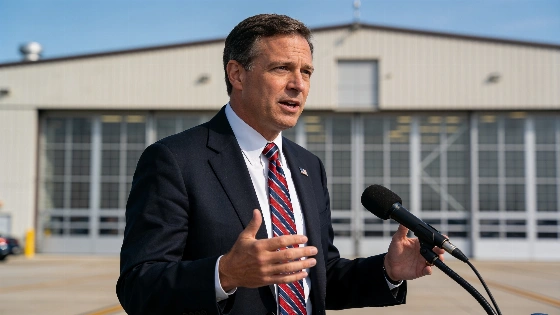
On July 27, 2026, John James arrived to speak at the General Motors Proving Ground in Milford, according to the photo caption accompanying the account of his campaign agenda.
The Republican U.S. representative from Macomb County has made changes to Michigan's business and education policies part of his pitch for governor. He has also proposed tax cuts and a rollback of clean-energy requirements, arguing that Michigan has become hostile to businesses.
By October, James and Democrat Jocelyn Benson were appearing as the leading candidates in gubernatorial debates. James clarified that a data-center pause he supports should be decided by local communities, not imposed statewide, according to Bridge Michigan.
That local distinction matters in Farmington and Farmington Hills, where municipal processes govern decisions about land use and development. The City of Farmington and the City of Farmington Hills would be among the local governments residents could consult for planning information or public-hearing details if a data-center proposal arose. Available reporting identifies no specific local project or pending hearing.
James has proposed phasing out Michigan's individual income tax. He also wants to suspend federal gasoline taxes and state gasoline taxes. He has called for revisiting road-funding rules under Public Act 51, aiming to reduce costs for drivers.
At a debate, James said revenue losses could be offset by cutting spending he considers wasteful and selected programs. WOOD TV8's reporting provided no detailed fiscal plan or timeline for replacing the revenue.
The question reaches beyond state finances. Oakland County administers county-level services. Cities make their own budget decisions, as do school districts, and James's proposals so far do not specify how state revenue changes would affect their funding. According to MidMichigan Now, he has also suggested ending the wholesale marijuana tax, some proceeds from which support road work. He has proposed reducing funding for the Michigan Economic Development Corporation as another way to pay for tax concessions.
Education is another part of the agenda. James has pointed to Mississippi's literacy efforts, emphasizing reading instruction and phonics. He has cited a goal of basic literacy by fourth grade. He also wants to shift resources from administrators toward teachers.
The Michigan Daily reported that debate coverage described Michigan as ranking 44th in K-12 outcomes. Mississippi had risen 34 places over 14 years. Farmington Public Schools' board is the local body residents can consult about district policies. Its public materials also cover meeting agendas and budget decisions. James's statewide proposals do not, by themselves, specify changes to district programs or governance.
Energy policy is a central point of contrast. Michigan law calls for the state to transition to clean energy by 2040. James opposes a mandatory path to that goal and favors an "all-of-the-above" mix that includes renewables. He also backs natural gas and nuclear power, saying a broader mix can help keep prices down and maintain reliability, as Michigan Public reported.
James's position would change the direction of state policy. The campaign proposals described in debate coverage do not set out a detailed replacement framework. Farmington and Farmington Hills residents can follow municipal agendas as proposals develop. They can also consult Farmington Public Schools board materials. Available reporting identifies no specific local action tied to James's platform.
Farmington Voice has also covered a separate Michigan energy-policy dispute involving Gov. Gretchen Whitmer and the Line 5 tunnel permit in the Line 5 dispute.