Michigan added Genesee County to its box tree moth quarantine after a new detection. The pest can strip ornamental boxwoods in one season and kill them if unchecked, affecting homeowners, landscapers and public-property managers across Oakland County.
MDARD now lists 14 Michigan counties under the box tree moth quarantine. Genesee County joined the list after the invasive pest was detected there.
The Michigan Department of Agriculture and Rural Development, or MDARD, said the regulated area previously covered Clinton, Eaton, Ingham, Jackson, Lapeer, Lenawee, Livingston, Macomb, Monroe, Oakland, St. Clair, Washtenaw and Wayne counties. Boxwoods can lose all their leaves. The shrubs may die.
Oakland County is already covered. That includes the City of Farmington and the City of Farmington Hills. Residents, landscaping companies and public-property managers should check the MDARD guidance before buying, treating or moving boxwood material.
Michigan established its interior box tree moth quarantine in 2023. The state first confirmed the pest in Livingston County in 2024. MDARD says the moth does not threaten Michigan's natural resources, but it can cause major leaf loss and kill ornamental boxwood shrubs.
The pest feeds on boxwoods. That limits its known host range. Losing mature shrubs can still cost homeowners, businesses and communities money.
Local governments and institutions may also face the issue. That includes the Oakland County administration and the Farmington Public Schools board when they manage or hire contractors for landscaping on public grounds.
The quarantine controls regulated plant material and pest movement. It does not close parks, schools or municipal facilities.
How to identify damage
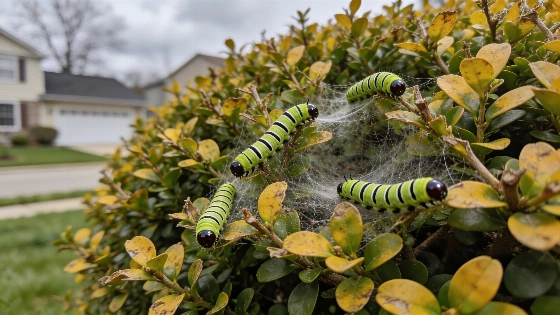
Yellowing is often the first visible sign, according to Michigan State University Extension. Inspect damaged plants closely for caterpillars. Look deep inside the shrub and among tightly clustered branches, where the insects can build nests with webbing.
The caterpillars are lime green with black stripes, white spots and hairs. Their heads are shiny black. Lime green frass, or insect waste, may appear on the plant, on the ground beneath it or in the webbing.
Adult moths are active from June through October. In North America, they are commonly white and brown. A white spot on the forewing can resemble a comma. Some adults are dark brown but still have the white forewing spot.
Why the pest matters
Jeremy Hertz, owner of Family Tree Doctor, told The Daily in spring 2025 that the insect can strip a boxwood of its leaves within one season if no action is taken. The plant may then suffer severe decline or die.
The box tree moth arrived in North America recently. The first known finding was in Toronto, Canada, in 2018. MSU Extension says infested shrubs may have been shipped to Michigan nurseries in 2021, even though the plants had been inspected for infestation.
That history explains why new and established boxwoods need close checks. An infestation can hide inside the shrub. Packed branches and webbing can make early detection difficult.
The signs can be subtle.
What to do with an infestation
MSU Extension recommends pesticide treatment in late July or early September. Its guidance lists bifenthrin or another pyrethroid insecticide approved for homeowner use as an option for controlling all life stages of the pest. Residents should follow the product label and all applicable state and local requirements.
MDARD's regulated-articles rule prohibits moving Buxus plant material, whether live or dead, from inside the regulated area to outside it unless the firm has a written compliance agreement. The same rule covers box tree moths.
The restriction can affect nurseries, landscape contractors and anyone transporting discarded or recently removed boxwood across the quarantine boundary. The rule applies to plant material.
Homeowners should inspect the entire plant instead of checking only the outer leaves. Yellowing, bare sections, caterpillars, webbing and lime green frass are the main signs to look for. The material provided identifies boxwoods as the moth's host plant, so the pest poses no known feeding risk to unrelated plants.
Residents who suspect an infestation outside the quarantine area should photograph the plant, report it and notify MDARD before spraying or disposing of the material. A photograph can help inspectors tell box tree moth damage from other causes of thinning or discoloration.
The Genesee County detection expands the quarantine beyond Livingston County and adds to the plant-health concerns facing Oakland County communities such as Farmington and Farmington Hills. The steps are direct: inspect boxwoods, identify the pest, avoid moving regulated material across the quarantine boundary and follow MSU Extension's treatment guidance.
Early inspection matters most for ornamental shrubs. One unchecked season can cause serious damage or kill the plant.