Michigan students are starting the 2026-2027 school year under statewide cellphone restrictions. Districts, including those serving Oakland County families, still decide how phones are stored, how violations are handled and when students may regain access.
Gov. Gretchen Whitmer signed the bipartisan cellphone legislation in February after proposing school smartphone restrictions in her 2025 State of the State address. Michigan students are now starting the 2026-2027 academic year under the new rule.
During instructional time, school districts must prohibit student cellphone use on school grounds. The law allows exceptions for emergencies and academic work.
The rules differ.
The law does not require one procedure in every school. Each district must write a policy that meets the state requirement and fits its own buildings. Local administrators decide how phones will be stored, when limited access may be allowed and how violations will be handled.
For families in Farmington and Farmington Hills, the practical details will come through district policy and school-level communication. There is no single statewide storage system.
The Farmington Public Schools board is the local body that reviews district policy. The City of Farmington and the City of Farmington Hills are separate municipal governments. They do not administer school discipline. Oakland County administration provides a regional civic context, but individual school districts enforce cellphone rules.
What the new rule requires
Supporters said fewer digital distractions would help students focus on classwork and build healthier habits around screens and social media. Michigan lawmakers had discussed competing proposals in spring 2025. Cellphone regulation had become a bipartisan legislative issue, not a sudden administrative decision.
Smartphone access is now nearly universal among teenagers. A Pew Research Center study found that about 95% of teens have access to a smartphone. Most also reported using platforms such as TikTok, Snapchat or Instagram. Nearly half said they use the internet almost constantly.
The state requirement covers instructional time. It does not automatically ban phones during every minute of the school day. District policies may differ on access during lunch or passing periods, as long as they preserve the classroom restrictions and stated exceptions.
Families should check their district's current handbook and board notices. Implementation remains local.
Schools had already taken different approaches
Many Michigan schools had cellphone rules before the statewide mandate. A University of Michigan study found that local policies varied. Some schools prohibited phones for the entire school day. Others allowed use during lunch and passing periods.
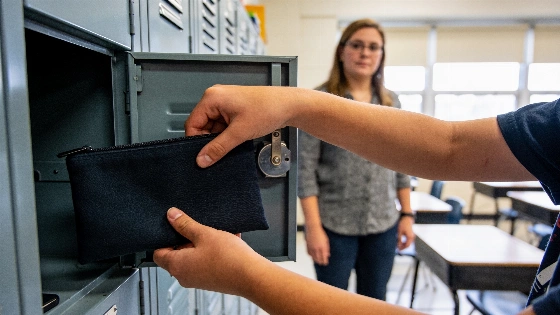
Avondale Middle School in Oakland County had already adopted one of the more restrictive systems. Students place their phones in magnetic pouches. School officials lock the pouches for the day.
During an April 2025 Michigan House of Representatives Education and Workforce Committee hearing, Principal Katie Gomez said administrators were pleased with the policy.
Gomez attributed higher standardized test scores and fewer fights in the building to the cellphone ban. She also said the policy reduced distractions for students and instructors. Those results describe one school's experience. They do not establish that every district will see the same outcome.
Dearborn Public Schools shows how a local rollout can work under the new framework. The district updated its policy for summer 2026 and connected restrictions on communication devices to the state requirement.
Other districts may use different storage methods, access periods and consequences. Students across Michigan will not necessarily experience identical rules.
Evidence on student outcomes
The push for restrictions is tied to concerns about screen time and its possible relationship to physical health, mental health and academic performance. A 2024 National Education Association survey found that 90% of educators supported policies that reduce cellphone use during instructional time.
Educators listed cyberbullying, social barriers and classroom distraction among their largest cellphone-related concerns.
The academic evidence is less settled. A national study published by the National Bureau of Economic Research found minimal effects on academic progress during the first three years after schools adopted cellphone bans.
The study also found that student discipline and well-being initially worsened. Both improved in later years.
That research limits the promises surrounding the Michigan law. A phone restriction may remove an immediate classroom interruption. It does not, by itself, prove that test scores or student well-being will improve statewide.
A 2026 national overview cited in coverage of the issue estimated that nearly 40 states had proposed K-12 cellphone restrictions. Roughly 20 states and Washington, D.C., had adopted stricter bell-to-bell policies. Those counts depend on how laws and district mandates are classified.
Why districts have flexibility
Michigan officials have promoted the requirement as one tool for improving student achievement while schools address declining or stagnant standardized test scores.
The legislation gives districts room to respond to different buildings, age groups and existing procedures. It does not replace every local policy with one statewide storage system.
That flexibility means families may encounter different rules from one Michigan district to another. The common baseline is a ban on cellphone use during instructional time, with exceptions for emergencies or academic purposes.
Each district will set the details for storage and enforcement. The Michigan Department of Education remains the appropriate state agency for statewide education guidance and records.
The change adds a statewide floor to a patchwork of school rules. It does not end local decision-making.
Recent reports from late September 2026 indicate that districts are still refining their procedures. Michigan's policy remains in an implementation phase, not a fully uniform system.
The strongest case for the ban is practical. Teachers can remove one persistent source of interruption from the classroom. Districts can set clearer expectations for students.
The available research does not support treating cellphone restrictions as a guaranteed academic fix. Michigan's policy is a classroom-management requirement. Its success should be judged by how consistently districts apply it and whether student discipline, well-being and learning improve after the initial adjustment period.