An 18-month Army extension gives Michigan Tech and Oshkosh Defense more time to adapt a 120-kilowatt kit for FMTV A2 vehicles. Two prototypes are due for government assessment and soldier evaluation.
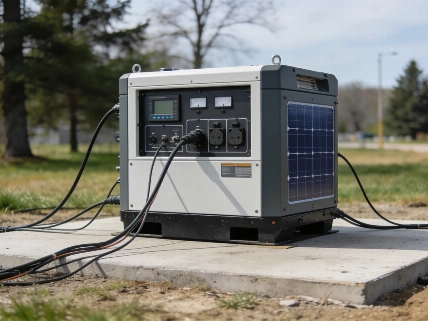
The Vehicle Integrated Power Kit, or VIPK, is designed to generate up to 120 kilowatts of electricity aboard a tactical vehicle. That power could run equipment used in field operations.
The Army has added 18 months to the project through a Defense Innovation Unit other transaction agreement, extending its timeline to three years. The Army has exercised $16.9 million to date, but the total project value was not specified. On Oct. 14, 2026, Oshkosh Defense announced a partnership with Michigan Technological University's Advanced Power Systems Research Center, known as APS LABS, to move the VIPK prototype toward a production-ready design.
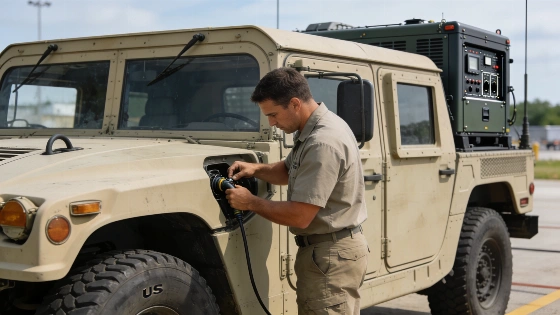
The FMTV A2 fitted with a VIPK appeared at the AUSA 2026 exhibition. Oshkosh Defense is the original equipment manufacturer for the Family of Medium Tactical Vehicles A2. The company is helping integrate the kit with that platform and move it toward scalable production.
VIPK is designed to provide up to 120 kW at 600 volts of direct current. It meets the Tactical Microgrid Standard, which is intended to let the kit operate alongside other compatible power systems in the field. Oshkosh has described it as a source of mobile, on-platform energy.
The kit is intended to support counter-drone systems and directed-energy weapons. Its planned uses also include missile defense. Command posts and field hospitals are among the other missions cited. By generating power aboard the vehicle, VIPK is designed to reduce reliance on external sources in austere environments.
The project remains in development. Prototype assessment and soldier evaluation are planned before production readiness.
Oshkosh says the next step is to complete and validate two prototypes for government assessment and soldier evaluation. APS LABS is then expected to build two more for further testing. Those prototypes will also support technology demonstrations. The team is preparing a Technical Data Package and refining the design for manufacturing.
Oshkosh is adapting the university-developed prototype for the FMTV A2 and supporting the transition toward a production-ready kit. The company says APS LABS brings research and development expertise. The center also contributes integration expertise, while Oshkosh brings production experience. The goal is a kit that can be manufactured and integrated with the existing vehicle platform. The Army extension is not a production order.
Other project partners include GS Engineering and Soli Consulting. LSA Solutions is also involved.
Military support includes the Portfolio Acquisition Executive, PAE, Agile Sustainment and Ammunition, AS&A. The Capability Program Executive, CPE, Combat Sustainment, CS, is also involved. Support also comes from the Project Manager, PM, Transportation Systems, TS.
The Product Director, PdD, Multi-Mission Protected Vehicle Systems, MPVS, is part of the effort. The Office of Secretary of War Defense Innovation Unit, DIU, is involved as well. The Office of Secretary of War Operational Energy-Innovation, OE-I, also provides support.
Other supporting organizations include the Ground Vehicle System Center, GVSC, and Combat Capabilities Development Command.
APS LABS has also delivered a prototype tactical hybrid-electric High-Mobility Multipurpose Wheeled Vehicle to the Army's Rapid Capabilities and Critical Technologies Office. Michigan Tech provides engineering services for the American Center for Mobility in Ypsilanti. Those projects show the university's work linking power systems research with vehicle development.
The VIPK project is separate from the proposed University of Michigan and Los Alamos National Laboratory computing center in Ypsilanti Township. Residents have raised concerns about its electricity demand and military research, as reported in this earlier report. Work on the vehicle kit is focused on prototype testing and soldier evaluation. The team is also preparing technical materials to assess production readiness.