A $20 million NSF award will fund IDiCaRS, a planned MSU center for diamond-based electronics. Researchers will test devices with heavy-ion beams at the Facility for Rare Isotope Beams.
Space radiation can damage conventional semiconductor devices, complicating spacecraft operations beyond low Earth orbit and on missions farther into space.
Michigan State University has received a $20 million National Science Foundation grant to establish a center for semiconductors designed to withstand radiation and other extreme conditions. The planned facility, Integrated Diamond and Carbon Research in Space Applications, or IDiCaRS, will bring materials research and device fabrication together at MSU. Researchers will also test devices there.
The center aims to shorten the path from developing a semiconductor material to testing a finished device under harsh conditions. The work could support more radiation-resistant electronics for spacecraft. It could also lead to heat-tolerant electronics for use on Earth.
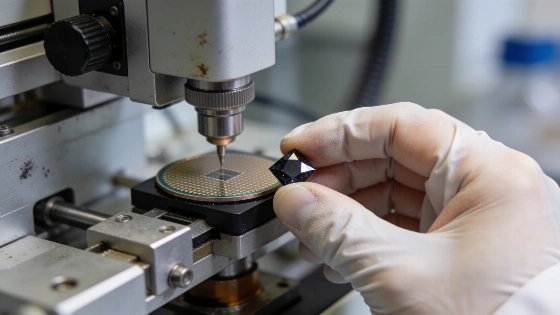
IDiCaRS is planned as a shared-use center for developing diamond and related carbon materials. Researchers will fabricate electronic devices there, then test them against radiation.
Heavy-ion testing will use beams at MSU's Facility for Rare Isotope Beams. MSU describes the planned center as a first-of-its-kind niche facility. Its proposed diamond foundry is meant to speed the move from materials development to device fabrication. Environmental testing would follow.
Diamond is under study for electronics because it conducts heat effectively and can withstand high temperatures. It can also tolerate radiation and electrical stress. By bringing capabilities now spread across facilities and locations into one research infrastructure, IDiCaRS is intended to reduce development cycles. The center could help establish shared methods for testing and qualifying electronics for extreme environments.
The project will draw on existing capabilities at FRIB. It will also involve the MSU Space Electronics Initiative and Fraunhofer USA Center Midwest. Wen Li, an MSU Research Foundation Distinguished Professor in the College of Engineering and executive director of Fraunhofer USA Center Midwest, will lead the facility.
More capable electronics could reduce spacecraft reliance on heavy shielding and redundant systems. That could make systems smaller and lighter, and improve their efficiency. These are potential outcomes, not reported results from the new facility. The research could also inform high-power electronics used on Earth. Next-generation communications technologies are another potential application.
IDiCaRS will be open to academic and industry researchers. Government researchers will also be able to use it. Aerospace companies could work on radiation-hardened electronics for missions beyond low Earth orbit. Defense contractors and satellite companies could use the center for similar work.
Semiconductor companies could access diamond growth and device fabrication. The center will also offer radiation testing. Potential applications include power systems and electric vehicles. Telecommunications is another area of interest.
The center is a research project, not a data-center or electricity-supply initiative. Separate earlier reporting covered Michigan data-center rules and Google's power arrangements.
MSU plans to use the facility to expand workforce development. Students are expected to gain access to advanced semiconductor materials and specialized equipment. They will also encounter manufacturing processes at research facilities.
The education plans include updated undergraduate and graduate coursework. MSU also plans a graduate certificate and an undergraduate minor tied to the center's research areas.
Outreach is planned for middle and high school students through space-electronics programs. Community college students will have additional opportunities. The project will build on the university's existing research partnerships and give students access to equipment used in advanced semiconductor research.
MSU says the shared facility is intended to strengthen Michigan's semiconductor and advanced-manufacturing capabilities. Its planned work includes material development and device production. Heavy-ion testing will take place at the university's Facility for Rare Isotope Beams.
Separately, the National Science Foundation has described a $20 million, two-year pilot intended to help small businesses commercialize deep technologies. The NSF pilot announcement concerns support for small businesses.