While most states have issued AI guidelines for public schools, few address student cheating, leaving teachers to manage rising misuse of generative AI tools without clear support or effective detection methods.
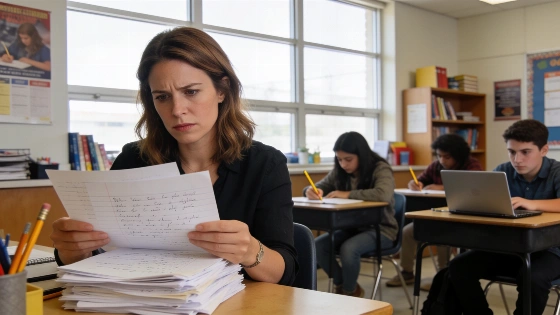
When Paige Wyatt realized her high school English students were submitting assignments lifted straight from AI tools, she didn't get a playbook from her district or state. Instead, she spent her own money on detection software, only to find herself outmatched by students who quickly learned to outmaneuver the technology.
Wyatt's experience is not unique. Across the country, teachers are confronting a surge in AI-assisted cheating, but state-level guidance has largely avoided the issue. According to a recent Common Sense Media survey, 70% of teens now use AI for schoolwork. Yet, most state policies focus on AI literacy and teacher efficiency, not on academic integrity or enforcement.
States Issue Guidance, But Avoid Cheating Solutions
At least 37 states and the District of Columbia have published recommendations for AI use in public schools, ranging from brief web pages to Illinois' 400-page manual. However, a review by Chalkbeat found that these documents typically devote only a few paragraphs to academic integrity, offering little practical advice for stopping students from using AI to complete assignments dishonestly.
Instead, states emphasize that AI should be used under human supervision and link to external resources-some developed with the backing of major AI companies. Concrete steps for detecting or deterring cheating are rare. In fact, more than a third of states explicitly warn schools not to rely on AI-detection tools, citing research showing these tools often misidentify genuine student work as AI-generated.
Some of the nation's largest school districts have attempted to fill the gap by developing their own policies. New York City, for example, delayed its AI guidance rollout for months after backlash, eventually releasing a new policy that discourages the use of AI-detection software. Other districts have adopted acceptable use policies, but these often leave the burden of enforcement on individual teachers.
Teachers and Districts Struggle With Enforcement
Without clear state direction, teachers are improvising. Some require more in-class, handwritten work. Others, like Wyatt, have tried detection tools, only to find students using paraphrasing software such as QuillBot to disguise AI-generated writing. The lack of consensus on what constitutes cheating-whether outlining with AI is acceptable, for example-adds to the confusion.
School board efforts to address the problem have met resistance. In Manassas City, Virginia, a proposal to add AI misuse to the student code of conduct was voted down over concerns it would create new burdens for teachers without providing effective tools. As Lisa Stevens, a board member and teacher, pointed out, enforcement is nearly impossible without reliable detection methods.
Some educators, like Christopher Harris of Genesee Valley BOCES in New York, argue that the solution may lie in rethinking assessment itself. With AI capable of producing polished writing on demand, he suggests teachers focus more on the learning process-such as oral assignments or requiring students to explain their revisions-rather than the final written product.
Policy Gaps and the Search for Answers
Historically, states have lagged in regulating new technology in schools. It took years for computer science requirements and cell phone restrictions to become standard. With generative AI, states have moved faster, but the lack of evidence-based policy is glaring. As MIT professor Justin Reich notes, there is no proven method for detecting AI-generated content or for defining the boundaries of acceptable use.
California's approach typifies the current landscape: the state offers districts a list of questions to consider when crafting integrity policies, but stops short of prescribing specific rules. In the absence of clear standards, teachers are left to experiment, often with little support or training.
Meanwhile, the consequences are real. Wyatt left teaching last year, citing AI's impact as one factor. She says students are only getting better at hiding their tracks, and without a support network or meaningful consequences, teachers are left isolated. "We need workshops for teachers to detect cheating. We need workshops for kids," she said.
Broader Context and Local Implications
While the debate over AI in schools is national, the practical impact is felt in classrooms and districts across the country. The lack of clear policy leaves teachers and administrators to navigate a rapidly changing landscape with little guidance. As seen in reported earlier, local governments are also grappling with how to integrate AI responsibly into public services, often moving faster than state or federal regulators.
For now, the responsibility for maintaining academic integrity in the age of AI falls squarely on teachers' shoulders. Until states move beyond vague recommendations and provide concrete, enforceable policies, educators will remain on the front lines-outnumbered, under-resourced, and forced to improvise solutions to a problem that is only growing more complex.