
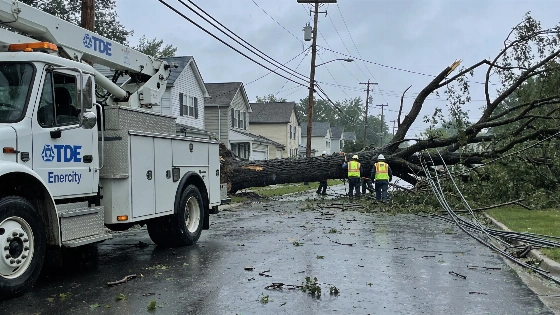
Tornado warnings and damaging winds swept through southeast Michigan Thursday, toppling trees, halting school dismissals, and leaving hundreds of thousands without electricity as utility crews raced to restore service
Hundreds of thousands of southeast Michigan residents faced a sudden blackout Thursday as severe storms swept through the region, downing trees, damaging power lines, and triggering tornado warnings across multiple counties. By late evening, nearly 280,000 homes and businesses remained without electricity, with utility crews working through the night to restore service.
At the height of the storms, more than 350,000 customers lost power, according to DTE Energy and Consumers Energy. The outages stretched from Lansing to Detroit, with the most significant disruptions reported around Lansing and west of Ann Arbor. The National Weather Service placed 3.24 million people under tornado threat in Wayne, Macomb, Oakland, Livingston, and Washtenaw counties, issuing warnings that began shortly after 3 p.m. and continued until nearly 5 p.m.
Storm Damage and Emergency Response
Communities across Metro Detroit and mid-Michigan reported widespread damage. Haslett alone saw more than 100 trees downed, while Edgemont Park and Brighton experienced wind gusts reaching 60 mph. In Hudson Mills and near Ann Arbor, fallen trees and power lines blocked roads and threatened property. The storm-chasing group Tornado Tacklers reported a likely tornado near Williamston, east of Lansing, with hundreds of trees toppled between Lansing and Detroit.
Police departments throughout the region issued urgent alerts, instructing residents to seek shelter in basements or safe rooms. Schools in Birmingham and Dearborn delayed student dismissals, keeping children inside until conditions improved. In Lenawee County, court proceedings were interrupted as staff moved to the basement for safety. Even the Michigan State Fair, which opened Thursday in Novi, was forced to evacuate fairgoers from the midway to the expo hall as dark clouds and rain swept in.
Utility Restoration Efforts
DTE Energy reported that by 11:13 p.m. Thursday, 263,574 customers were still without power, down from more than 300,000 earlier in the day. Consumers Energy counted 16,317 outages, a reduction from the 23,000 peak. DTE deployed 3,400 members of its Storm Response Team, restoring power to over 70,000 customers affected by storms on both Wednesday and Thursday. The company projected that 65% of impacted customers would have service restored by the end of Friday, 90% by Saturday, and the remainder by Sunday. Consumers Energy had 127 crews in the field working to repair lines and clear debris.
The National Weather Service confirmed that a tornado touched down in Marysville on Wednesday evening, carving a path 0.35 miles long and 175 yards wide with winds reaching 75 mph. As of Thursday, officials were still assessing whether additional tornadoes had touched down during the latest round of storms, with meteorologists coordinating with county emergency managers to determine if further surveys were needed.
Community Impact and Next Steps
The severe weather disrupted daily routines across southeast Michigan. School districts, courts, and public events all faced sudden interruptions, with safety protocols activated in real time. Residents in affected areas were left to navigate blocked roads, damaged property, and uncertainty about when power would return. Utility companies urged patience as crews worked through hazardous conditions to restore service, emphasizing that full restoration could take several days for the hardest-hit neighborhoods.
For southeast Michigan, this latest round of storms underscores the vulnerability of local infrastructure to severe weather and the importance of coordinated emergency response. While utility crews and first responders moved quickly to limit the impact, the scale of outages and damage highlights the ongoing challenge of maintaining grid reliability in the face of increasingly volatile weather patterns. Residents and local institutions will be watching closely to see whether promised restoration timelines hold-and whether lessons from this event lead to more resilient systems in the future.
Michigan's emergency management and utility response systems are designed to prioritize restoration for critical facilities such as hospitals, police stations, and water treatment plants before moving to residential neighborhoods. Residents can track outage maps and estimated restoration times through DTE Energy and Consumers Energy websites. The National Weather Service continues to monitor conditions and will issue further warnings if additional severe weather is expected.
- Transportation & Infrastructure
- Local Utilities & Service Outages
- Public Safety
- Fire & Emergencies
- Verification & What We Know
- Environment & Great Lakes
- Metro Detroit
- Detroit
- Wayne County
- Macomb County
- Washtenaw County
- Ann Arbor
- Lansing
- School Closure
- Emergency Alert System
- DTE Energy
- Consumers Energy
- Power Outage
- Suburban Collection Showplace