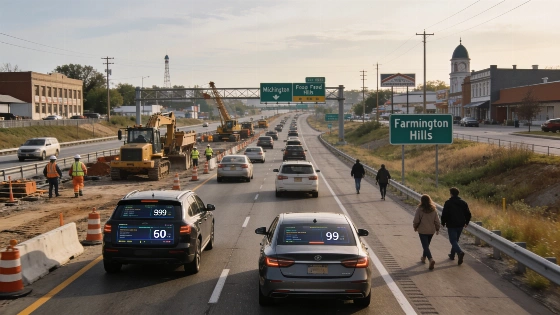
MDOT plans to enroll 1,000 participants in a six-month pilot starting in early 2027. The test will show whether mileage charges could complement or replace Michigan's gas tax.
MDOT launched the Michigan Road Usage Charge, or MiRUC, Pilot Project in mid-2026 under Public Act 22 of 2025, Article 15, Part 2, Section 1005.
The planned six-month pilot is scheduled to begin in early 2027 with 1,000 participants. It will not immediately change Michigan's road-funding system. Instead, the test will produce evidence for a final report to the Legislature at the end of 2027.
Drivers in Farmington and Farmington Hills will not face a new mileage fee during the study. Oakland County communities are watching the project because the state is testing a possible funding model, not imposing one statewide.
The pilot will examine how a road user charge could be collected when drivers are assessed by miles traveled rather than gallons of fuel purchased. MDOT's materials cover mileage reporting and participant privacy. They also address the Technical Advisory Committee and the legislative deadlines governing the project.
MDOT says Michigan's transportation revenues have not kept pace with inflation. That gap puts pressure on road maintenance and operations. It also affects the infrastructure connecting residents with jobs, schools, health care, goods and services. The local routes used by families in Farmington Public Schools face the same funding pressures as roads carrying employees between Farmington, Farmington Hills and regional job centers.
MiRUC follows MDOT's 2024 to 2025 Road Usage Charge Study. The work measured Michiganders' awareness and perceptions of road usage charges through a statewide survey. It also used a demonstration to test ways of collecting and processing the information required for a road user charge program. The study reviewed factors that could influence a shift to public transit.
Michigan's current primary road-funding formula relies on a state gas tax charged per gallon. As of October 2026, the tax is 52.4 cents per gallon. Most proceeds support state and local roads, along with public transportation, according to CBS News Detroit reporting. Revenue is tied to fuel purchases rather than directly to the number of miles a vehicle uses public roads.
More fuel-efficient vehicles and changing transportation patterns have pushed MDOT to study a mileage-based model. The agency is weighing whether it could provide a more sustainable alternative. For Farmington and Farmington Hills, the practical issue is whether a future formula would give local road maintenance a predictable share of funding.
The debate is running alongside a fight over current gas-tax revenue. Senate Bill 1187 proposed a temporary suspension of the gas tax. It was sent to the Senate Committee on Finance, Insurance and Consumer Protection and was not brought to a Senate vote on October 2, 2026.
The Senate ended that session without advancing the proposal. House Speaker Matt Hall opposed a suspension because he said it could weaken Michigan's long-term road-funding plan.
The financial stakes are substantial. The Michigan Infrastructure & Transportation Association estimated that a three-month suspension could reduce road revenue by about $600 million. Separate statements by lawmakers put the potential loss at roughly $700 million.
MITA also says Michigan faces an annual road-funding shortfall of more than $2 billion, even after adopting a longer-term transportation plan. The organization warns that cutting fuel revenue without a dependable replacement could mean fewer projects and delayed repairs. It also warns of risks to construction employment, as described in its road-funding analysis.
Those figures explain why mileage charges remain on the table while lawmakers debate the gas tax. A pilot can measure administrative costs and driver participation. It can also test privacy protections, payment options and the effect on households that drive different distances or use different vehicle types.
Local implementation would require coordination beyond MDOT. Oakland County's administration and municipal governments operate within the same transportation network. Transit agencies and the Farmington Public Schools board also depend on decisions about state and local funding.
The City of Farmington and the City of Farmington Hills would not set a statewide charge. Their road programs and capital priorities could still shift if Michigan changes how it distributes transportation revenue.
The pilot's results will not decide policy by themselves. Legislators would still have to authorize a permanent road user charge and set protections for drivers without reliable digital access. They would also have to account for rural and high-mileage drivers, then decide whether a new system should supplement or replace the gas tax.
State transportation records and legislative filings will guide that process. MiRUC remains a research project rather than a new bill at the pump or a charge on every mile driven.
Enrollment is scheduled for early 2027, with the report expected by the end of 2027.