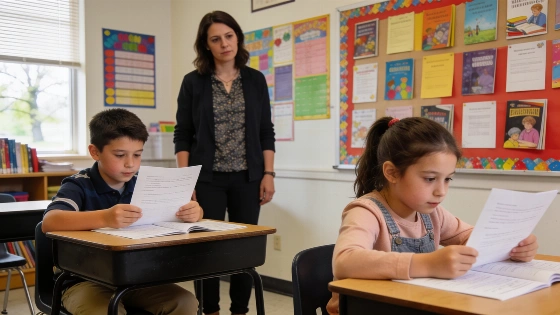
Just 38.2 percent of Michigan third graders scored proficient in English Language Arts on the 2026 M STEP, marking the lowest rate in recent years and raising concerns for families and educators across the state
Michigan's third grade reading proficiency has fallen to its lowest point in recent memory, with only 38.2 percent of students meeting English Language Arts standards on the 2026 M STEP. The latest results, released Friday, confirm a continued downward trend that is now drawing urgent attention from school leaders and parents statewide.
For families, the numbers are more than statistics-they reflect the reality facing students in classrooms from Detroit to the Upper Peninsula. The M STEP, or Michigan Student Test of Educational Progress, is administered each spring to public school students in grades three through seven for English and math, and to eighth and eleventh graders for additional subjects. This year's data shows proficiency rates slipping not just in third grade, but across multiple grade levels.
Statewide Scores and Local Impact
According to the Michigan Department of Education, third grade English Language Arts proficiency dropped from 38.9 percent in 2025 to 38.2 percent in 2026. The decline is not isolated-reading scores are down across grades three through seven, and math results show similar patterns in many districts. Eighth graders take the PSAT 8/9 for English and math, while science and social studies are assessed through the M STEP. High school juniors face the SAT, WIN Readiness Assessment, and additional M STEP subjects.
District-level results reveal significant variation. Some communities have managed to maintain or slightly improve scores, but many others are seeing declines that mirror the statewide average. The state has provided an online tool for parents and residents to look up their local district's performance in English and math, making it easier to compare results and identify areas of concern.
What the Numbers Mean for Michigan Schools
These results arrive as Michigan continues to invest in education initiatives, including a recent $150 million allocation for one-time educator bonuses. Despite these efforts, the proficiency rate for third graders has now reached a new low, raising questions about the effectiveness of current strategies. State Superintendent Michael Rice has publicly acknowledged the need for improvement, emphasizing that reversing the trend will require sustained focus and resources.
Literacy has become a central issue in Michigan's education policy debates. Governor Gretchen Whitmer has repeatedly pledged to boost reading outcomes, and the topic remains a flashpoint in statewide elections. The stakes are high: third grade reading proficiency is widely recognized as a key predictor of future academic success and graduation rates.
How to Access Local Test Results
Parents and community members can use the state's online lookup tool to review English and math scores for their local school district. The tool covers results for grades three through seven on the M STEP, as well as SAT scores for eleventh graders. Eighth grade students' performance on the PSAT 8/9 and M STEP science and social studies tests is also available. For a broader perspective on recent education trends, see the earlier breakdown of new college degree initiatives in Michigan.
Michigan's approach to standardized testing has evolved over the past decade, with the M STEP replacing older assessments and the state shifting to a mix of state and national exams at different grade levels. The Michigan Department of Education oversees the process, and results are used to inform policy, allocate resources, and identify schools in need of support. While the state continues to invest in teacher bonuses and literacy programs, the latest data underscores the scale of the challenge ahead. Without a clear turnaround, Michigan risks falling further behind national benchmarks, and the pressure on policymakers to deliver measurable improvement will only intensify.