A University of Michigan project uses eyewitness accounts from Russia's first two years of full-scale war to teach students about Ukraine, evidence and civic institutions.
In spring 2022, Ukrainian journalist and civic activist Nataliya Gumenyuk and colleagues from abroad began documenting testimony from Russia's invasion.
They founded The Reckoning Project: Ukraine Testifies as an international initiative. Work continued until an archive, a digital website and educational materials took shape.
The resulting textbook is free and multilingual. It uses accounts from the first two years of Russia's full-scale war to examine sovereignty. Other lessons address democracy and human rights. Separate material covers war crimes and genocide.
The project was developed with scholars from the University of Michigan. Geneviève Zubrzycki discussed it in an interview with Ukrinform. She is a professor of sociology at the university and director of the Weiser Center for Europe and Eurasia.
The intended audience is broad. Teachers and students can use the lessons, while readers with little knowledge of Ukraine can approach the material without closely following the war.
For educators in the Farmington area, the resource could connect international events with civic learning.
Adoption would remain a decision for individual educators and administrators, including staff working in Farmington Public Schools. It is not a program of the City of Farmington or the City of Farmington Hills. Local schools and governments hold different responsibilities. The Oakland County administration and the Michigan Department of Education provide broader public-sector context for regional education and civic programming.
Teachers assessing the material can compare its methodology, language availability and age appropriateness with their district policies. The Farmington Public Schools website is a local reference for district information. The City of Farmington and City of Farmington Hills remain relevant to community calendars and public programming, not curriculum approval.
The archive was built with courtroom use in mind.
Gumenyuk's team learned from lawyers how to gather evidence that could be presented to the International Criminal Court in The Hague or to Ukrainian courts. The team also worked with Ukraine's prosecutor general so journalistic testimony would not be rejected for failing to meet legal standards. That process sets the initiative apart from a conventional journalistic archive.
The records have since moved beyond the classroom. Reporting by the Ukrainian broadcaster 1+1 said testimony collected through the initiative helped support a case in Argentina by a Ukrainian citizen against Russian individuals accused of torture.
That reported use explains the project's focus on careful preservation, corroboration and chain-of-custody practices. Interviews are treated as evidence that may need to withstand legal scrutiny.
The materials are available at no cost through the project's website.
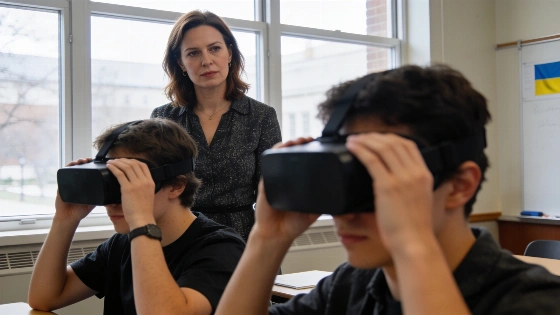
The platform includes virtual-reality tools intended to convey what people hear and see during bombardment. A map traces the advance of Russian forces. It also records Ukrainian resistance. A separate layer shows incidents of violence connected to the invasion.
The textbook has been translated into Ukrainian through cooperation with Taras Shevchenko National University of Kyiv. Russian editions are also available. Belarusian editions are available as well.
Polish and French editions are being prepared. Spanish and Portuguese translations are planned.
The multilingual format lets teachers use the same core material in different classrooms and national settings. It also reaches readers who encounter Ukraine through a language other than English. The content remains tied to testimony gathered during the war's first two years, rather than presenting a general history of the country.
For local educators, language access may matter when students and families bring different linguistic backgrounds into the classroom. Any use in Farmington schools would still have to follow district review procedures and applicable guidance from the Michigan Department of Education. The project does not replace local curriculum decisions.
Zubrzycki described the University of Michigan's collaboration with a Ukrainian nongovernmental organization as unique. The university also works with other Ukrainian organizations.
In December 2024, the university hosted a meeting of experts to prepare recommendations for Donald Trump's incoming administration.
The educational focus is deliberate. Zubrzycki said the project should reach young people whose worldviews are not yet fully formed, especially those with limited knowledge of Ukraine or the war.
The textbook treats the conflict as a regional event. It also presents the war as a case study in the institutions and rights that shape public life.
Classroom instruction is tied to a documented archive and courtroom standards. Interactive tools add another route into the material instead of leaving students with abstract summaries of the invasion. The project links testimony to evidence, then connects that evidence to civic concepts.
Its classroom value rests on the connection between lived experience and public education. The University of Michigan collaboration gives teachers material rooted in testimony and organized around sovereignty. Other sections address democracy and human rights.
Community readers placing the lessons in a local civic setting can separate the roles of schools from those of city governments. Farmington Public Schools handles district education. The City of Farmington and City of Farmington Hills handle municipal matters. County and state offices provide separate administrative oversight.