Line 5 carries up to 540,000 barrels of petroleum products daily and supplies more than half of Michigan's propane demand. Recent Wisconsin incidents have put the pipeline's safety record and oversight under fresh pressure.
At Enbridge's Superior Terminal, the company estimates that replacing Line 5's daily volume by road would send about 2,100 tanker trucks east across Michigan every day.
Line 5 carries up to 540,000 barrels of light crude oil, light synthetic crude oil and natural gas liquids each day. Enbridge says that volume would require the estimated 2,100 trucks to leave Superior and travel across Michigan.
That works out to about 90 trucks leaving the terminal every hour. The comparison shows the pipeline's practical role, but the estimate comes from Enbridge rather than an independent traffic study. It does not settle questions about pipeline safety or environmental risk.
What Line 5 carries
The products transported through Line 5 heat homes and businesses. They fuel vehicles. They also power industry in Michigan.
Enbridge says the pipeline supplies 65% of propane demand in the Upper Peninsula and 55% of statewide propane demand. Those figures give one piece of energy infrastructure a substantial supply role.
The effects reach beyond the pipeline's route and terminal locations. Households and farms rely on the fuel. Manufacturers and local emergency planners also face the consequences of how it moves.
For residents following energy and transportation issues from Farmington and Farmington Hills, the local questions involve how fuel reaches regional markets. They also involve how emergency agencies coordinate with pipeline operators and how public records document inspections and response planning.
The City of Farmington, City of Farmington Hills, Farmington Public Schools board and Oakland County administration are separate public bodies with different responsibilities. None of those municipal or school entities operates Line 5.
Designed for the Great Lakes
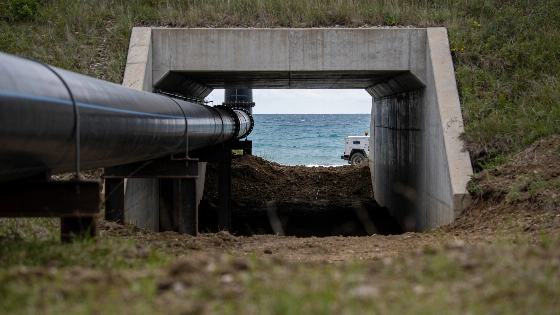
Line 5 was built in 1953 to remove oil-carrying tanker traffic from the Great Lakes. Its underground route also avoids moving the same products by truck or rail, which Enbridge says reduces roadway use and air emissions tied to those alternatives.
The Straits of Mackinac crossing has additional physical protections. Enbridge says the pipe has an enamel coating and walls at least 0.812 inches thick. The company says those walls are three times as thick as those of a typical pipeline.
The crossing was placed in an area where cold water and limited oxygen reduce the potential for corrosion. Those are company-described design features. They need to be weighed against regulatory inspections and incident records, along with independent environmental review.
Monitoring, maintenance and recent scrutiny
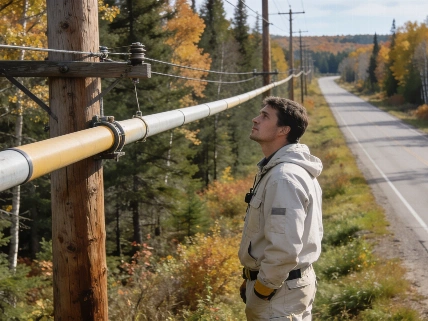
Enbridge says it has operated Line 5 for more than 65 years through regular inspections, maintenance and continuous system monitoring. The company also describes additional safety measures for the section crossing the Straits of Mackinac.
State departmental registries and environmental agencies provide a separate public-record framework for reviewing permits, enforcement actions and compliance information. That distinction matters because the available information is primarily an account of Enbridge's design and operating practices, rather than an independent assessment.
The company's stated safeguards explain how Line 5 is intended to operate. They do not remove the need for inspection and oversight.
Recent developments involving the Line 5 reroute in northern Wisconsin have sharpened that oversight question. A federal appellate ruling recognized that Enbridge continued to occupy portions of Bad River Band land unlawfully after easements covering roughly two miles expired. The ruling gave the company additional time to complete a bypass.
The dispute began with the tribe's 2019 lawsuit seeking to stop operation and remove the pipeline. Enbridge proposed a bypass in 2020. Wisconsin Public Radio's report describes the court-related status.
Enbridge is building an approximately 41-mile replacement route in Ashland and Iron counties. Tribal communities and environmental organizations oppose the project.
In October 2026, the company reported a water-bearing formation breach while installing a section beneath the Marengo River. Enbridge said it was monitoring and containing the flow with the Wisconsin Department of Natural Resources and engineering and environmental specialists.
The Wisconsin DNR had not confirmed the reported aquifer damage at the time of publication. Regional reporting on the reroute provides additional detail.
A separate August 25, 2026, incident near Saxon, Wisconsin, involved an unattended subcontractor truck that rolled into an open trench. The truck damaged an operating pipeline and released about 1.3 million gallons of natural gas liquids, or approximately 33,000 barrels, according to the available reporting.
Federal documents placed preliminary emergency-response, property-damage and environmental-restoration costs above $15.1 million. Bad River Band accused Enbridge of violating rules, including by constructing an unauthorized temporary bypass near Saxon, and asked the Wisconsin DNR to hold the company accountable. Those allegations and cost figures should be distinguished from independently adjudicated findings.
Michigan's infrastructure choice
Line 5's role sits within a broader question about how Michigan moves essential products while weighing infrastructure needs against environmental concerns. An earlier investment analysis examined how companies compare costs and site readiness when making Michigan investment decisions. The same analysis showed how infrastructure capacity can shape practical choices, even when the industries differ.
For Michigan households and businesses that rely on propane or other petroleum products, Line 5 currently carries a volume that would require thousands of daily truck trips if moved by road. Its six-decade operating history and added protections at the Straits form the basis of Enbridge's safety case. The system's scale and the Wisconsin incidents keep monitoring in focus.
Local officials and residents do not need to treat supply reliability and environmental accountability as mutually exclusive. City of Farmington and City of Farmington Hills public-meeting materials, Farmington Public Schools board records and Oakland County administration notices show how community institutions publish decisions within their own jurisdictions.
Pipeline oversight, however, rests primarily with state and federal regulators rather than local school or municipal governments. Up to 540,000 barrels a day move through buried infrastructure instead of an estimated 2,100 tanker trucks.