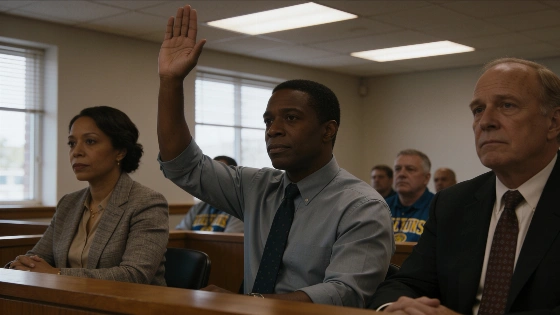
Michigan City's Common Council unanimously backed a union petition seeking more local utility workers, stronger training and public reporting after severe-weather outages hit three Northern Indiana counties.
Nearly 375,000 of NIPSCO's approximately 500,000 customers lost power after the Aug. 11 derecho, which hit LaPorte, Lake and Porter counties. The outage response now sits at the center of a Michigan City push for more permanent local utility workers.
Michigan City's Common Council unanimously approved a resolution supporting a petition from United Steelworkers Local Union 12775 District 7. The resolution asks state officials and utility regulators to examine whether Northern Indiana has enough frontline workers to handle outages.
It also calls for more training, local hiring and public reports on vacancies, restoration performance, contractor use and workforce investments. Mayor Angie Nelson Deuitch met with union representatives on Sept. 22, then signed the petition and helped move the resolution forward.
What the resolution requests
The petition is titled "Keep Utility Jobs Local: Strengthen NIPSCO Staffing, Reliability, and Storm Response for Northern Indiana." It seeks a permanent local workforce, expanded apprenticeships, stronger emergency planning and clearer information about how NIPSCO staffs its response to major outages.
Through the resolution, the Council called on Gov. Mike Braun, the Indiana General Assembly, the Indiana Utility Regulatory Commission and the Indiana Office of Utility Consumer Counselor to review staffing needs in Northern Indiana and set workforce-growth targets. It also asks those institutions to support apprenticeships, encourage local hiring and training, and make sure communities receive adequate utility service and emergency preparation.
The Council further urged the Indiana Utility Regulatory Commission to consider workforce levels and emergency readiness in proceedings that affect NIPSCO customers. The requested public reports would cover frontline staffing, vacancy rates, storm-restoration performance, contractor use and workforce-development spending.
Storm response drove the push
The Aug. 11 derecho damaged about 1,500 distribution poles and five high-voltage poles, according to NIPSCO. Thousands of trees also came down after heavy rain left the ground saturated. Indiana outage testimony later described the scale of the restoration work.
Some homes and businesses reportedly remained without electricity for as long as two weeks. On Sept. 29, an Indiana legislative interim committee continued reviewing NIPSCO's response and wider questions about electric-system reliability.
Staffing became a central issue at that hearing. NIPSCO union president Ryan Baker said the number of lineworkers fell from 233 in 2020 to 183 in 2026. He estimated that 50 more workers could provide about 800 hours of skilled labor each day.
NIPSCO Chief Operating Officer Vince Parisi said the company had prepared for the storm it expected. Weather forecasts repeatedly underestimated the storm's actual strength.
According to the City of Michigan City, the derecho showed why trained crews need to reach damaged utility systems quickly. The resolution recognizes mutual-aid crews as an emergency resource, but says outside help should add to a permanent workforce rather than replace workers who know local communities and infrastructure.
That request does not order NIPSCO to hire a set number of workers or create a new state rule. It asks regulators and state leaders to review staffing and preparedness while encouraging the utility to invest in local workers. U.S. Rep. Frank Mrvan has separately asked the Federal Energy Regulatory Commission to investigate NIPSCO's actions after the outage.
Michigan City's workforce programs
The utility proposal fits with workforce programs already operating in Michigan City. The city has hosted and funded two Indiana Plan classes for residents pursuing skilled-trades careers. It has also run an internship program that served more than 40 interns over the past two and a half years and partnered with Goodwill Industries on a re-entry program.
Several people from the first internship group later became full-time city employees. Mayor Angie Nelson Deuitch linked that result to the utility petition, saying training and employment programs can help build the workforce needed to maintain essential services.
The resolution is not a rate decision, construction approval or binding staffing order. It is a public-policy statement that sends the union's requests to state officials and utility oversight agencies. Certified copies will go to Gov. Mike Braun, State Sen. Rodney Pol Jr., State Rep. Randy Novak, legislative leaders, the Indiana Utility Regulatory Commission, the Indiana Office of Utility Consumer Counselor and USW Local Union 12775 District 7.
The workforce debate comes alongside other utility-planning disputes in Indiana. Saginaw's requirements tied to a Google power deal were detailed in an earlier utility report. Michigan City's resolution addresses a different question: whether utilities have enough trained people available when infrastructure breaks down.
Other regional systems are reviewing their emergency plans as well. After the derecho, South Shore Line began planning a backup dispatch center, more generators and stronger backup power systems. The railroad also brought in a supplier with 150 generators to help keep service running during the outage. South Shore Line planning shows how a utility failure can affect transportation and other essential services.
What happens next
The resolution asks state lawmakers and regulators to act, but the available record sets no deadline for those agencies and includes no staffing commitment from NIPSCO. For now, the concrete result is the Council's unanimous endorsement and distribution of the certified resolution.
The document ties emergency readiness to apprenticeships, local hiring and public reporting. Any change in staffing will depend on decisions by NIPSCO, state officials and utility regulators.