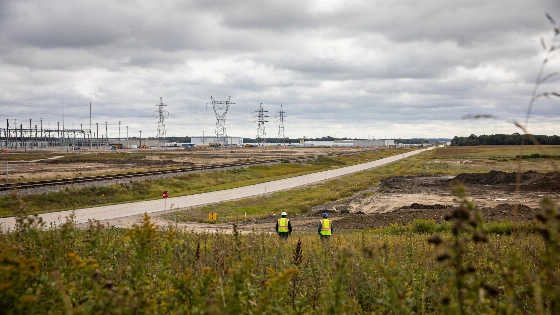
Project materials describe the Michigan Advanced Manufacturing District near Flint as a large, utility-ready industrial site. Public search results do not independently verify its acreage, infrastructure capacity, state funding, construction status or future tenants.
Project materials place the proposed Michigan Advanced Manufacturing District in Mundy Township near Flint on about 1,300 contiguous acres, with plans to grow beyond 1,400 acres. Those figures come from the material reviewed for this report. Available search results did not provide an independently verifiable municipal or state record confirming the current acreage.
The same material describes a site built to support more than one gigawatt of electricity demand and about 6.0 billion cubic feet of annual natural-gas use. That would make AMD one of the region's most ambitious industrial-site concepts. The figures remain planned or reported capacity, not proof of an operating manufacturing campus. No independently verifiable result found for this update confirms that the proposed demand has been contracted, delivered or placed into service.
Readiness as a competitive edge
AMD has been presented as site-certified through the Michigan Economic Development Corporation's MI Sites program. The project material also says it secured nearly $260 million through the Michigan Strategic Fund. Available search results did not independently confirm the certification, the funding amount, the dates of any approvals or whether new Michigan Strategic Fund decisions have been issued since the original material was published. Official state meeting records and departmental registries would be needed to treat those points as current project status.
The district has also been described as having rail service, access to seven freeway interchanges along I-75 and I-69, proximity to Bishop International Airport and water capacity of about 64 million gallons per day. The property is said to use an overlay-zoning structure that would preserve it for advanced manufacturing and high-technology investment. The available results do not establish when the land was acquired, when any overlay was adopted or whether the reported water and transportation capacity is available to a tenant now.
Because the project sits in Genesee County, local checks would normally include records from Mundy Township, county agencies and the relevant state economic-development bodies. The Genesee County government portal provides a municipal and county contact point. Its availability does not confirm AMD's acreage, zoning, infrastructure commitments or financing.
Tyler Rossmaessler and the Flint & Genesee Economic Alliance are identified in the original material as advocates for the district's development strategy. The available search results for this update did not include independent official statements from Rossmaessler, the alliance, the Michigan Economic Development Corporation or Mundy Township. That absence does not show that no statements or records exist. It means the claims still need support from primary documents.
The distinction matters as manufacturers weigh domestic production, supply-chain resilience, reshoring and nearshoring. A site with land control, utility planning, transportation links and a development framework can let a company move from evaluation toward execution without starting every approval and infrastructure question from scratch. It does not mean a tenant has selected the site or that construction will begin.
Power capacity comes with cost questions
Consumers Energy has been described as working with the Flint & Genesee Economic Alliance and state leaders to position AMD for large industrial users. The utility's economic-development programs are presented as ways to address energy efficiency, operating costs and sustainability. Available power is only one part of a manufacturer's location decision, and the search materials supplied for this rewrite did not independently verify a project-specific utility agreement.
Consumers Energy's economic-development rate has been described as available to customers whose energy demand exceeds 35 megawatts. The program is intended to help large users manage electricity costs while the utility works with companies through site evaluation, facility design, operations and future expansion. Any use of that rate by AMD would depend on the utility's review and on a qualifying customer or project.
Lindsey McGuirk, identified in the original material as Consumers Energy's Director of External Engagement, Growth, is also described as connecting businesses with energy engineers early in development. That coordination can shape facility design, improve efficiency and identify ways to cut long-term energy costs before construction decisions are fixed. The available results did not independently confirm a current project schedule or utility construction milestone.
The district's energy profile is unusually specific: more than one gigawatt of planned electricity capacity and about 6.0 billion cubic feet of annual natural-gas consumption. Those figures describe what AMD has been positioned to support in the project description, not a manufacturing operation already running at that scale. They do not prove that the region has assigned or built the full capacity.
Workforce reaches beyond Genesee County
Large industrial projects also need workers after a facility opens. AMD is described as being near the University of Michigan-Flint, Kettering University and Mott Community College, and within commuting distance of Michigan State University, the University of Michigan and Wayne State University. These institutions provide regional context, but the available materials do not document a signed workforce agreement or a specific employer training program for AMD.
The Flint region's labor reach extends across central and southeastern Michigan, including Detroit, Ann Arbor, Lansing and Saginaw. The original material argues that skilled workers, education partners and manufacturing experience give companies a basis for long-term hiring and growth. That is a site-selection argument, not evidence that a particular company has committed jobs to the district.
For a Farmington Voice audience, the project also shows why regional economic-development claims need to be separated from confirmed public actions. Records from the State of Michigan, the Michigan Economic Development Corporation and the Michigan Strategic Fund can establish approvals and funding. Township planning documents can establish zoning, while county or utility records can establish infrastructure work. None of the available search results supplied for this rewrite established a new investor, a construction start or a change in the district's reported size.
That workforce argument sits alongside the physical infrastructure rather than replacing it. Rail, highways, airport access, water service, power capacity, natural-gas supply and zoning address different parts of the same site-selection decision. For employers, the value is in considering those pieces together before a project arrives. For residents, the questions include traffic, water demand, land use, public cost and the timing of any construction.
Preparation survives individual setbacks
AMD's preparation could create a long-term economic-development asset even if a particular project does not move forward. The original material says each pursuit strengthens the region's position because work completed on the property remains available for the next opportunity. Whether that preparation has produced completed infrastructure or only a development framework remains a question for official records.
That approach connects with Michigan's broader effort to attract suppliers and advanced manufacturers. The state's earlier supplier initiative similarly links industrial growth with capital, buyers and workforce support. AMD focuses on the physical platform where a major operation could be built.
The district is therefore described in the project strategy as more than available land. It is a coordinated site-development effort involving state financing, local economic development, utility planning, transportation links, zoning and higher-education access. The available evidence still supports calling it a proposed or marketed industrial platform, not a confirmed operating district.
For site selectors and manufacturers, that coordination is the central promise. Michigan's Advanced Manufacturing District has been presented as a Flint-region industrial platform with the scale, energy planning and workforce connections that large projects demand. Based on the records available for this update, it does not guarantee a tenant, a finished plant, a construction start or delivery of the reported utility capacity. AMD may be a significant economic-development opportunity, but its headline figures and current status still require confirmation through official Mundy Township, Genesee County, Michigan Strategic Fund, MEDC and utility records.