
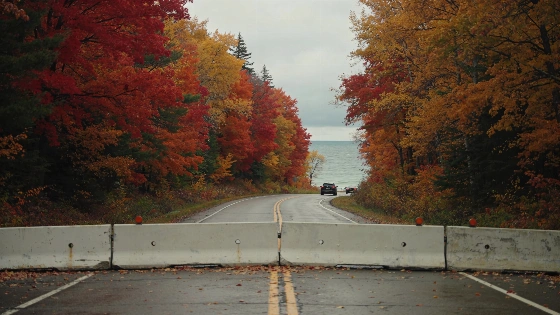
Fall color is extending the 2026 travel season across New York, Colorado and Michigan. Travelers must check road access, elevation forecasts and vehicle rules before leaving.
Michigan's M-119 Tunnel of Trees is drawing autumn travelers despite flood repairs near Division Road and Devil's Elbow. The route is not fully open.
Those restrictions are part of a wider pattern across New York, Colorado and Michigan. Tourism agencies and transportation departments report different color windows along mountain roads, forest routes and Great Lakes shorelines.
The season fills the gap between summer tourism and winter recreation. It also demands route checks before departure.
Michigan routes face lasting closures
The M-119 Tunnel of Trees runs between Harbor Springs and Cross Village along Lake Michigan. It remains a major Midwest leaf-peeping route.
The Michigan Department of Transportation spent $1.1 million in 2026 on protective chip seal across 20 miles of the scenic byway. Severe flooding earlier this year still limits through traffic.
MDOT's North Region update says the M-119 section near West Stutsmanville Road has reopened after repairs. The spring-flood-damaged section needed $300,000 in slope stabilization. At least two other restrictions remain in place. Travelers should check the MDOT North Region update before leaving.
Drivers still face detours near Division Road and Devil's Elbow. The Division Road closure is expected to continue into summer 2027. Travelers heading toward Cross Village must follow local detour signs around both closed sections.
Some parts of M-119 remain open. The 2026 route cannot be treated as one continuous drive.
Michigan has approximately 19 million acres of forest. State parks managed by the Michigan Department of Natural Resources receive roughly 38 million visits each year.
Tourism produced a $54.8 billion economic impact in 2024 and supported about one in every 17 jobs statewide. Fall road travel matters well beyond weekend recreation.
For Farmington Voice readers planning a long-distance trip, civic notices and highway information come from different agencies. The City of Farmington, City of Farmington Hills, Farmington Public Schools Board of Education and Oakland County administration each keep their own public notices and calendars.
The City of Farmington portal can help residents find municipal updates. Road conditions on the Tunnel of Trees remain the responsibility of state and local transportation authorities.
Adirondack color changes by elevation
New York's Adirondack region offers the longest viewing window because color changes at different elevations. In the official report for September 23-29, 2026, Whiteface Mountain in Wilmington had reached 55% color change and was near peak.
Tupper Lake and Mt. Arab stood at 50% to 55%. Benson reached 50%. Newcomb, Long Lake and Old Forge were among the communities expected to see some of the clearest changes during that period.
Lake Placid stood at 25% color change in the same report. The gap lets visitors move between higher mountain roads and lower lake valleys as the season advances across the 6-million-acre Adirondack Park.
Elevation changes everything.
The Adirondack Park is the largest publicly protected wilderness area in the contiguous United States. Its fall peak does not arrive on one date across the entire region.
New York recorded 321.2 million visitors in 2025. Those travelers generated $97.6 billion in direct spending and a total economic impact of $152.7 billion.
Adirondack visitor spending reached nearly $2.6 billion in 2025, up 2.8% from the prior year. Tourism accounted for 18.7% of regional employment.
Warren County produced $956.6 million in visitor spending, including $481.6 million in lodging revenue. Venues operated by the Olympic Regional Development Authority in Lake Placid recorded more than 1.2 million visits during the 2025-26 fiscal year.
Those numbers matter after the summer rush. Lodging operators, retailers and attractions depend on the fall period.
Colorado offers a shorter mountain window
Colorado's foliage season is shorter because of altitude. Colorado Department of Transportation guidance places the expected peak in central mountain corridors between 8,000 and 9,500 feet in mid-to-late September.
Areas above 9,500 feet change earlier. Summer drought conditions sped up leaf change in some valleys.
Reuters reported that peak color in Colorado was already underway or approaching. An expert identified as "Mr. Aspen" cautioned that the season could be less vivid than the previous two years.
For northern Colorado mountain areas, the third week of September was identified as a peak period.
Around Aspen, traffic builds on roads to Maroon Bells and Independence Pass. Maroon Bells is about 10 miles west of Aspen and requires shuttle bus reservations.
Independence Pass reaches 12,095 feet. Colorado prohibits vehicles or vehicle-and-trailer combinations longer than 35 feet because of narrow lanes and switchback turns.
The window is short.
Colorado has 26 designated scenic byways. The Colorado Department of Transportation recommends travel from Tuesday through Thursday.
The state recorded 96.8 million visitors in 2025. They generated $29.2 billion in traveler spending. That makes the fall corridor a major transportation and visitor-management challenge, even during a season shorter than New York's.
Air links support fly-drive trips
Commercial flights give long-distance travelers access to all three foliage regions. Adirondack Regional Airport in Saranac Lake offers daily Cape Air flights to Boston Logan and New York JFK.
Aspen/Pitkin County Airport is served by American Airlines, Delta Air Lines and United Airlines. Seasonal connections run through Denver, Dallas/Fort Worth, Chicago and Los Angeles.
Pellston Regional Airport in Emmet County provides daily Delta Connection service to Detroit Metropolitan Airport. The route helps travelers reach the Tunnel of Trees.
Air travel helps. It does not remove the need to check road conditions, vehicle limits or active detours.
The foliage calendar is not one national event with a single reliable peak date. New York's high elevations were near peak in late September, while lower Adirondack communities were still developing color.
Colorado's high-altitude corridors were reaching peak color earlier. Michigan's color was moving south from the Upper Peninsula.
The strongest travel plan follows geography more than the calendar. Verify the intended route. Check restrictions before taking a mountain vehicle. Reserve the Maroon Bells shuttle.
Do not assume a scenic highway is fully open.
For local communities, the 2026 season brings measurable spending and jobs. It also puts pressure on the roads and passes that carry visitors to the fall color.
New York, Colorado and Michigan are turning a short seasonal attraction into a substantial travel period. Infrastructure details now shape the trip as much as the leaves do.
The best 2026 foliage trip will rely on elevation forecasts and confirmed access, not a fixed date or a famous route name. Active closures and vehicle rules define the experience.