Colds, COVID-19, RSV and stomach bugs are circulating as Michigan health officials track a confirmed measles outbreak and prepare for flu season. A new poll asks parents which part of sick season is hardest to manage.
A Michigan health update dated March 19, 2026, lists a confirmed measles outbreak in Washtenaw County. It does not identify Farmington or Farmington Hills. Families also face the usual school-year spread of colds, COVID-19, RSV and stomach bugs.
These illnesses can disrupt classes, work schedules and household plans. Health officials are also preparing for flu season.
The real question is practical. Which part of sick season puts the most pressure on families trying to care for a child and keep up with school?
The illnesses families are watching
The school year often brings more common illnesses among children. This season includes several familiar concerns at once. Respiratory infections such as colds, COVID-19 and RSV can move through homes, as can stomach bugs.
Measles is also on the health watch list. The Michigan measles update records the confirmed outbreak in Washtenaw County on March 19, 2026. It does not place the outbreak in Farmington or Farmington Hills.
Families should check current case information from the Michigan Department of Health and Human Services. A statewide alert does not prove that illness is spreading locally.
The national numbers explain why families are paying attention. The CDC reported 3,887 confirmed measles cases in the United States as of October 1, 2026. Of those cases, 95% were associated with outbreaks. Michigan was among the affected jurisdictions.
The agency also reported 42 new outbreaks during 2026. Those numbers do not show that a particular Farmington-area school has an outbreak. They do make vaccination status and timely public-health guidance important topics for families.
Flu activity remains low nationally, but it is rising. In its week 38 surveillance report, the CDC listed 31,513 laboratory-confirmed influenza hospitalizations in FluSurv-NET from October 1, 2025, through September 26, 2026.
That is a national surveillance figure. It is not a count of hospitalizations in Oakland County or Farmington.
Preparation is the immediate task
Doctors and public-health agencies generally describe preparation in practical terms. Parents cannot keep every illness out of a classroom. They can review routine immunizations, ask health-care providers about seasonal vaccines and keep basic supplies at home.
Families also need a plan for care when a child becomes ill. Small steps help.
For families connected to Farmington Public Schools, attendance questions should go through the district's current policies and the child's school. Farmington and Farmington Hills are separate municipalities. Residents should distinguish city information from guidance issued by Oakland County or the State of Michigan.
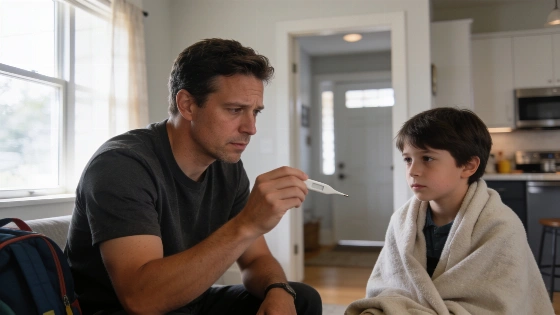
When a child gets sick, the problem reaches beyond the child's comfort. Families may need to arrange care, manage transportation and adjust work schedules while handling school routines.
The supplied information does not specify attendance rules, exclusion periods or treatment plans. Those details should not be assumed.
Families examining the link between illness and school participation can read this earlier attendance report. It provides separate context on missed school days in Michigan.
Statewide attendance data show why the issue still matters. According to Reuters, overall Michigan school attendance rose to 91.5% in the 2025-26 school year. Chronic absenteeism fell to 27.2%, which was a fourth consecutive improvement.
The same report said chronic absenteeism in Detroit Public Schools Community District was 60%. That figure was five percentage points lower than two years earlier.
Those statewide and Detroit numbers cannot describe Farmington Public Schools. They do show how health, transportation, family circumstances and school engagement can overlap.
What parents are being asked
The poll asks parents to identify the hardest part of keeping children healthy during sick season. Some may point to recurring illnesses. Others may focus on what happens when a child gets sick or on the strain that health needs place on school and household responsibilities.
The poll itself is the point. Families are being asked to define the problem in their own terms.
The timing gives the question a clear purpose. The school year is underway. A confirmed measles outbreak has been identified elsewhere in Michigan. Measles activity is being tracked nationally, and flu season is ahead.
Families have reason to assess what they need before illness disrupts the routine.
Sick season cannot be reduced to one warning. It also cannot be avoided entirely. Families need current information and realistic plans while the Michigan Department of Health and Human Services, Oakland County administration and local school officials monitor conditions.
The Farmington Public Schools board and individual schools can provide local operational information. Medical decisions should be discussed with a qualified health-care professional.
The poll should keep attention on the problems parents actually face. There is no simple way to keep every child healthy.
For families in Farmington and nearby communities, preparation may mean finding backup child care, planning for missed school and work or checking immunization records. It may also mean deciding how the household will respond when the next fever, cough or stomach bug arrives.