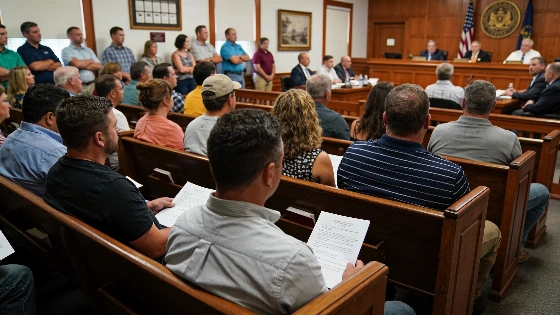
More than 150 residents gathered at the Hayneville courthouse to demand answers from county officials about the proposed 800-acre Project Red Clay data center, which has requested enough power for one million homes and raised concerns over local oversight
More than 150 residents of Lowndes County, Alabama, assembled at the Hayneville courthouse this week to call for greater transparency from county commissioners regarding Project Red Clay, a proposed hyperscale data center that would be among the largest in the state. The meeting drew residents living near the planned 800-acre site, many of whom expressed frustration over a lack of information about the project's impact on their community.
Project Red Clay has requested 1,500 megawatts of energy capacity from Alabama Power, a figure equivalent to the electricity needs of roughly one million homes. For context, Alabama has about two million households statewide. The project's scale and potential effects on local infrastructure have prompted residents to organize through the group Protect Lowndes County, which has gathered approximately 350 signatures on a petition demanding more openness from county officials.
Residents Seek Answers on Project Details
During the commission meeting, a representative of Protect Lowndes County read the group's petition, which calls for the release of public records, disclosure of all entities involved, and the creation of an online dashboard to keep residents informed. Despite these requests, county commissioners stated they had no new information to share at this time.
Developers of Project Red Clay issued a statement confirming that a new LLC, Sandstone Cliffs DevCo, has been established to oversee the initial phases of the project. The LLC is owned by Cloverleaf, which is responsible for its operations. However, the developers declined to identify the future operator of the data center, citing an unfinished agreement. The estimated development cost for the project is at least $1.5 billion.
Calls for Planning and Zoning Authority
Ryan Anderson, a staff attorney with the Southern Environmental Law Center, addressed the commission to remind officials of their legal obligations regarding public records. Anderson emphasized that transparency is not optional and is essential for public trust, especially for a project of this magnitude. After initially being cut off due to time limits, Anderson was allowed to finish her remarks following a motion from the commission's vice chair.
Anderson also noted that the lack of county planning or zoning authority enabled Cloverleaf to purchase land and begin development without local oversight, a situation common in many Alabama counties. In response, Commissioner Robert Harris introduced a resolution supporting legislation to grant Lowndes County planning and zoning powers. The resolution passed unanimously.
Community Organizing and Broader Context
Other residents, including Negatha Holt, encouraged the community to remain engaged and resist apathy, pointing out that local opposition has delayed or blocked billions of dollars in data center projects nationwide since May 2024. The debate over data centers has become a prominent issue in Alabama's upcoming midterm elections, with Democrats advocating for a one-year moratorium and Republicans highlighting potential economic benefits.
The Association of County Commissions of Alabama recently passed a resolution supporting a comprehensive approach to land use authorization, rather than industry-specific measures. Executive Director Sonny Brasfield stated that counties need broader authority to manage growth in unincorporated areas effectively.
As local governments across the country grapple with the challenges of large-scale data projects, experts have stressed the importance of prioritizing privacy, security, and accountability. For example, recent guidance on government data sharing, as discussed in a related Farmington Voice report, highlights the need for robust safeguards to maintain public trust.
Project Red Clay's future remains uncertain as residents continue to push for transparency and local officials consider new planning and zoning measures. The outcome could shape how similar developments are handled in Alabama and beyond.