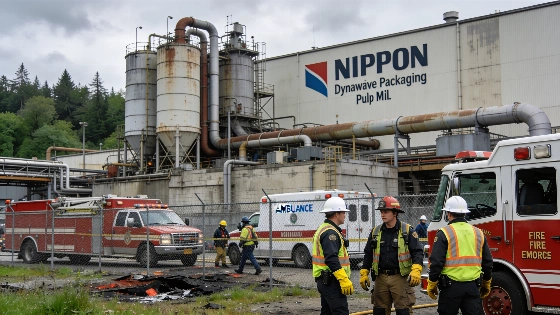
A chemical tank collapse at Nippon Dynawave Packaging in Longview, Washington killed 11 workers in May. State and federal records show the mill had a long record of safety complaints, equipment failures and toxic chemical releases before the tragedy.
When a chemical tank failed at Nippon Dynawave Packaging in Longview, Washington this May, killing 11 workers, it was not an isolated incident. State and federal records reveal the mill had been cited for dozens of safety and environmental violations over the past decade, raising questions about why the risks were allowed to accumulate until disaster struck.
Investigators found that the company continued to use a tank it knew was "not fit for continued service," according to a recent report from the U.S. Chemical and Safety Board. The collapse released a caustic liquid known as white liquor, causing severe injuries and deaths as workers began their shifts. The tragedy stands as one of the deadliest workplace accidents in the United States in recent decades.
Years of warnings and violations
State agencies had repeatedly flagged the Longview mill for safety lapses and environmental hazards. Since 2016, the Washington Department of Ecology issued 54 violation notices and fined the company $41,500 for eight serious environmental breaches. The Department of Labor and Industries investigated more than a dozen safety complaints since 2018, imposing nearly $7,000 in fines for violations ranging from equipment failures to hazardous chemical exposure.
Workers at the 530-employee facility filed complaints about broken valves, leaking tanks, and dangerous fumes. In one case, an ammonia tank valve was left open because its handle was detached, exposing delivery drivers to toxic air and creating a risk of explosion. The state fined the company $2,890 for failing to inspect and maintain pipes and valves, the highest penalty imposed on the plant in a decade.
Repeated chemical releases and equipment failures
Beyond the fatal tank collapse, the mill has a documented history of chemical leaks and equipment breakdowns. Between 2017 and 2023, the U.S. Environmental Protection Agency's National Response Center received eight reports of methyl mercaptan releases from the plant, including one incident that hospitalized a nearby resident. The facility was also fined $4,500 in 2024 for excessive sulfur dioxide emissions after residents complained of noxious odors that made them sick and forced them indoors.
Other incidents included a 2020 black liquor spill of 250,000 gallons, chlorine leaks in 2021 and 2024, and a 2021 white liquor release that overflowed containment and entered a storm drain. Fire investigators blamed old equipment for a 2023 fire involving a conveyor belt and wood chip piles, echoing worker complaints about aging, poorly maintained machinery.
Injuries, lawsuits and ongoing investigations
Since 2015, more than $2.4 million in workers' compensation claims have been paid for 169 employees injured on the job at the Longview mill, including cases involving caustic chemical exposure. The mother of two brothers killed in the May disaster has filed a wrongful-death lawsuit, alleging the company failed to maintain equipment, train staff, and implement emergency procedures.
State labor officials had planned to interview workers about two separate safety complaints the very week the tank collapsed. One involved a worker who fell chest-deep into a sinkhole filled with hot stock while trying to fix a stuck valve-a problem that had persisted for months. Both investigations remain open as authorities continue to examine the plant's safety culture and maintenance practices.
What happens next for the Longview community
The Nippon Dynawave Packaging mill produces pulp for paper goods and remains a major employer in Longview. The company says it is cooperating with state and federal regulators as investigations continue, but has declined to comment on specific findings about maintenance and equipment failures. For residents and workers, the disaster has brought renewed scrutiny to industrial safety standards and the effectiveness of regulatory oversight in preventing preventable tragedies.
State and federal agencies are expected to release further findings in the coming months. The outcome will determine whether the mill faces additional penalties, operational changes, or new requirements to protect workers and the surrounding community from future harm.
Washington's regulatory system flagged the warning signs at Nippon Dynawave Packaging for years, but enforcement actions and fines failed to prevent catastrophe. The Longview disaster is a stark reminder that persistent safety violations and neglected maintenance can have fatal consequences, and that oversight must be matched by real accountability if similar tragedies are to be avoided elsewhere.