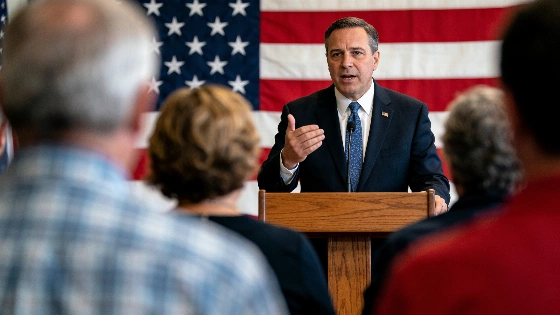
Vice President JD Vance visited Sterling Heights to support Michigan Republican candidates and challenge Democratic Senate nominee Abdul El-Sayed, as the state's high-profile Senate race intensifies ahead of the 2026 midterms
Vice President JD Vance returned to Michigan on Monday, making his fourth visit in two years to campaign for Republican candidates and urge party unity ahead of the 2026 midterm elections. Speaking in Sterling Heights, Vance emphasized the importance of winning Michigan's open U.S. Senate seat and framed the contest as a critical choice for voters.
Vance was joined by several GOP candidates, including U.S. Senate nominee Mike Rogers and gubernatorial candidate John James. The event focused heavily on the Senate race between Rogers and Democratic nominee Abdul El-Sayed, with Vance and others repeatedly referencing El-Sayed's recent public statements and policy positions.
Senate Race and Candidate Tensions
Throughout his remarks, Vance criticized El-Sayed for comments made after the March attack on West Bloomfield's Temple Israel, suggesting El-Sayed showed selective compassion based on religious affiliation. El-Sayed had issued a statement condemning the attack but included the phrase "hurt people hurt people," which drew criticism from some Jewish Democrats, including Michigan Attorney General Dana Nessel. El-Sayed later apologized at the Democratic Party's nominating convention in Lansing, clarifying his intent and responding to Vance's characterization of him as "evil."
The campaign rhetoric escalated further when Vance and Rogers addressed comments El-Sayed made about Vance's wife, questioning whether Vance's white grandfather would have approved of their interracial marriage. Vance responded by telling the crowd that such personal remarks were inappropriate and urged El-Sayed to avoid involving his family in political discourse.
Policy Focus: Trucking and Public Safety
Vance and U.S. Transportation Secretary Sean Duffy also highlighted a recent federal crackdown on fraudulent trucking schools, which resulted in the closure of more than 100 institutions nationwide. At a Detroit press conference earlier in the day, Duffy alleged that some schools allowed individuals to pass commercial driver's license tests without sufficient English proficiency or training. The Department of Transportation is now moving to close an additional 160 schools for similar violations. Vance argued that ensuring truck drivers are legal residents with adequate qualifications is essential for public safety on American roads.
During his visit, Vance did not address rising gas prices or affordability issues, topics he had discussed in previous Michigan appearances. According to AAA, the average price of gasoline in Michigan increased from $3.87 per gallon in March 2025 to $4.15 as of Monday. In March, Vance had told voters that high gas prices were likely temporary, focusing instead on economic growth and job creation in the state.
Republican Campaign Strategy
The Sterling Heights event also served as a platform for other Republican candidates, including attorney general hopeful Doug Lloyd and congressional candidate Mike Bouchard Jr. Lloyd, currently Eaton County prosecutor, positioned himself as a nonpartisan advocate for "fair law, not lawfare," and called for an end to politically motivated legal actions. State House Speaker Matt Hall and U.S. Rep. Lisa McClain were also present, promoting Republican efforts to reduce taxes and increase public safety.
While Vance did not address the issue of data centers in his prepared remarks, the topic has become increasingly relevant for Michigan voters. President Donald Trump, in contrast, used social media to encourage communities to support data center development, arguing it would bring jobs and lower taxes. Vance, speaking to reporters before the event, noted that most opposition to data centers arises when local utility bills increase, suggesting that controversy is tied to direct resident impact.
Context and Next Steps
With just over two months until the November 2026 midterm elections, Michigan's Senate race remains one of the most closely watched contests in the country. The outcome will help determine control of the U.S. Senate and could influence national policy on issues ranging from transportation to economic development. For more on the dynamics shaping the Rogers-El-Sayed contest, see this recent analysis of key issues in the Michigan Senate race.
Michigan's political landscape continues to evolve as both parties mobilize supporters and sharpen their campaign messages. The coming weeks are expected to bring further candidate visits, policy announcements, and debates as voters prepare to make their choices in November.