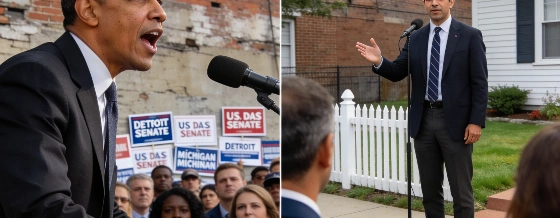
Michigan's open U.S. Senate seat has sparked a high-stakes contest between Mike Rogers and Abdul El-Sayed, with voters focused on health care, affordability, and the candidates' ties to national figures ahead of the November election
Michigan voters are preparing to choose a new U.S. Senator this November, as Republican Mike Rogers and Democrat Abdul El-Sayed face off in one of the nation's most closely watched races. The contest will determine who replaces retiring Senator Gary Peters and could influence which party controls the Senate in 2027. Both candidates bring sharply contrasting records and policy priorities, and their backgrounds and associations with national political figures are drawing significant attention.
As the campaign intensifies, issues such as health care, economic pressures, housing, and the candidates' positions on former President Donald Trump have emerged as central topics. The outcome is expected to have lasting effects on Michigan's representation in Washington and on key federal policies affecting the state.
Economic Pressures and Housing
Affordability remains a top concern for Michigan families, with rising costs for groceries, rent, and child care outpacing wage growth. Michigan's median household income continues to lag behind the national average, and many residents are feeling the strain of inflation and a tight job market.
Abdul El-Sayed has proposed expanding support for union membership, increasing investment in research and development, and enforcing anti-monopoly laws. He supports eliminating corporate tax breaks and introducing a wealth tax on the highest earners, similar to policies championed by U.S. Senator Bernie Sanders. El-Sayed also calls for lower utility costs and more assistance for homes and businesses affected by power outages. On housing, he advocates for a nationwide "building boom" of affordable homes and stronger protections against unfair evictions and speculative investors.
Mike Rogers, meanwhile, is focused on tax cuts for working families and revitalizing Michigan's manufacturing sector. He has called for shop classes in every high school and argues that Democratic policies have contributed to higher energy costs through increased regulation. In February, Rogers announced a housing plan that would allow tax-free withdrawals from 529 college savings accounts for first-time homebuyers, reduce housing regulations, and offer new incentives for builders.
The Trump Factor and Political Alignments
Both candidates' relationships with national political figures are shaping the race. Rogers has closely aligned himself with Donald Trump, promising to support the former president's agenda and echoing some of Trump's disputed claims about the 2020 election. This approach helped Rogers maintain support among Republican voters during the primary, but it remains to be seen how it will play with the broader electorate in November.
El-Sayed, a progressive Democrat, has drawn support from figures like Bernie Sanders but faces challenges uniting the party after a contentious primary. Outside spending has played a significant role, with groups backing Rogers pledging more than $45 million for the general election. El-Sayed has criticized the influence of special interest money, especially after being heavily outspent in the primary by groups supporting his Democratic rival.
For more on how campaign claims and attacks have escalated in recent weeks, see this recent fact check on campaign rhetoric from Farmington Voice.
Healthcare and Insurance Costs
Healthcare policy is a major dividing line in the race. El-Sayed supports moving beyond the Affordable Care Act to a single-payer "Medicare for All" system, guaranteeing health coverage for all U.S. residents. He has said he would allow workers to keep supplemental private insurance through unions or employers. Critics argue that such a system could require tax increases and potentially reduce access to care, while some unions have expressed concern about losing negotiated health benefits.
Rogers opposes single-payer healthcare and has called for expanding the TrumpRx program to lower prescription drug costs. He supports penalties for providers and insurers that fail to disclose prices or deny coverage excessively. Rogers voted against the Affordable Care Act while in Congress and has opposed extending enhanced premium tax credits for marketplace insurance plans.
Data Centers, Technology, and Regulation
The construction of a $56 billion data center complex in Saline and similar projects across Michigan have brought technology policy into the spotlight. El-Sayed has called for public ownership of artificial intelligence and wants to regulate AI firms like public utilities, proposing binding agreements to keep electric rates down and ensure compliance with clean energy laws. He also supports penalties for developers and utilities that fail to meet these standards.
Rogers has taken a more cautious approach, suggesting a one-year moratorium on new data centers to allow time for public questions and regulatory review. He has emphasized the need to balance economic development with community concerns about energy use and environmental impact.
Money in Politics and Special Interests
Campaign finance has been a flashpoint throughout the race. El-Sayed has made reducing the influence of money in politics a central theme, pointing to the outsized spending by outside groups in both the primary and general elections. He has also criticized the role of organizations like the American Israel Public Affairs Committee (AIPAC), which spent heavily in support of his primary opponent. This stance has complicated his efforts to win over some Jewish Democrats, who have expressed concern about his rhetoric regarding Israel and AIPAC.
Rogers has faced scrutiny over his post-congressional work in the private sector, with El-Sayed alleging that he profited from relationships built during his time in Washington. Rogers has denied these claims and pushed back against being labeled a "pharma lobbyist."
Israel, the Middle East, and Immigration
Foreign policy and immigration have also become contentious issues. Rogers has launched a "Democrats for Mike Rogers" coalition to attract voters concerned about El-Sayed's positions on Israel and the Middle East. Some Republican attacks have focused on El-Sayed's Muslim faith and Egyptian heritage, which El-Sayed has publicly addressed, emphasizing his commitment to representing all Michiganders.
On immigration, El-Sayed has called for abolishing the Immigration and Customs Enforcement (ICE) agency, citing concerns about aggressive enforcement tactics. Rogers, a former FBI agent, supports Trump's immigration policies and has criticized ongoing debates over Department of Homeland Security funding.
The Michigan Senate race is expected to remain highly competitive through November, with both candidates working to broaden their appeal beyond their party bases. The outcome will have significant implications for Michigan's role in federal policy and the balance of power in the U.S. Senate.
Michigan's U.S. Senate seat is one of the most consequential races in the country this year. The winner will help shape national policy on health care, economic development, technology, and immigration. Voters can expect continued debate on these issues as the campaign heads into its final months.