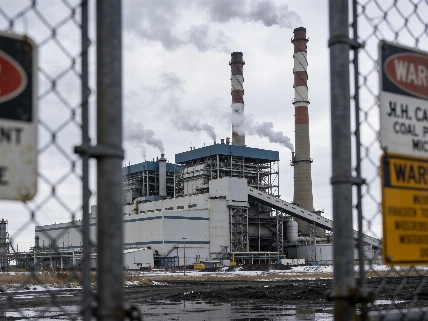
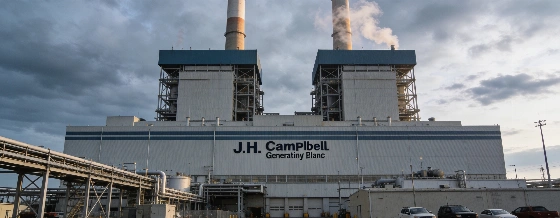
A federal appeals court has struck down the Trump administration's emergency order requiring the J.H. Campbell Generating Plant in Michigan to stay open past its planned retirement, citing lack of legal grounds and high costs for local ratepayers.
A federal appeals court has overturned the Trump administration's order to keep the J.H. Campbell Generating Plant in Michigan running past its planned shutdown, ending a costly intervention that left Midwest ratepayers covering the extra expenses. The Campbell plant, operated by Consumers Energy in Ottawa County, was the last coal-fired facility in the company's Michigan fleet and was set to close on May 31, 2025, after more than sixty years in operation (Michigan Department of Environment, Great Lakes, and Energy).
On Friday, the U.S. Court of Appeals for the District of Columbia Circuit ruled unanimously that the Department of Energy went beyond its legal authority when it ordered the 64-year-old plant to stay open. The court found no real emergency to justify the move, despite the administration's warnings about grid reliability. The judges wrote that Section 202(c) of the Federal Power Act is meant for rare, urgent situations and does not allow the DOE to override state energy planning based on vague, long-term concerns.
Legal challenge and court ruling
Michigan, Illinois, and Minnesota, along with several environmental groups, challenged the federal order in court. The judges said the emergency powers used by Energy Secretary Chris Wright were only meant for immediate, extraordinary events-not for routine policy disputes. They noted that the Campbell plant's retirement had been planned well in advance, with input from state and regional grid authorities. Michigan Attorney General Dana Nessel led the state's challenge, calling the federal order a political move that unfairly shifted costs to Michigan residents (Bridge Michigan).
Consumers Energy spokesperson Brian Wheeler said the company would keep following the latest 90-day DOE directive while reviewing the court's decision. The court also made clear that state and regional agencies, like the Michigan Public Service Commission and the Midcontinent Independent System Operator (MISO), are responsible for grid reliability-not federal emergency orders.
Financial and environmental impact
Extending the Campbell plant's operation past its scheduled closure has already cost about $259 million, according to recent financial reports. These costs are expected to be passed on to Midwest ratepayers, raising concerns for local families and businesses, including the Farmington Public Schools district, which tracks utility costs in its annual budget. Environmental groups say keeping old coal plants running not only raises bills but also prolongs air and water pollution that could have been avoided if retirements went ahead as planned. The City of Farmington Hills has pointed to the need for cleaner energy in its sustainability plans.
The Department of Energy defended its actions, saying the emergency orders-including those for plants in Indiana, Colorado, Florida, and Washington-helped prevent blackouts during severe winter storms in early 2025. DOE spokeswoman Emily Matthews said coal generation in affected regions rose by 25% during the peak of the storms, with the Campbell plant providing over 650 megawatts of power daily from January 21 to February 1. The court, however, found these reasons did not meet the legal standard for overriding state retirement plans.
Broader context and next steps
The Campbell case is one of several legal fights that followed President Donald Trump's January 2025 national energy emergency declaration, which cited rising electricity demand from artificial intelligence and data center growth. The administration's use of emergency powers to keep fossil fuel plants online has drawn criticism for raising utility bills and undermining state energy planning. An oil and gas plant in Pennsylvania was also ordered to keep running as a backup for the mid-Atlantic grid, as reported earlier.
Consumers Energy said it is reviewing the court's decision but will keep operating the Campbell plant under the current DOE directive, which runs through mid-November. Environmental groups, including the Environmental Defense Fund and Sierra Club, say they will keep fighting similar orders elsewhere, arguing that keeping "unreliable, aging coal plants" online is wasteful and risky. The Oakland County Board of Commissioners has scheduled a public hearing to discuss how federal energy interventions affect local communities.
Understanding emergency power use
Under the Federal Power Act, the Department of Energy can order power plants to keep running only when there is an immediate threat to grid reliability and no other options. The law is meant for rare emergencies-like natural disasters or sudden infrastructure failures-not for policy disagreements or to override state decisions on plant retirements. The court's ruling reinforces the limits of federal authority in energy planning and affirms the role of states in managing their own electricity resources.
While the Energy Department says its actions prevented blackouts during extreme weather, the court's decision makes clear that federal agencies cannot bypass established retirement plans without a clear, documented emergency. The outcome puts the administration's broader strategy for extending fossil fuel plant operations on uncertain legal ground and shifts attention back to state-led energy transitions. For Michigan and its neighbors, the ruling highlights the real costs of federal overreach and the courts' role in checking executive power over local energy systems.