Republican Mike Rogers accuses Democrat Abdul El-Sayed of opposing Michigan traditions like football and fireworks, but a closer look shows some comments were taken out of context as the Senate campaign intensifies after the August 4 primary
Michigan's U.S. Senate race has turned contentious as Republican candidate Mike Rogers and his supporters claim that Democratic nominee Abdul El-Sayed is out of touch with state traditions, citing past remarks about football, fireworks, and Mackinac Island. The debate escalated after the August 4 primary, with both campaigns trading accusations and clarifying positions.
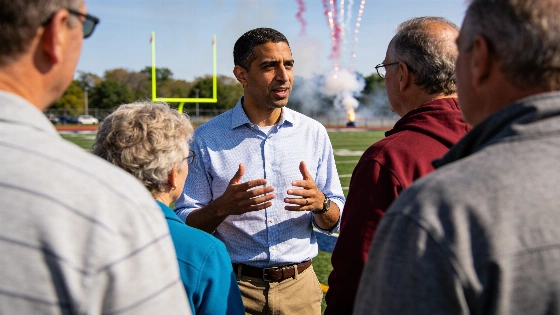
Rogers, a former congressman, has argued in recent interviews that El-Sayed wants to "do away with our fireworks, football, the Fourth of July," referencing comments El-Sayed made as a public health official and podcaster. El-Sayed, who played football at Andover High School in Bloomfield Hills, responded by challenging Rogers to a football game, emphasizing his personal connection to the sport.
Football and Public Health Concerns
The controversy over football stems from a February 2023 episode of El-Sayed's podcast "America Dissected," where he discussed the risks of brain injuries and other health issues associated with the sport. While El-Sayed acknowledged his love for football and credited it with teaching him valuable life lessons, he also questioned whether the sport could be made safer and more ethical. He did not call for banning football, but raised concerns about player safety, especially following high-profile injuries like that of Buffalo Bills safety Damar Hamlin in January 2023.
Republican critics have used these remarks to suggest El-Sayed opposes football entirely. However, El-Sayed's campaign has highlighted his history as a high school football captain and a Detroit Lions fan, sharing photos and videos of him playing the sport. The campaign maintains that his comments were about improving safety, not eliminating football.
Fireworks, July 4th, and Changing Views
El-Sayed's critics have also circulated a since-deleted video from his time as Wayne County's public health director, in which he outlined health and environmental risks associated with fireworks. The video, posted after July 4th celebrations in 2024, discussed air quality concerns, potential harm to veterans with PTSD, and risks to children and pets. Rogers has argued that El-Sayed deleted the video to hide his true views, but El-Sayed's campaign says his current position is different and that he now celebrates the Fourth of July with fireworks like many Michiganders.
To support this, the campaign pointed to a July 2025 social media post where El-Sayed wished Michigan residents a happy Fourth of July and encouraged them to enjoy the fireworks. The campaign argues that Republicans are focusing on old comments to distract from more pressing issues facing Michigan families.
Mackinac Island Remarks and Political Backlash
Another point of contention is a resurfaced clip from a 2020 documentary about El-Sayed's 2018 gubernatorial campaign, in which he said, "I hate Mackinac so much," while walking on the island. The comment, widely shared by conservative media, was interpreted by some as disdain for a beloved Michigan destination. El-Sayed's campaign clarified that his remarks were directed at the annual Mackinac Policy Conference, not the island itself, and that he finds the event dominated by corporate lobbyists and not representative of his approach to politics.
The viral clip prompted responses from Rogers and other Republicans, who defended Mackinac Island as a state treasure. El-Sayed countered by highlighting the cost of attending such events and questioning whether ordinary families can afford to visit the island as easily as wealthy political figures.
Context and Campaign Dynamics
While El-Sayed has made critical comments about football, fireworks, and Mackinac Island in the past, a review of his statements shows he did not advocate for banning these traditions. Instead, his remarks focused on public health and ethical considerations, and his campaign says his views have evolved. The Rogers campaign continues to use these past comments to frame El-Sayed as disconnected from Michigan values, while El-Sayed's team argues the attacks are a distraction from substantive policy debates.
Michigan's U.S. Senate seat is open in 2026, drawing national attention and significant spending from both parties. The race is expected to remain competitive, with both candidates seeking to define their opponent's record and appeal to voters' sense of state identity and tradition.
In Michigan, the U.S. Senate race is decided in a statewide general election, with candidates advancing from party primaries. The campaign period often features debates, public appearances, and media scrutiny of candidates' records and statements. Voters will have the opportunity to choose their next senator in November 2026.