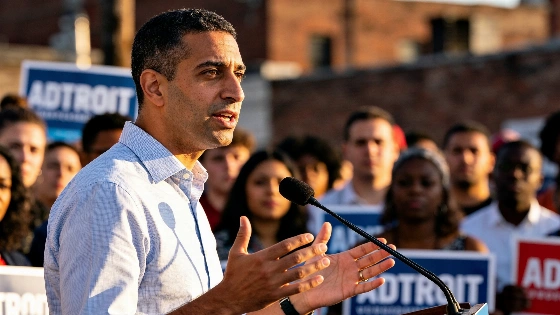
Abdul El-Sayed is working to bring together Michigan Democrats after a divisive primary, but skepticism among Black and Jewish voters could affect his campaign as he prepares to face Republican Mike Rogers in November
Abdul El-Sayed, the Democratic nominee for U.S. Senate in Michigan, is seeking to unite his party after a closely contested primary, but faces ongoing skepticism from key Democratic voting blocs, including Black and Jewish communities. As the general election approaches, Republican candidate Mike Rogers is aiming to capitalize on these divisions.
El-Sayed, a progressive who has made Medicare for All a central issue, won the Democratic nomination by a narrow margin. However, he underperformed in cities with large Black populations and has faced criticism from some Jewish Democrats over his stance on Israel. Michigan is home to approximately 1.4 million Black residents and 129,000 Jewish residents, making these groups significant in a statewide election.
While major Democratic figures such as former President Barack Obama, Governor Gretchen Whitmer, and Vice President Kamala Harris have offered their support to El-Sayed, some party leaders remain cautious. Attorney General Dana Nessel, who is Jewish, has publicly urged El-Sayed to moderate his rhetoric, particularly regarding Israel and the American Israel Public Affairs Committee (AIPAC). During the primary, AIPAC spent over $32 million supporting El-Sayed's opponent, Haley Stevens, and attacking El-Sayed through the United Democracy Project super PAC.
Despite these challenges, Democratic leaders are working to present a unified front. Stevens, who lost to El-Sayed, has pledged her support, and the Michigan Democratic Party Black Caucus has endorsed El-Sayed, emphasizing the need to focus on the general election rather than lingering primary disputes. Still, some local leaders and strategists acknowledge that El-Sayed must strengthen his relationships with Black and working-class voters, as he did not win any of the 15 Michigan counties with the lowest proportion of college graduates.
Jewish Voters Remain Wary
El-Sayed's criticism of U.S. policy toward Israel has led to discomfort among some Jewish Democrats. Decky Alexander, chair of the Michigan Democratic Party's Jewish caucus, noted that many Jewish voters are undecided or considering sitting out the election. El-Sayed has attempted to reach out to Jewish communities, but concerns remain, especially among those who view criticism of Israel as a sensitive issue. Recent polling suggests that while 70% of American Jews do not see criticism of Israel as antisemitic, only about half consider supporting Israel to be extremely or very important.
Meanwhile, Michigan's Arab-American population, estimated at 283,000, turned out in record numbers during the primary, particularly in Dearborn. This demographic shift could influence the general election, as El-Sayed's campaign has resonated with many Arab-American voters.
Republican Strategy
Mike Rogers, the Republican nominee, is actively courting Democrats who feel alienated by El-Sayed's progressive platform. Rogers has positioned his campaign as an alternative for voters who are uncomfortable with what he describes as divisive or extreme views. Republican strategists believe that persuading some Democrats to either support Rogers or abstain from voting could be decisive in a close race.
Republicans have also sought to frame El-Sayed and other progressive candidates as embracing socialist or communist ideas, a message echoed by former President Donald Trump at recent rallies. The GOP hopes this strategy will appeal to moderate voters and those concerned about the direction of the Democratic Party.
Despite a competitive Republican gubernatorial primary, Democratic turnout in the recent election was significantly higher, with 1.5 million Democrats voting compared to 900,000 Republicans. Young voters, especially on college campuses like Michigan State University, showed strong support for El-Sayed, suggesting that enthusiasm among progressives remains high.
The next three months will be critical as El-Sayed works to broaden his appeal and address concerns within his own party. The outcome of the Senate race could hinge on whether he can successfully unite Michigan Democrats and win back skeptical voters in key communities.
Michigan's U.S. Senate seat is open following the retirement of Senator Debbie Stabenow. The general election is scheduled for November, and both parties are expected to intensify their outreach to undecided voters and key demographic groups in the coming weeks.
In Michigan, statewide campaigns often require candidates to build coalitions across diverse communities. The Democratic Party's ability to reconcile internal differences and mobilize its base will be closely watched as the election approaches. The role of outside spending, particularly from groups like AIPAC, and the turnout among Black, Jewish, and Arab-American voters could prove decisive in determining the state's next U.S. Senator.