
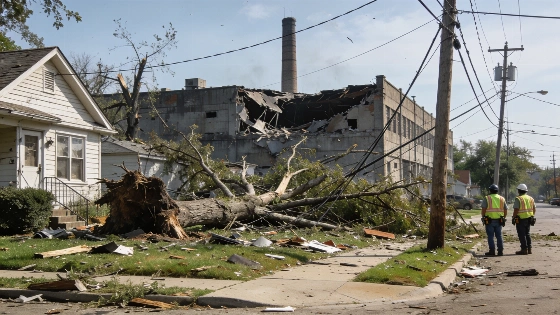
A powerful EF2 tornado struck Detroit for the first time in nearly three decades, damaging homes, businesses and parks along a 3.5-mile path. Residents are urged to avoid downed power lines as cleanup continues.
Detroit's east side was hammered Thursday afternoon by a tornado that ripped through neighborhoods and industrial corridors, marking the city's first confirmed tornado in 29 years. The National Weather Service classified the storm as an EF2, with peak winds estimated at 115 mph, and confirmed a 3.5-mile damage path that left homes roofless, trees uprooted and industrial buildings torn open.
For residents and business owners, the aftermath is immediate and visible. Roofs are missing, utility poles are snapped, and debris is scattered across streets from Hancock Street near downtown to the far edge of Belle Isle. One person was injured, but the scale of property damage is still being assessed as emergency crews work to restore power and clear hazards.
Path of the Detroit tornado
The tornado touched down at 4:14 p.m. near Hancock Street and Ellery Place, quickly intensifying as it moved south-southeast. The most severe destruction was recorded between Mack Avenue and Mount Elliott Street, where several industrial buildings lost sections of their roofs and exterior walls. In residential areas around Concord Avenue and Canton Street, large trees were snapped or uprooted, and homes suffered broken windows, torn siding and partial roof loss.
On St. Paul Street, two vacant buildings collapsed, and debris from the Utica Washers building was found nearly a mile away. The tornado's path continued across East Jefferson Avenue, damaging trees in Gabriel Richard Park and nearly tearing down the sign at Pekin restaurant. After crossing part of the Detroit River, the storm battered Belle Isle, toppling trees and hurling a scull boat into a tree near the boat house. The confirmed damage path ended near the Model Yacht Basin on Belle Isle's eastern side.
Additional tornadoes and ongoing investigations
Thursday's severe weather was not limited to Detroit. The National Weather Service also confirmed an EF0 tornado in Lincoln Park, which touched down at 4:12 p.m. near Fort Street and Memorial Park. This weaker tornado, with peak winds of 70 mph, traveled just 0.16 miles and damaged trees and transmission lines before dissipating near the Senior Center. No injuries were reported in Lincoln Park, which has now seen two tornadoes in 2026.
Investigators in Canada are examining storm damage in east Windsor to determine whether it was caused by the same tornado that crossed Detroit and Belle Isle or by a separate event. The National Weather Service's survey does not confirm a continuous tornado track into Canada, and the final determination will depend on the results of the Canadian survey. Meanwhile, an EF0 tornado with 75 mph winds struck near Marysville on Wednesday, bringing the two-day total to at least three tornadoes in Southeast Michigan.
Detroit's first tornado since 1997
The last time Detroit experienced a confirmed tornado was July 2, 1997, when an F2 tornado traveled from northwest Detroit through Highland Park and Hamtramck. That storm was part of a larger outbreak that injured nearly 100 people and caused almost $100 million in damage across northern Wayne County. In contrast, Thursday's tornado, while powerful and destructive, resulted in only one reported injury and no fatalities.
Cleanup is underway, but hazards remain. Downed power lines are a particular risk, and residents are urged to stay at least 25 feet away from any fallen wires or objects in contact with them. DTE Energy customers can report outages by calling 1-800-477-4747, and Detroit residents needing emergency shelter can contact the Detroit Housing Resource HelpLine at 866-313-2520.
What residents should know now
As crews work to restore power and clear debris, the city faces a long recovery. The National Weather Service's detailed survey provides a clear record of the tornado's path and intensity, but the full cost of the damage will take time to calculate. Residents should continue to avoid storm-damaged areas and report hazards to authorities. The rare nature of this event-Detroit's first tornado in nearly three decades-underscores the unpredictable risks that even urban centers face from severe weather.
While Detroit's emergency response has been swift, the city's infrastructure and residents will be dealing with the consequences for weeks. The fact that only one injury was reported is a testament to both luck and the effectiveness of local warnings. As with cybersecurity threats discussed in reported earlier, the lesson is clear: preparedness and rapid response are essential, but nature's unpredictability can still catch even the most vigilant communities off guard.