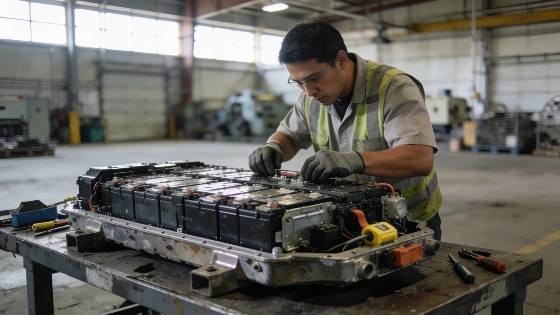
Companies in Michigan are testing retired EV batteries for energy storage before recycling them. NextCycle Michigan and a proposed statewide collection framework are also addressing safety, infrastructure and the battery supply chain for the next decade.
A battery removed from an electric vehicle may still hold roughly 70% to 80% of its original capacity. That remaining charge is pushing Michigan companies to test retired packs for energy storage before they go to recycling.
Packs that no longer work well in cars could power construction sites, concerts, grid-support systems and commercial facilities. The exact remaining life depends on chemistry, age, operating history and safety condition. Capacity alone does not certify a battery for reuse.
That distinction matters.
Michigan is using the NextCycle Michigan Accelerator to turn the idea into operating businesses. The free program, funded by the Michigan Department of Environment, Great Lakes, and Energy, offers help with business planning, technical work, supply-chain contacts, funding strategies and marketing. Its EV Battery Reuse & Recycling track listed Aug. 7, 2026, as its application deadline. That timing shows the initiative has moved toward project selection and implementation rather than remaining an open call for proposals. The current phase is detailed in the program's accelerator information.
For Farmington and Farmington Hills, the issue reaches beyond industrial growth. Local governments, schools, fire departments and household waste programs may need instructions for damaged, recalled or end-of-life batteries. Residents use the City of Farmington's public information channels and the Farmington Public Schools board for notices about facilities, safety and environmental programs. Oakland County administration coordinates regional services that can affect collection and emergency planning.
Reuse before recycling
Great Lakes Recycling is one of the companies moving the work forward. The 90-year-old family-owned company in River Rouge moved into a 60,000-square-foot facility in September 2025. It had shifted from ferrous metal recycling to electronics and EV batteries. The facility can now process 100 to 150 battery packs each day under safety protocols for packs that may still hold a dangerous charge.
Every incoming load is weighed, tagged, categorized and entered into an electronic tracking system. Workers isolate questionable loads in shipping containers. Approved packs go to staging. Temperature monitoring can trigger camera alerts and notify the local fire department.
GLR has cut the time needed to dismantle standard packs to four to six minutes. Workers also cut voltage repeatedly to reach safer levels before the packs move downstream.
GLR is pursuing UL 1974 certification. That certification would allow the company to officially certify batteries for reuse. The company also earned Level 3 certification through the Automotive Recyclers of Michigan to remove battery packs from vehicles. It is working with scrapyards and auto recyclers on collection and safe handling.
The safety problem does not end with the vehicle. Battery designs, shapes and chemistries vary widely. Discharged packs still require careful diagnostics, handling and treatment.
Residents should never place a damaged or swollen battery in household recycling or trash. They should follow instructions from their local waste authority, retailer, manufacturer or fire department.
Building an energy-storage market
GLR is working with Volt Harbor on a NextCycle grant application for energy-storage testing. Under the proposed supply chain, GLR would evaluate incoming packs and conduct initial tests. Volt Harbor would carry out further assessments and place suitable batteries in storage units.
Volt Harbor grew out of National Science Foundation-funded research at the University of Michigan. Its software lets storage modules use different battery makes and models with varying voltage, capacity and degradation. The system does this without costly balancing equipment.
The company joined the accelerator to learn about Michigan's supply chain and commercial market. Through the program, it connected with a Michigan-based project developer. That developer now serves as a sales channel partner and installation provider.
Volt Harbor is targeting commercial and industrial facilities with high electricity and storage costs. Its modular UltraCore system is designed to provide power when grid infrastructure cannot handle demand. It may reduce the need for expensive upgrades.
Data centers are another target. Their power requirements can vary widely, and they may need rapid deployment.
Volt Harbor is also working with the DTE Emerging Technology Fund on a pilot storage system for EV charging. Installation is scheduled for spring 2027. The system would store electricity during low-demand periods and use it during costly peak periods when the grid is constrained.
According to GLR, a battery with a 75% to 80% state of health may no longer work effectively in a vehicle. It can still be useful for energy storage down to 30% state of health. That creates an estimated additional 50% to 60% of useful life before final recycling.
Those figures are project estimates, not a universal performance standard. Every second-life system still needs engineering controls, monitoring and fire-safety planning.
Faster testing and better recovery
ReCharge Recycling is pursuing a similar plan. Founded in 2022 as the U.S. subsidiary of United Battery Recyclers International, the company tests batteries to find their next-best use.
ReCharge estimates that 90% to 95% of the batteries it receives still have usable capacity. Removal from a vehicle does not automatically end a pack's useful life.
A grant project with the University of Michigan-Dearborn focuses on an algorithm that could cut testing time from four to six hours to five to 10 minutes. Faster testing would increase daily capacity. It would also help companies find reusable packs before sending them through more expensive recycling processes.
The time savings remain a development goal until the system is validated across battery types and operating conditions.
ReCharge plans to sell battery-health data to insurance companies and professional auto dismantlers. Its business-to-business e-commerce platform is under development. The platform would offer parts such as bus bars, bolts and cases that are often discarded during recycling.
The potential material supply is large. S&P Global Mobility estimates that recycled batteries could meet about 36% of global cobalt demand by 2037. The estimate also covers 31% of nickel demand and 22% of lithium demand.
Those figures depend on collection, safe processing and viable economics. Some batteries currently cost more to recycle than the recovered materials are worth.
When reuse no longer makes sense, EPA-described recovery routes include smelting and leaching. These processes can recover cobalt, nickel, lithium and manganese for new battery cells. Their environmental footprint and economics depend on the facility, battery chemistry and process controls.
A pipeline already forming
Michigan does not need a precise forecast for future EV sales to prepare. Early-generation EV batteries are beginning to reach retirement. Larger numbers from vehicles sold since 2016 are expected to become available for reuse, repurposing or recycling during the next decade.
Battery life is also exceeding the assumptions behind many warranties. Manufacturers commonly offered coverage for eight years or 100,000 miles. Many batteries are now expected to last 12 to 15 years, and some may last up to 20 years.
Their remaining capacity gives recyclers and storage companies a reason to test packs before processing them. Those projections are not guarantees for every vehicle or battery chemistry.
Michigan's wider recycling work provides part of the context. Flint's experience with expanded household recycling through expanded recycling access shows how collection systems determine whether recoverable material reaches the next stage.
EV batteries need a more specialized chain. Fire and explosion risks make transportation, storage and dismantling central parts of the process.
The collection question has reached state policy.
In September 2026, two Michigan House bills under discussion proposed a statewide stewardship framework for covered batteries. If enacted, the bills would restrict sales beginning July 1, 2028. The proposal described by Michigan Counties would require at least two collection points in every county and one point per 10,000 county residents.
Those are proposed statutory requirements. Michigan does not yet have that statewide network.
Michigan Advance reported on the legislative discussion in connection with disposal hazards. The issue goes beyond the commercial reuse model. Improperly stored lithium-ion batteries can ignite during collection, transport or waste processing.
Coordination among the State of Michigan, Oakland County administration, municipal fire services and local waste programs will matter even before lawmakers finalize a statewide system.
For residents of Farmington and Farmington Hills, a future stewardship system could change where portable batteries, e-bike batteries and vehicle packs are accepted. It could also determine how damaged batteries are isolated and who pays for transportation.
The City of Farmington Hills, the City of Farmington and Farmington Public Schools would not replace state or county regulators. Their public notices, facility policies and emergency communications could help explain statewide requirements locally. Residents should check current municipal instructions. A drop-off site may not accept EV packs.
NextCycle Michigan is seeking more partners that produce, process, transport or support EV and battery components. Organizations can work with accelerator teams, sponsor showcase awards or tracks, provide market information or help build supply-chain connections. The program can be reached at NextCycleMI@recycle.com.
Michigan's strongest battery strategy is not to treat every retired pack as waste. The companies supported through NextCycle Michigan are building a practical order: test first, reuse a battery when it remains suitable, then recycle its materials when its useful life ends.
That plan will not remove the technical or financial barriers. It gives Michigan a way to capture more value from batteries already on the road. It may also reduce demand for new raw materials and improve safety for communities that handle the packs.