
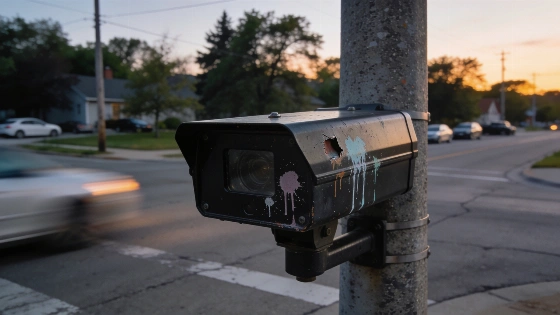
Communities across Michigan are seeing a rise in vandalism of police license plate cameras as lawmakers consider new regulations and residents voice concerns about surveillance and data privacy
Communities throughout Michigan are reporting a surge in vandalism against police-operated license plate cameras, as debate intensifies over the use of surveillance technology and the need for stronger privacy protections. The devices, often referred to as Flock cameras after a leading manufacturer, have been damaged, disabled, or stolen in more than a dozen locations across the state, including Birmingham, Commerce, Farmington Hills, Independence Township, Novi, Orion Township, Pontiac, Rochester Hills, Waterford, Wayne, and West Bloomfield. Incidents have also been reported in Kent and Kalamazoo counties.
One of the most prominent cases involved Robert Stanaj of Bloomfield Hills, who admitted to painting over camera lenses at night. Stanaj was eventually arrested and charged with multiple felonies, which were later reduced to a misdemeanor. He was sentenced to two days in jail, ordered to pay fines and restitution, and says he now regrets his actions. Stanaj has since drafted a bill to ban the use of such cameras, hoping to address privacy concerns through legislation rather than direct action.
Opposition to license plate readers is not limited to individual acts of vandalism. Residents and advocacy groups, including the American Civil Liberties Union of Michigan, have raised alarms about the potential for mass surveillance and the lack of statewide regulation. Currently, Michigan does not have a law governing the use or public reporting of license plate readers, leaving policy decisions to individual municipalities or police departments. Critics argue that this patchwork approach allows for inconsistent data retention and sharing practices, increasing the risk of privacy violations.
Flock cameras are typically installed on poles near intersections and capture images of passing vehicles and their license plates. The data is stored in searchable databases used by police to investigate crimes, locate suspects, or find missing persons. According to Flock Safety, the cameras have assisted in high-profile investigations, including locating suspects in mass shooting cases and missing persons. The company maintains that its cameras do not use facial recognition or detect the race or gender of drivers.
Despite these assurances, concerns persist about how long data is stored and who can access it. Some communities, such as Bloomfield Township, operate transparency portals that allow the public to see how many cameras are in use, how many license plates have been scanned, and how often police have received alerts for vehicles on so-called hotlists. However, participation in these portals is optional, and many neighboring communities do not provide this level of transparency.
Recent legislative proposals in Michigan aim to address these gaps. Two bills pending in the state House would require police to obtain a warrant to access license plate data in most cases and limit data retention to 14 days. A Senate version of the legislation was introduced in 2024, with supporters arguing that continuous data collection without oversight is an overreach. The bills would also require court approval for data release in criminal or missing person investigations.
Public meetings across metro Detroit have drawn residents voicing concerns about surveillance technology. In April, opponents of Flock cameras attended an Oakland County Board of Commissioners meeting to protest a contract for a surveillance drone pilot program. Despite the opposition, the contract was approved. Some municipalities, such as Westland, have chosen to end their contracts with Flock, while others are reviewing their agreements.
Law enforcement officials say vandalism of the cameras is a crime that can hinder investigations and delay emergency responses. In Waterford, Spencer Anderson of Clarkston faces charges for damaging Flock cameras, while police in Novi and West Bloomfield continue to investigate similar incidents. Most attacks occur at night and are sometimes captured by nearby security cameras, aiding police in identifying suspects. In the case of Stanaj, investigators used GPS tracking and cell phone records to link him to multiple damaged cameras across several communities.
Flock cameras cost thousands of dollars each, with communities paying annual fees to keep them operational. The devices are promoted as tools for public safety, but the ongoing debate highlights the tension between law enforcement needs and residents' expectations for privacy and transparency.
As Michigan lawmakers consider new regulations, the future of license plate camera use remains uncertain. Residents, advocacy groups, and local governments continue to weigh the benefits of the technology against the risks to civil liberties and personal privacy.
In Michigan, the use of license plate readers is currently governed by local policy rather than state law. This means each municipality or police department can set its own rules for data collection, retention, and sharing. Transparency portals, when available, offer some insight into how the technology is used, but participation is voluntary. The proposed state legislation would standardize these practices and introduce new safeguards, but until such measures are enacted, communities will continue to navigate the balance between public safety and privacy on their own.