
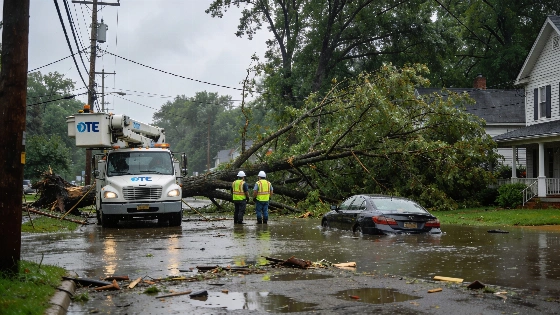
Severe storms brought more than two inches of rain to parts of southeast Michigan on September 3 and 4, leaving over 250,000 homes and businesses without power and causing widespread flooding and damage
More than a quarter million Michigan residents woke up without electricity after severe thunderstorms swept across the state on September 3 and 4, toppling trees, flooding streets, and damaging homes and businesses from Detroit to the Upper Peninsula. The storms delivered intense rainfall, with some southeast Michigan communities recording over two inches in less than 24 hours, according to the National Weather Service.
Downed power lines and blocked roads created immediate hazards for drivers and emergency crews. In metro Detroit, historic buildings and neighborhoods on the east side suffered significant damage, while stranded vehicles and impassable intersections forced detours throughout the region. The widespread outages affected both DTE Energy and Consumers Energy customers, with restoration efforts complicated by ongoing rain and debris.
Rainfall Totals by Region
Rainfall varied widely across Michigan, but southeast communities bore the brunt. Gregory reported 2.68 inches, Birmingham 2.59 inches, Milford 2.48 inches, Northville 2.35 inches, and Jackson 2.20 inches as of September 4. In mid-Michigan, Mount Pleasant saw 1.82 inches, Durand 1.68 inches, and Shepherd 1.67 inches. West Michigan totals were lower, with Bellevue at 1.24 inches, Sparta at 0.78 inches, and Saranac at 0.77 inches. The Upper Peninsula also received heavy rain, with Ironwood at 1.17 inches and Marquette at 1.12 inches.
Flood advisories were issued for several northwest Michigan counties, though some rainfall data for those areas remained unavailable as of Friday morning. The Community Collaborative Rain, Hail and Snow Network did not yet report totals for all affected locations.
Storm Damage and Ongoing Risks
Beyond flooding and outages, the storms left a trail of structural damage. On Detroit's east side, the National Weather Service office in White Lake began investigating whether a tornado or strong straight-line winds caused the most severe destruction. The agency planned a formal survey to determine the exact cause. Meanwhile, emergency crews worked to clear debris and restore access to blocked streets and neighborhoods.
With more rain falling on September 4, officials warned that saturated ground could lead to additional flooding and slow recovery efforts. Residents in affected areas were urged to avoid downed power lines, report outages, and monitor local advisories for updates on road closures and utility restoration.
Utility Response and Community Impact
DTE Energy and Consumers Energy reported more than 250,000 customers without power statewide as of Friday morning. Restoration crews faced challenging conditions, including ongoing rainfall and widespread debris. The outages disrupted daily life for thousands of households and businesses, with some historic sites in Detroit among the damaged properties.
Flooded basements, impassable roads, and stranded vehicles added to the disruption, particularly in southeast Michigan. Local governments and public works departments mobilized to address immediate hazards and begin cleanup, but officials cautioned that full recovery could take several days depending on weather and access conditions.
Michigan's response to severe weather events relies on coordination between local governments, utility companies, and emergency management agencies. The National Weather Service provides real-time updates and damage assessments, while utility providers prioritize restoration based on safety and critical infrastructure needs. Residents can track outage maps and advisories through DTE Energy, Consumers Energy, and local emergency management channels.