North Carolina and Michigan have announced millions in new grants for electric vehicle charging and clean mobility projects, including hydrogen fuel cell trucks and fast charging sites. Construction and deployment are set to ramp up over the next three years.
North Carolina and Michigan are making major investments in electric vehicle charging and clean mobility, aiming to expand infrastructure for drivers and businesses in both states. The latest funding covers not only standard EV charging but also hydrogen fuel cell technology and fast charging for areas with limited grid capacity. Local governments and school districts are watching these developments as they plan future fleet upgrades and public charging access.
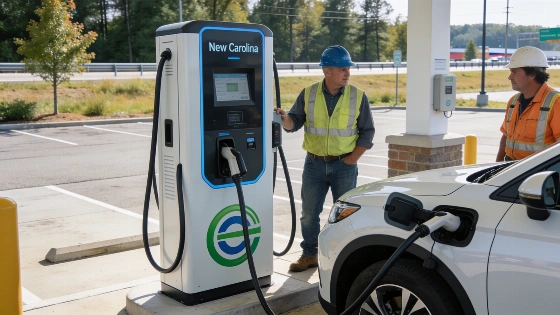
North Carolina's Department of Transportation (NCDOT) has awarded $14.4 million to eight companies to install and operate 14 new EV charging sites along key travel routes. This is the second round of funding from the National Electric Vehicle Charging Infrastructure (NEVI) Program, bringing the state's total federal allocation to $109 million. The new stations will be located in cities such as Asheboro, Columbus, High Point, Kinston, Raleigh, Wadesboro, and Weaverville, covering both urban and rural areas. NCDOT expects the full network of NEVI-funded chargers to be finished within three years, closing gaps along major highways and improving access for residents and travelers. The first NEVI projects, funded in 2024, led to five operational charging locations. The current expansion is meant to reach more communities and school districts, including those overseen by the Farmington Public Schools board and similar organizations in North Carolina (NCDOT projects portal).
Michigan targets hydrogen and fast charging
Michigan's latest mobility grants, announced by Governor Gretchen Whitmer, direct $1.5 million to ten projects through the Michigan Mobility Funding Platform. The grants support both real-world deployment and pilot testing, with a focus on hydrogen-powered vehicles and advanced charging. Detroit Hydrogen Exchange received $250,000 to put a hydrogen fuel cell Class 8 refuse truck into municipal service in Detroit, testing it in daily operations. Neology was awarded $250,000 to open a hydrogen production and refueling site in Detroit for medium- and heavy-duty vehicles. OpenRoad Technologies, a climate tech startup, received $135,000 to test scalable, battery-buffered Level 3 charging at sites where the electric grid is limited. These projects are coordinated with the Michigan Department of Transportation and the Office of Future Mobility and Electrification, which help plan statewide infrastructure and public-private partnerships.
Other grant recipients are working on air, land, and water mobility solutions, part of Michigan's effort to broaden its clean transportation sector. The Michigan Mobility Funding Platform is a partnership between the Office of Future Mobility and Electrification, the Michigan Economic Development Corporation, and the Michigan Department of Transportation. The program aims to help companies bring new technologies to market and support industries that provide jobs and economic growth in the state, with oversight and reporting requirements involving Oakland County administration and local city councils.
Federal and state funding accelerate infrastructure
Both states are using federal and state funds to speed up the rollout of charging and fueling infrastructure. North Carolina's NEVI-funded sites will be reimbursed for project costs, lowering financial risk for participating businesses and encouraging faster construction. Michigan's grants are intended to spur innovation and real-world testing, with a focus on hydrogen as a complement to battery-electric vehicles for heavy-duty use. The City of Farmington and other municipalities are following these projects, since expanded charging access could affect local zoning, emergency services, and public meeting agendas.
For North Carolina, the NEVI program is expected to deliver a statewide network of fast chargers within three years, filling in key gaps along highways and making long-distance EV travel more practical. In Michigan, the focus on hydrogen and advanced charging reflects the state's automotive background and its goal to stay at the forefront of mobility technology. The funding also supports job creation and the growth of local industries tied to clean transportation, with possible benefits for school districts and public works departments as they consider future fleet electrification.
Local context and ongoing challenges
While these investments are a significant step, challenges remain. As reported earlier, expanding EV charging infrastructure does not guarantee affordability or access for all, especially low-income households. Both states will need to address equity and practical access as they add new charging and fueling sites, with input from city councils, school boards, and county agencies during public comment periods and local elections.
The NEVI program is part of a broader federal effort to build a national network of EV chargers, with states responsible for planning and implementation. Michigan's approach, combining hydrogen and battery-electric projects, shows the complexity of moving to clean mobility. The next phase will test whether these investments can deliver reliable, accessible, and affordable charging options for a wide range of users, including those in Farmington, Farmington Hills, and throughout Oakland County.
- Transportation & Infrastructure
- Public Works & Capital Projects
- Local Utilities & Service Outages
- Automotive & Manufacturing
- Environment & Great Lakes
- Federal Policy & Regulation
- Data & Investigative Analysis
- Michigan Department of Transportation
- Federal Highway Administration
- Transit Agencies and Mobility Systems
- Utilities and Public Works
- Grid Reliability
- Electricity Rates
- Public Works
- Automakers and Vehicle Brands
- Infrastructure Investment and Jobs Act