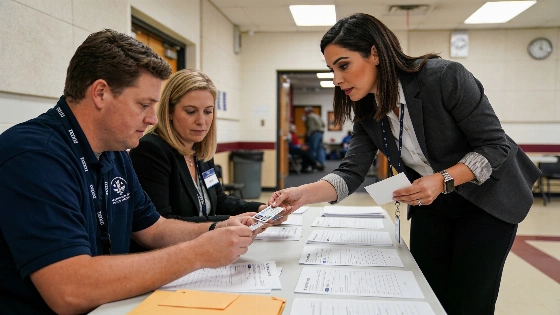
As the November midterm elections approach, claims about noncitizen voting are fueling new debates over election security, with officials in several states responding to federal allegations and proposed legislation that could affect voter registration requirements.
With the November midterm elections drawing near, claims about noncitizen voting are intensifying political debate and prompting new scrutiny of election security measures across the United States. President Donald Trump and his allies have amplified concerns about the possibility of noncitizens casting ballots, urging federal agencies and lawmakers to tighten voter verification processes.
Trump has called for the U.S. Postal Service to send mail ballots only to voters confirmed as U.S. citizens. Meanwhile, a recent Census Bureau report, cited by the president, suggested that 24,000 noncitizens may have voted illegally in the 2020 election. However, election experts have questioned the methodology behind this report, noting that errors in matching voter files to federal records could have produced false positives.
Federal and State Officials Respond to Allegations
The Department of Homeland Security (DHS) has also entered the discussion, with Secretary Markwayne Mullin sending letters to officials in California, Nevada, New Jersey, and Pennsylvania. The letters alleged that nearly 250,000 noncitizens could be registered to vote in those four states. State officials have pushed back, with California's secretary of state stating that her office had not shared voter registration data with DHS and expressing doubts about the accuracy of the federal claims.
In New Jersey, state officials acknowledged that about 6,600 noncitizens were improperly registered through the motor vehicle system in 2023 and 2024, but said fewer than 400 of them had actually voted. The state has since begun replacing the vendor responsible for the registration errors. Pennsylvania's secretary of the commonwealth reported that DHS officials themselves admitted to having low confidence in their initial figures and promised to provide more details on their methodology. Nevada's secretary of state also questioned the federal government's approach, emphasizing ongoing efforts to maintain accurate voter rolls.
Proposed Legislation and Election Security Measures
Amid these disputes, Trump and Republican lawmakers are pushing for new federal legislation known as the Safeguard American Voter Eligibility (SAVE) America Act. The bill, which has passed the House but is stalled in the Senate, would require documented proof of citizenship for voter registration and mandate photo identification at the polls. Supporters argue that these measures would strengthen election integrity, while opponents warn that millions of eligible voters lack easy access to citizenship documents, potentially disenfranchising them.
A University of Maryland study estimates that 21.3 million eligible U.S. voters do not have, or cannot easily obtain, documents proving their citizenship. Critics of the proposed legislation say the focus on noncitizen voting is being used to justify restrictive voting requirements and could set the stage for legal challenges to election results.
Local and National Implications
Election officials and voting rights advocates have noted that proven cases of noncitizen voting remain extremely rare and are already punishable as felonies. Nevertheless, the heightened attention to the issue is raising concerns about public trust in the electoral process. Some observers warn that the spread of unverified claims could undermine confidence in the outcome of the midterms, especially in closely contested races.
Recent developments in California highlight the ongoing scrutiny, as federal prosecutors in Los Angeles announced the arrest of a Honduran national accused of fraudulent voter registration. Officials indicated that more investigations may follow, particularly in states with competitive congressional races.
These debates are unfolding as courts continue to weigh in on election-related disputes. For example, a federal judge recently dismissed a Department of Justice lawsuit seeking access to Minnesota's full voter registration list, marking another instance where federal efforts to intervene in state election administration have faced legal setbacks. The case, covered in a recent Farmington Voice report, underscores the ongoing tension between federal oversight and state control of elections.
As the midterms approach, election officials in several states are working to reassure voters that safeguards are in place to prevent ineligible voting and to maintain accurate registration rolls. The outcome of the legislative debate and the handling of these claims could shape election procedures and public confidence for years to come.