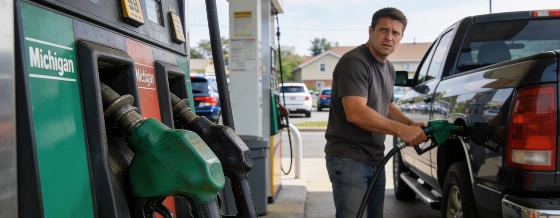
Drivers across Michigan are seeing steep increases at the pump, with diesel reaching $6.54 per gallon and gasoline nearing $5 in some areas. The spike is raising concerns about rising costs for households and businesses as global conflicts disrupt oil supplies.
Drivers in Michigan are facing some of the highest fuel prices the state has ever seen. Diesel has climbed to a record $6.54 per gallon, and gasoline is approaching $5 in several areas. AAA and local news outlets confirm the jump, which is already affecting transportation and delivery costs for residents and businesses. The impact is expected to ripple through the local economy (CBS News Detroit).
On Thursday, September 17, AAA Michigan reported the statewide average for regular gasoline at $4.76 per gallon. That's up 22 cents in a single day and 45 cents over the past week. Diesel prices have been breaking records daily, rising from $6.25 to $6.34 before hitting the new high. These are the highest prices ever recorded in Michigan. In Farmington and Farmington Hills, city officials say they're getting more questions from residents about how the increases will affect city vehicles and school transportation budgets.
Global conflicts push prices higher
The latest price surge is closely linked to conflict involving Iran and other Arab nations, along with attacks on energy infrastructure in Europe. Oil companies point to shrinking reserves and reduced refining capacity, both in the Middle East and in Europe, where the war between Russia and Ukraine continues to damage key energy sites. These disruptions have tightened global oil supply and driven up costs for U.S. consumers. The U.S. Department of Energy reported a national average on-highway diesel price of $6.285 per gallon for the week ending September 14, a new national record (fleet fuel price report).
Earlier this year, U.S. fuel prices reached similar highs before briefly dropping when diplomatic talks suggested a possible end to the war. But renewed and expanded military strikes in the Middle East have reversed that trend, sending prices up again. Petroleum analysts say the 2022 spike was mostly due to pandemic disruptions and sanctions on Russia after its invasion of Ukraine. This time, the main driver is the war involving U.S. air strikes against Iran, with no clear end in sight.
Economic impact and local response
As fuel prices rise, there's growing concern about the broader economic effects. High diesel costs in particular threaten to raise the price of goods and services across Michigan, as trucking and delivery companies pass on their expenses. The situation has already led to protests in other countries, according to news reports, as communities worldwide deal with volatile energy markets. In Farmington, city officials say higher fuel costs could affect the timing of public works projects and emergency services, a topic discussed at recent City Council meetings.
Some analysts, including GasBuddy's Patrick De Haan, have warned that prices could go even higher, but also caution against rumors online, such as claims that the U.S. has only 40 days of fuel left. While it's unclear how long the current surge will last, the main causes-ongoing wars and disrupted shipping lanes-show no sign of ending soon. The Farmington Public Schools board has started reviewing transportation contracts and bus routes because of the higher fuel costs, according to recent board minutes.
Michigan trends and recent history
Michigan has seen brief periods of even higher average gasoline prices, especially in 2022, but the current mix of record diesel costs and fast-rising gasoline prices is putting new pressure on households and businesses. The state relies heavily on trucking to move goods, so diesel spikes can quickly lead to higher prices for everyday items. AAA Michigan says the average price for regular unleaded gasoline on September 14 was $4.31 per gallon, up 28 cents from the previous week and $1.04 higher than a year ago, showing just how quickly prices have risen.
Michigan isn't alone in dealing with energy market swings. Other communities have faced similar disruptions in recent years. For example, Flint's recycling program set a city record after distributing new carts to residents, as reported earlier by Farmington Voice. Both stories show how global and national trends can have immediate effects on local communities, including those in Oakland County.
With no clear sign of when fuel prices might stabilize, Michigan residents and businesses are left to deal with an unpredictable market. The current surge highlights how vulnerable local economies are to international conflict and infrastructure problems. Until those issues are resolved, drivers should expect continued price swings at the pump and be ready for possible increases in transportation and delivery costs.