A $1 million grant will support a three-year research project led by the University of Michigan and Michigan State University, examining how clean energy investments in Detroit, Chicago, and Columbus affect local neighborhoods.
When cities invest in clean energy, who actually benefits? That question is at the heart of a new research project focused on Detroit, Chicago, and Columbus. These cities are seeing major climate infrastructure projects, but it is not always clear how much local residents gain from them. In Detroit, for example, recent storms and tornadoes have put a spotlight on energy resilience. The Detroit City Council has started to discuss alternatives to DTE Energy, including options like microgrids and battery storage (Planet Detroit).
With a $1 million grant from the Alfred P. Sloan Foundation, researchers at the University of Michigan and Michigan State University are launching a three-year study to track how urban decarbonization projects affect nearby residents and whether those communities have a real voice in the process. The project, announced on September 14, 2026, will run through 2029. Both universities will work with local governments and community groups (MSU Today).
Six neighborhood projects under review
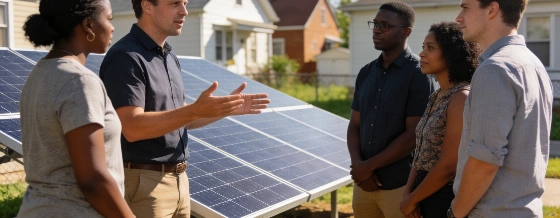
The study, called "Decarbonizing the Hood: Conditions, Perceptions, Principles and Evaluation of Equitable Urban Energy Transitions," will look at six specific clean energy projects. In Detroit, the focus will be on the Solar Neighborhoods Initiative and the O'Shea Solar Park. In Chicago, researchers will study the Bronzeville Community Microgrid and the West Woodlawn geothermal project. Columbus will be represented by the Linden neighborhood's energy efficiency retrofits and the American Addition net-zero energy project. These projects were chosen for their impact at the neighborhood level and their potential as models for other cities.
The research team will compare these projects to see who is involved in planning, how benefits and burdens are shared, and what shapes outcomes for residents. The project is led by Tony Reames, Tishman Professor of Environmental Justice at the University of Michigan, and Meghan Wilson, assistant professor of American politics and public policy at Michigan State University. The Bronzeville microgrid in Chicago, for example, has been noted as a way for neighborhoods to recover quickly from grid outages, thanks to solar power and battery storage-a point Reames has discussed publicly (CBS News Detroit).
Training new energy justice researchers
The project will also serve as a training program for students. Each year, graduate and undergraduate students from both universities will get hands-on experience with community-based research, with graduate students mentoring undergraduates. The program will offer summer fellowships to undergraduates from historically Black colleges and universities, aiming to bring more Black scholars into energy research. This effort fits with broader diversity and inclusion goals at both universities.
Fellows will present their work at an annual symposium attended by community partners, utility staff, and policymakers. The goal is to make sure the research reflects both technical knowledge and the lived experience of residents. Local school districts, including Farmington Public Schools, have shown interest in adding clean energy topics to their curricula, connecting research with classroom learning.
Community voices and policy impact
Project leaders say the research will focus on the perspectives of residents most affected by new energy infrastructure. Community groups such as Blacks in Green, IMPACT Community Action, and American Addition are among the partners. Results will be shared with policymakers and local organizations through publications and outreach events over the three years. The City of Columbus and its neighborhood associations are expected to help organize public hearings and make sure local voices are included in decisions.
The grant will fund research, training, and efforts to ensure that clean energy benefits are shared fairly and that residents have a say in decisions. As more cities move toward decarbonization, the findings from this study could shape how future projects are planned and evaluated. Communities like Farmington and Farmington Hills are watching these developments for ideas they might use locally.
Project context and next steps
This research comes as Detroit, Chicago, and Columbus pursue ambitious clean energy goals, often with projects funded by both public and private sources. The study's focus on equity and community participation reflects a growing understanding that technical solutions alone are not enough-residents need to be part of the process. The project will run for three years, with regular updates and public presentations as results come in. Residents interested in following local clean energy efforts can check the City of Farmington Council for updates on sustainability planning and public engagement.
By focusing on the experiences of those most affected, this project could help cities find better ways to make clean energy transitions fair and effective for all communities involved.