
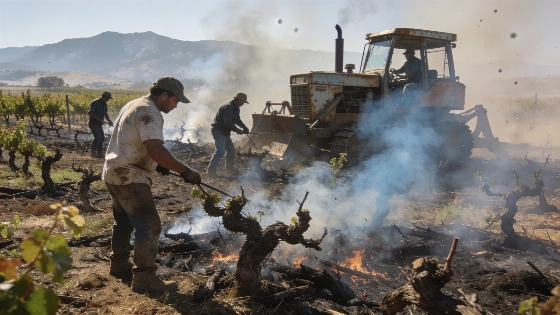
California wine growers are pulling out and burning vineyards as national wine sales drop to their lowest point in decades, with shifting consumer habits and health concerns driving the decline
California's wine industry is facing a sharp downturn as growers across the state remove and burn vineyards in response to falling sales. Industry leaders say the decline in demand has left many unable to sustain operations, forcing difficult decisions about the future of family businesses and long-standing agricultural land.
According to recent reporting by The New York Times, some vineyard owners have chosen to sell their land or close businesses that have operated for generations. Jason Smith, CEO of Valley Farm Management, told the Times that he saw at least one of his pinot noir vineyards burned after deciding to exit the business, ending a 51-year family legacy.
Sales Decline and Changing Preferences
Wine sales in the United States have dropped to their lowest level in more than 20 years, according to industry data cited by The New York Times. The decline is attributed to several factors, including increased public awareness of health risks associated with alcohol, an aging Baby Boomer population, and growing competition from cannabis and cocktails among younger consumers. Last year, approximately 38,000 acres of wine grapes-about 7 percent of the state's total-were removed, and over 500,000 tons of grapes went unharvested, based on estimates from the California Association of Winegrape Growers.
Impact on Growers and Communities
The removal and burning of vineyards has had a visible impact on rural communities and the landscape of California's wine regions. Randy Baranek of Fowler Brothers Farming, whose crews burn thousands of acres annually, described the process as erasing a piece of local history, with some vineyards dating back 80 to 100 years. The loss of these vineyards not only affects growers but also the broader agricultural economy and local heritage.
Industry Outlook and Uneven Recovery
Despite the overall decline, not all wineries are experiencing losses. According to a 2026 report from Silicon Valley Bank cited by Inc., the top quartile of wineries is seeing sales growth of about 8 percent, while the bottom quartile is shrinking by around 10 percent. This uneven recovery highlights the challenges facing smaller and mid-sized producers, even as some larger or more established brands manage to adapt to changing market conditions.
The current situation underscores the volatility of agricultural markets and the importance of adapting to evolving consumer preferences. For many California communities, the fate of local vineyards will depend on whether demand stabilizes and whether growers can find new ways to sustain their businesses in a shifting landscape.