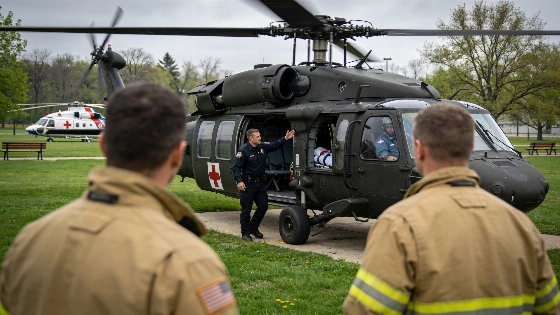
A UH-60 Black Hawk and a University of Michigan Survival Flight helicopter joined Northville Township firefighters at Millennium Park. The drill covered patient transfers and landing-zone operations, then tested emergency communications.
The Black Hawk touched down at Millennium Park during a Northville Township exercise built around critical-care transfers in a large-scale emergency.
The public event brought together Northville Township firefighters and military aviators. A University of Michigan Survival Flight medical crew also took part, according to independent reporting by WXYZ.
Firefighters worked with flight crews on the steps that connect ground responders to helicopter teams. They identified a landing zone and coordinated radio communications. Crews also prepared a patient for transfer to an air-medical team.
A Michigan Medicine Survival Flight helicopter operated at the site, giving participants a chance to work through the medical side of the response alongside its aviation demands.
William Caruso, EMS coordinator for Northville Township, helped organize the exercise because local crews have relatively few opportunities to work with helicopter emergency medical services. Short ground-transport times in the area generally reduce the need for air transport during routine calls. A serious incident could still require an aircraft.
That limited experience makes deliberate practice important.
The exercise let crews rehearse the operation before an actual emergency. Responders would need to manage a patient while securing the aircraft area. They would also have to adapt as conditions changed. The Northville Township website remains the appropriate municipal source for township notices and department information. No change to local emergency procedures was identified after this event.
The training centered on the handoff itself rather than discussion alone. Participants practiced communications between ground personnel and flight crews. They also worked through patient movement and each team's responsibilities during the transfer.
Those steps matter when a helicopter operates near an emergency scene. Responders need a shared understanding of where people and equipment can move safely.
Military aviators added another operational partner. Northville Township firefighter-paramedic Robert Casamatta also serves as a National Guard medevac pilot, giving him experience with emergency medical response and helicopter operations.
WXYZ attributed to Casamatta the assessment that this type of coordination will likely be needed in the future. A real patient landing in the area would more likely involve Survival Flight than a military Black Hawk.
The exercise showed why cooperation between Northville Township and Oakland County emergency-response partners matters. Regional medical services are part of that network, even when a call begins locally.
A rare air-medical transfer can force agencies to coordinate quickly across jurisdictional lines. The aircraft crew must receive accurate information about the patient. It also needs clear details about the landing area and hazards.
For residents, the event demonstrated preparedness rather than the launch of a new service or a change in emergency policy. It was open to the public and offered a visible look at the behind-the-scenes work involved in a high-risk, uncommon operation.
The Michigan Department of Military and Veterans Affairs provides broader public information about the state's National Guard through its Army National Guard information.
No injuries or aircraft accidents connected to the training were identified. Available independent reports also identified no official investigations. No procedural changes tied to the exercise were reported.
The principal outcome was practical familiarity. Northville Township firefighters and military aviation personnel worked with University of Michigan Survival Flight crews before a real patient transfer leaves no room for a first attempt.